Harrison Roger A, Cock Don
Research Scientist in Public Health, Directorate of Public Health, Bolton Primary Care Trust, Bolton, UK.
BMC Health Serv Res. 2004 Nov 10;4(1):31. doi: 10.1186/1472-6963-4-31.
A systematic review identified a range of methods, which can influence response rates. However, analysis specific to a healthcare setting, and in particular, involving people expected to be poor responders, was missing, We examined the effect of pre-warning letters on response rates to a postal survey of sedentary patients whom we expected a low rate of response.
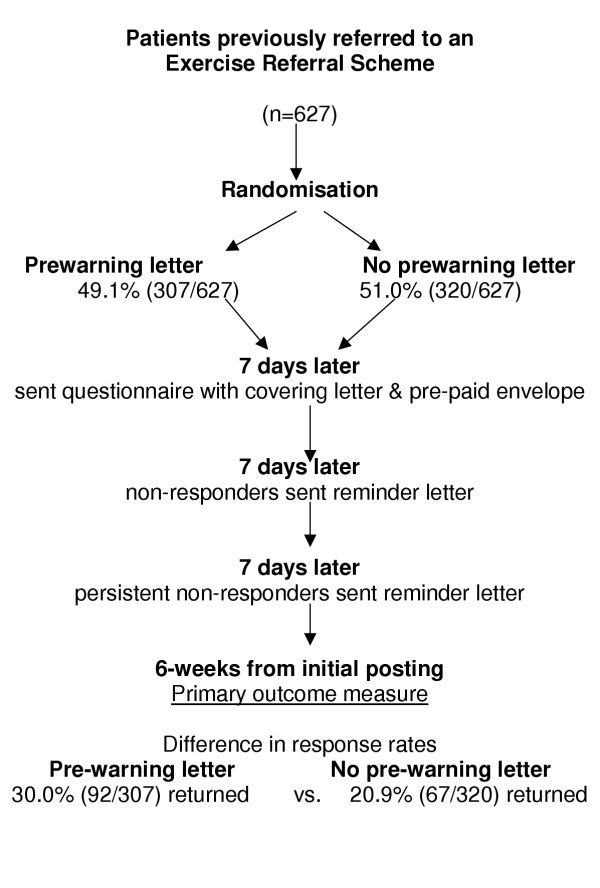
Participants were randomised to receive a pre-warning letter or no pre-warning letter, seven days before sending the main questionnaire. The main questionnaire included a covering letter and pre-paid return envelope. After seven days, non-responders were sent a reminder letter and seven days later, another reminder letter with a further copy of the questionnaire and return envelope.
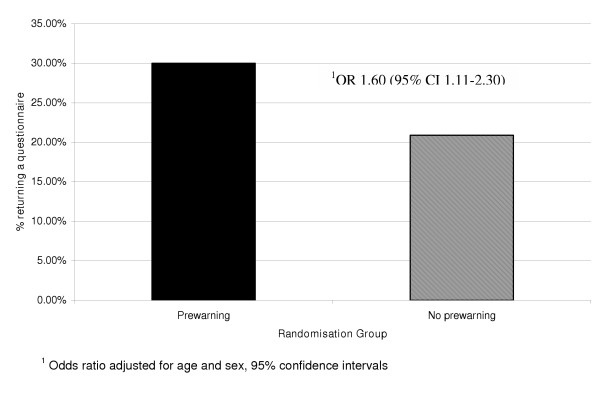
627 adults, with a mean age of 48 years (SD 13, range 18 to 78) of whom 69.2% (434/627) were women, were randomised. 49.0% (307/627) of patients were allocated to receive a pre-warning letter and 51.0% (320/627) no pre-warning letter, seven days in advance of posting the main questionnaire. The final response rate to the main questionnaire was 30.0% (92/307) amongst those sent a pre-warning letter and 20.9% (67/320) not sent a pre-warning letter, with an adjusted odds ratio of 1.60 (95% CI 1.1, 2.30).
The relatively low cost method of sending a pre-warning letter had a modest impact on increasing response rates to a postal questionnaire sent to a group of patients for whom a low response rate was anticipated. Investigators should consider incorporating this simple intervention when conducting postal surveys, to reduce the potential for nonresponse bias and to increase the study power. Methods other than postal surveys may be needed however when a low response rate to postal surveys is likely.
一项系统评价确定了一系列能够影响回复率的方法。然而,针对医疗保健环境,特别是针对预计回复率较低人群的分析却缺失。我们研究了预先警告信对邮寄问卷调查回复率的影响,该调查针对久坐不动的患者,预计其回复率较低。
在发送主要问卷前七天,将参与者随机分为两组,一组收到预先警告信,另一组未收到。主要问卷包括一封附函和一个预付回邮信封。七天后,未回复者收到一封催复信,再过七天,又收到一封催复信,同时附上一份问卷副本和回邮信封。
627名成年人被随机分组,平均年龄48岁(标准差13,范围18至78岁),其中69.2%(434/627)为女性。在邮寄主要问卷前七天,49.0%(307/627)的患者被分配收到预先警告信,51.0%(320/627)的患者未收到。收到预先警告信的患者中,对主要问卷的最终回复率为30.0%(92/307),未收到预先警告信的患者中,回复率为20.9%(67/320),调整后的优势比为1.60(95%可信区间1.1,2.30)。
发送预先警告信这种成本相对较低的方法,对提高寄给预计回复率较低患者群体的邮寄问卷的回复率有一定影响。研究人员在进行邮寄调查时应考虑采用这种简单干预措施,以减少无应答偏倚的可能性并提高研究效能。然而,当邮寄调查的回复率可能较低时,可能需要采用邮寄调查以外的其他方法。