Tuma Dean J, Casey Carol A
Omaha VA Alcohol Research Center, Department of Veterans Affairs, USA.
Alcohol Res Health. 2003;27(4):285-90.
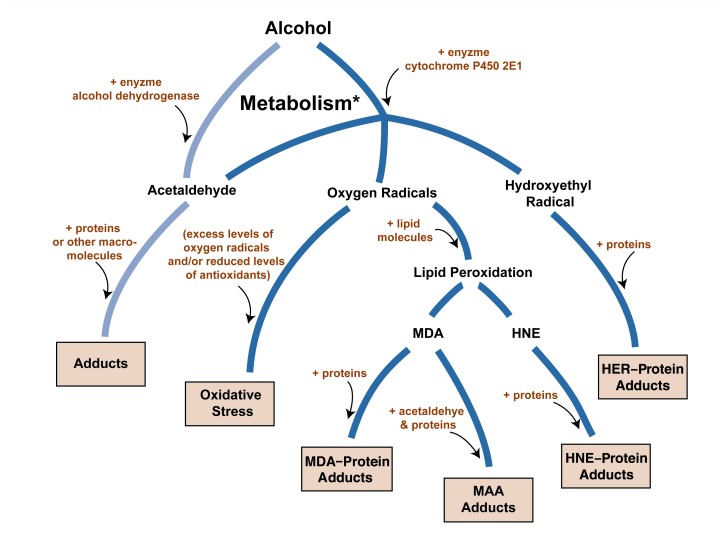
Alcohol breakdown in the liver results in the generation of the reactive molecule acetaldehyde and, as a byproduct, highly reactive oxygen-containing molecules known as oxygen radicals. Both acetaldehyde and oxygen radicals can interact with proteins and other complex molecules in the cell, forming hybrid compounds called adducts. Other adducts are formed with aldehyde molecules, which are produced through the interaction of oxygen radicals with lipids in the cells. Adduct formation impedes the function of the original proteins participating in the reaction. Moreover, the adducts may induce harmful immune responses. Both of these effects may account for some of the damage observed in alcoholic liver disease. Adduct formation has been shown to occur in the livers of humans and animals consuming alcohol and to start and predominate in those liver regions that show the first signs of liver damage.
肝脏中的酒精分解会产生反应性分子乙醛,作为副产品还会产生高反应性的含氧化合物,即氧自由基。乙醛和氧自由基都能与细胞中的蛋白质及其他复杂分子相互作用,形成称为加合物的混合化合物。其他加合物则是由醛分子形成的,醛分子是通过氧自由基与细胞中的脂质相互作用产生的。加合物的形成会阻碍参与反应的原始蛋白质的功能。此外,这些加合物可能会引发有害的免疫反应。这两种效应可能是酒精性肝病中观察到的一些损伤的原因。加合物的形成已在饮酒的人和动物的肝脏中被证实会发生,并且在那些显示出肝脏损伤最初迹象的肝脏区域开始并占主导地位。