Lambrechts Louis, Halbert Jean, Durand Patrick, Gouagna Louis C, Koella Jacob C
Laboratoire de Parasitologie Evolutive, CNRS UMR 7103, Université P, & M, Curie, CC 237, 7 quai St Bernard, 75252 Paris cedex 05, France.
Malar J. 2005 Jan 11;4:3. doi: 10.1186/1475-2875-4-3.
Most studies on the resistance of mosquitoes to their malaria parasites focus on the response of a mosquito line or colony against a single parasite genotype. In natural situations, however, it may be expected that mosquito-malaria relationships are based, as are many other host-parasite systems, on host genotype by parasite genotype interactions. In such systems, certain hosts are resistant to one subset of the parasite's genotypes, while other hosts are resistant to a different subset.
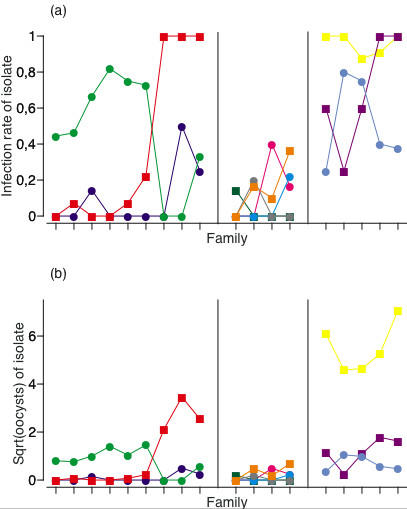
To test for genotype by genotype interactions between malaria parasites and their anopheline vectors, different genetic backgrounds (families consisting of the F1 offspring of individual females) of the major African vector Anopheles gambiae were challenged with several isolates of the human malaria parasite Plasmodium falciparum (obtained from naturally infected children in Kenya).
Averaged across all parasites, the proportion of infected mosquitoes and the number of oocysts found in their midguts were similar in all mosquito families. Both indices of resistance, however, differed considerably among isolates of the parasite. In particular, no mosquito family was most resistant to all parasites, and no parasite isolate was most infectious to all mosquitoes.
These results suggest that the level of mosquito resistance depends on the interaction between its own and the parasite's genotype. This finding thus emphasizes the need to take into account the range of genetic diversity exhibited by mosquito and malaria field populations in ideas and studies concerning the control of malaria.
大多数关于蚊子对疟原虫抗性的研究都集中在蚊子品系或群体对单一寄生虫基因型的反应上。然而,在自然情况下,可以预期蚊子与疟疾的关系,如同许多其他宿主 - 寄生虫系统一样,是基于宿主基因型与寄生虫基因型的相互作用。在这样的系统中,某些宿主对寄生虫基因型的一个子集具有抗性,而其他宿主对不同的子集具有抗性。
为了测试疟原虫与其按蚊媒介之间的基因型与基因型相互作用,用几种人类疟原虫恶性疟原虫分离株(从肯尼亚自然感染儿童中获得)对主要非洲媒介冈比亚按蚊的不同遗传背景(由单个雌性的F1后代组成的家系)进行挑战。
在所有寄生虫中平均来看,所有蚊子家系中感染蚊子的比例及其中肠中发现的卵囊数量相似。然而,两种抗性指标在寄生虫分离株之间差异很大。特别是,没有一个蚊子家系对所有寄生虫都具有最强抗性,也没有一个寄生虫分离株对所有蚊子都具有最强感染力。
这些结果表明,蚊子的抗性水平取决于其自身基因型与寄生虫基因型之间的相互作用。这一发现因此强调了在有关疟疾控制的观念和研究中,需要考虑蚊子和疟疾野外种群所表现出的遗传多样性范围。