Buermeyer A B, Thompson N E, Strasheim L A, Burgess R R, Farnham P J
McArdle Laboratory for Cancer Research, University of Wisconsin, Madison 53706.
Mol Cell Biol. 1992 May;12(5):2250-9. doi: 10.1128/mcb.12.5.2250-2259.1992.
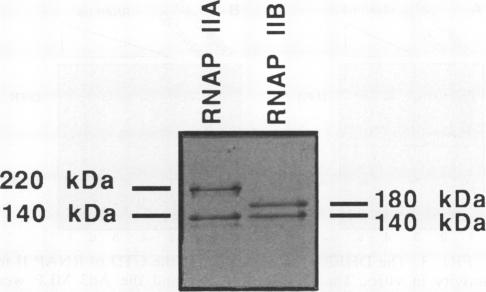
We examined the ability of purified RNA polymerase (RNAP) II lacking the carboxy-terminal heptapeptide repeat domain (CTD), called RNAP IIB, to transcribe a variety of promoters in HeLa extracts in which endogenous RNAP II activity was inhibited with anti-CTD monoclonal antibodies. Not all promoters were efficiently transcribed by RNAP IIB, and transcription did not correlate with the in vitro strength of the promoter or with the presence of a consensus TATA box. This was best illustrated by the GC-rich, non-TATA box promoters of the bidirectional dihydrofolate reductase (DHFR)-REP-encoding locus. Whereas the REP promoter was transcribed by RNAP IIB, the DHFR promoter remained inactive after addition of RNAP IIB to the antibody-inhibited reactions. However, both promoters were efficiently transcribed when purified RNAP with an intact CTD was added. We analyzed a series of promoter deletions to identify which cis elements determine the requirement for the CTD of RNAP II. All of the promoter deletions of both DHFR and REP retained the characteristics of their respective full-length promoters, suggesting that the information necessary to specify the requirement for the CTD is contained within approximately 65 bp near the initiation site. Furthermore, a synthetic minimal promoter of DHFR, consisting of a single binding site for Sp1 and a binding site for the HIP1 initiator cloned into a bacterial vector sequence, required RNAP II with an intact CTD for activity in vitro. Since the synthetic minimal promoter of DHFR and the smallest REP promoter deletion are both activated by Sp1, the differential response in this assay does not result from upstream activators. However, the sequences around the start sites of DHFR and REP are not similar and our data suggest that they bind different proteins. Therefore, we propose that specific initiator elements are important for determination of the requirement of some promoters for the CTD.
我们检测了缺乏羧基末端七肽重复结构域(CTD)的纯化RNA聚合酶(RNAP)II(称为RNAP IIB)在HeLa提取物中转录多种启动子的能力,其中内源性RNAP II活性用抗CTD单克隆抗体抑制。并非所有启动子都能被RNAP IIB有效转录,转录与启动子的体外强度或共有TATA框的存在无关。这在双向二氢叶酸还原酶(DHFR)-REP编码基因座富含GC、无TATA框的启动子中表现得最为明显。虽然REP启动子能被RNAP IIB转录,但在抗体抑制反应中加入RNAP IIB后,DHFR启动子仍无活性。然而,添加具有完整CTD的纯化RNAP时,两个启动子都能被有效转录。我们分析了一系列启动子缺失情况,以确定哪些顺式元件决定了对RNAP II CTD的需求。DHFR和REP的所有启动子缺失都保留了各自全长启动子的特征,这表明指定对CTD需求所需的信息包含在起始位点附近约65 bp范围内。此外,由单个Sp1结合位点和克隆到细菌载体序列中的HIP1起始子结合位点组成的DHFR合成最小启动子,在体外活性需要具有完整CTD的RNAP II。由于DHFR的合成最小启动子和最小的REP启动子缺失都被Sp1激活,该检测中的差异反应并非由上游激活剂引起。然而,DHFR和REP起始位点周围的序列不相似,我们的数据表明它们结合不同的蛋白质。因此,我们提出特定的起始子元件对于确定某些启动子对CTD的需求很重要。