Chang Yun Sil, Hwang Jong Hee, Kwon Hyuk Nam, Choi Chang Won, Ko Sun Young, Park Won Soon, Shin Son Moon, Lee Munhyang
Department of Pediatrics, Samsung Medical Center, Samsung Cheil Hospital, Sungkyunkwan University School of Medicine, Seoul, Korea.
J Korean Med Sci. 2005 Feb;20(1):61-4. doi: 10.3346/jkms.2005.20.1.61.
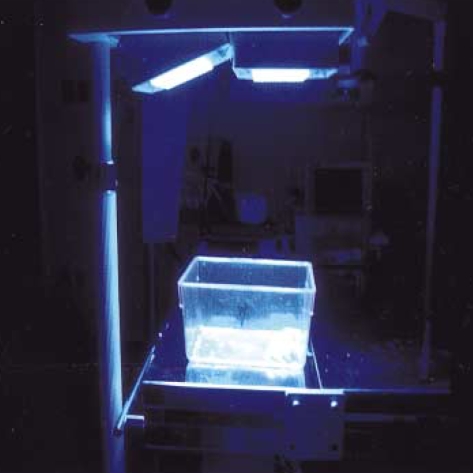
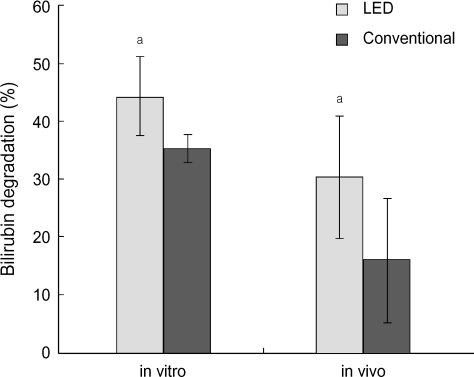
High intensity light emitting diodes (LEDs) are being studied as possible light sources for the phototherapy of neonatal jaundice, as they can emit high intensity light of narrow wavelength band in the blue region of the visible light spectrum corresponding to the spectrum of maximal bilirubin absorption. We developed a prototype blue gallium nitride LED phototherapy unit with high intensity, and compared its efficacy to commercially used halogen quartz phototherapy device by measuring both in vitro and in vivo bilirubin photodegradation. The prototype device with two focused arrays, each with 500 blue LEDs, generated greater irradiance than the conventional device tested. The LED device showed a significantly higher efficacy of bilirubin photodegradation than the conventional phototherapy in both in vitro experiment using microhematocrit tubes (44+/-7% vs. 35+/-2%) and in vivo experiment using Gunn rats (30+/-9% vs. 16+/-8%). We conclude that high intensity blue LED device was much more effective than conventional phototherapy of both in vitro and in vivo bilirubin photodegradation. Further studies will be necessary to prove its clinical efficacy.
高强度发光二极管(LED)正作为新生儿黄疸光疗的潜在光源进行研究,因为它们能够发射出窄波段的高强度光,该光位于可见光光谱的蓝色区域,与胆红素最大吸收光谱相对应。我们研发了一种高强度的氮化镓蓝色LED光疗原型设备,并通过体外和体内胆红素光降解测量,将其疗效与商业使用的卤素石英光疗设备进行比较。该原型设备有两个聚焦阵列,每个阵列有500个蓝色LED,其产生的辐照度高于所测试的传统设备。在使用微量血细胞比容管的体外实验(44±7%对35±2%)和使用冈恩大鼠的体内实验(30±9%对16±8%)中,LED设备均显示出比传统光疗更高的胆红素光降解疗效。我们得出结论,高强度蓝色LED设备在体外和体内胆红素光降解方面比传统光疗有效得多。需要进一步研究以证明其临床疗效。