Benda Jan, Longtin André, Maler Len
Department of Cellular and Molecular Medicine, Faculty of Medicine, University of Ottawa, Ottawa, Ontario, K1H 8M5 Canada.
J Neurosci. 2005 Mar 2;25(9):2312-21. doi: 10.1523/JNEUROSCI.4795-04.2005.
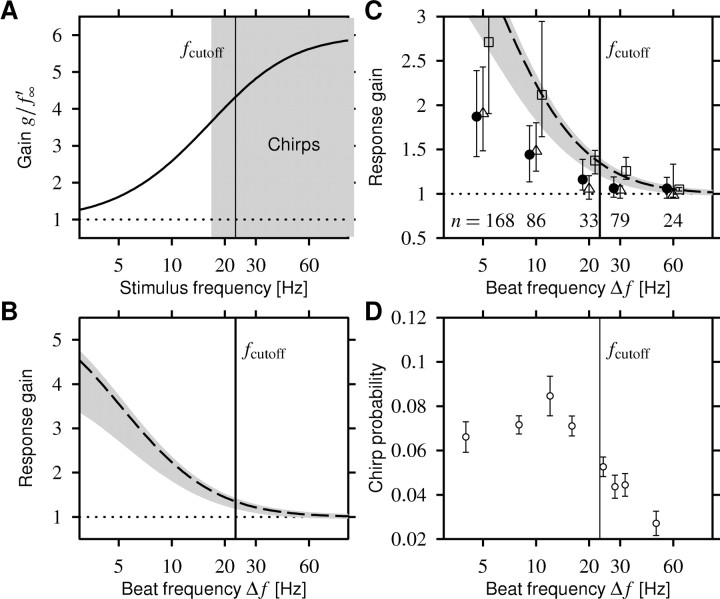
Spike-frequency adaptation is a prominent feature of many neurons. However, little is known about its computational role in processing behaviorally relevant natural stimuli beyond filtering out slow changes in stimulus intensity. Here, we present a more complex example in which we demonstrate how spike-frequency adaptation plays a key role in separating transient signals from slower oscillatory signals. We recorded in vivo from very rapidly adapting electroreceptor afferents of the weakly electric fish Apteronotus leptorhynchus. The firing-frequency response of electroreceptors to fast communication stimuli ("small chirps") is strongly enhanced compared with the response to slower oscillations ("beats") arising from interactions of same-sex conspecifics. We are able to accurately predict the electroreceptor afferent response to chirps and beats, using a recently proposed general model for spike-frequency adaptation. The parameters of the model are determined for each neuron individually from the responses to step stimuli. We conclude that the dynamics of the rapid spike-frequency adaptation is sufficient to explain the data. Analysis of additional data from step responses demonstrates that spike-frequency adaptation acts subtractively rather than divisively as expected from depressing synapses. Therefore, the adaptation dynamics is linear and creates a high-pass filter with a cutoff frequency of 23 Hz that separates fast signals from slower changes in input. A similar critical frequency is seen in behavioral data on the probability of a fish emitting chirps as a function of beat frequency. These results demonstrate how spike-frequency adaptation in general can facilitate extraction of signals of different time scales, specifically high-frequency signals embedded in slower oscillations.
峰频率适应是许多神经元的一个显著特征。然而,除了滤除刺激强度的缓慢变化外,关于其在处理与行为相关的自然刺激中的计算作用,我们所知甚少。在这里,我们给出一个更复杂的例子,展示峰频率适应如何在从较慢的振荡信号中分离瞬态信号方面发挥关键作用。我们在弱电鱼细吻线翎电鳗(Apteronotus leptorhynchus)的快速适应电感受器传入纤维上进行了体内记录。与对来自同性同种个体相互作用产生的较慢振荡(“节拍”)的反应相比,电感受器对快速通讯刺激(“小啁啾声”)的放电频率反应得到了强烈增强。我们能够使用最近提出的峰频率适应通用模型,准确预测电感受器传入纤维对啁啾声和节拍的反应。该模型的参数通过对阶跃刺激的反应为每个神经元单独确定。我们得出结论,快速峰频率适应的动力学足以解释这些数据。对来自阶跃反应的额外数据的分析表明,峰频率适应的作用是相减性的,而不是如抑制性突触所预期的那样是相除性的。因此,适应动力学是线性的,并创建了一个截止频率为23赫兹的高通滤波器,将快速信号与输入中的较慢变化分离。在关于鱼发出啁啾声的概率作为节拍频率函数的行为数据中也观察到了类似的临界频率。这些结果证明了一般情况下峰频率适应如何能够促进不同时间尺度信号的提取,特别是嵌入在较慢振荡中的高频信号。