Bolzer Andreas, Kreth Gregor, Solovei Irina, Koehler Daniela, Saracoglu Kaan, Fauth Christine, Müller Stefan, Eils Roland, Cremer Christoph, Speicher Michael R, Cremer Thomas
Department of Biology II, Anthropology and Human Genetics, Ludwig Maximilians University, Munich, Germany.
PLoS Biol. 2005 May;3(5):e157. doi: 10.1371/journal.pbio.0030157. Epub 2005 Apr 26.
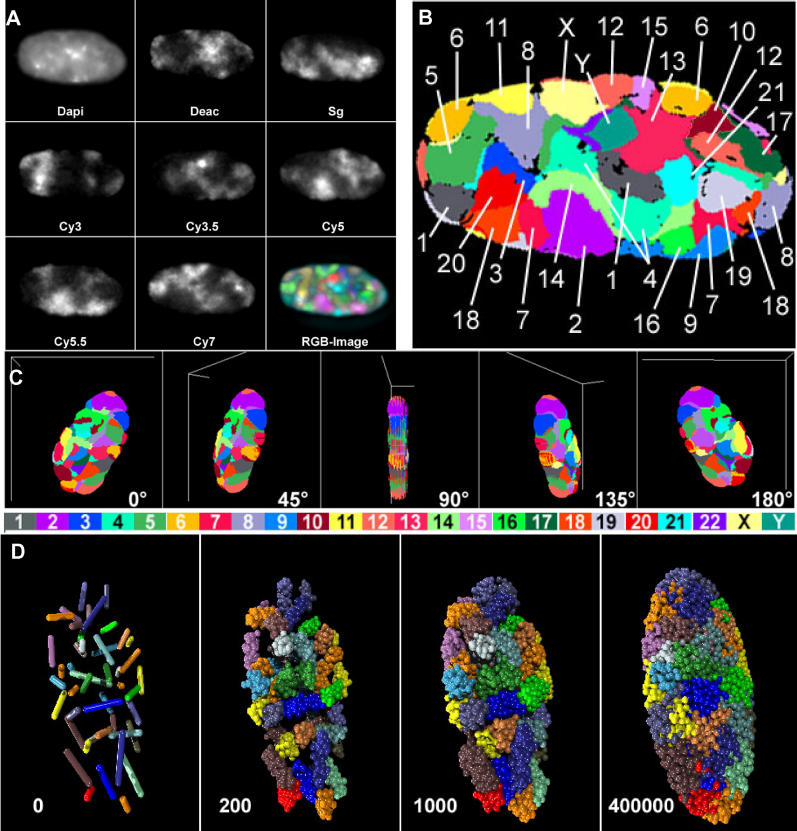
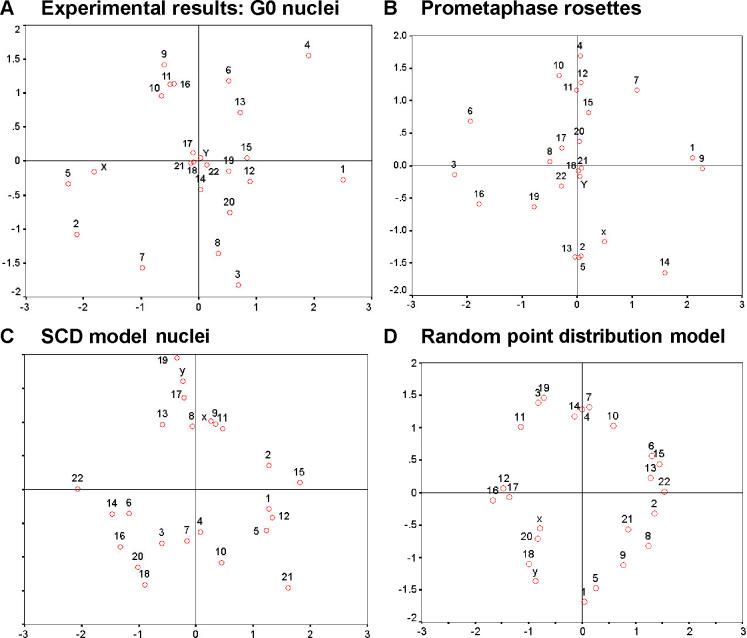
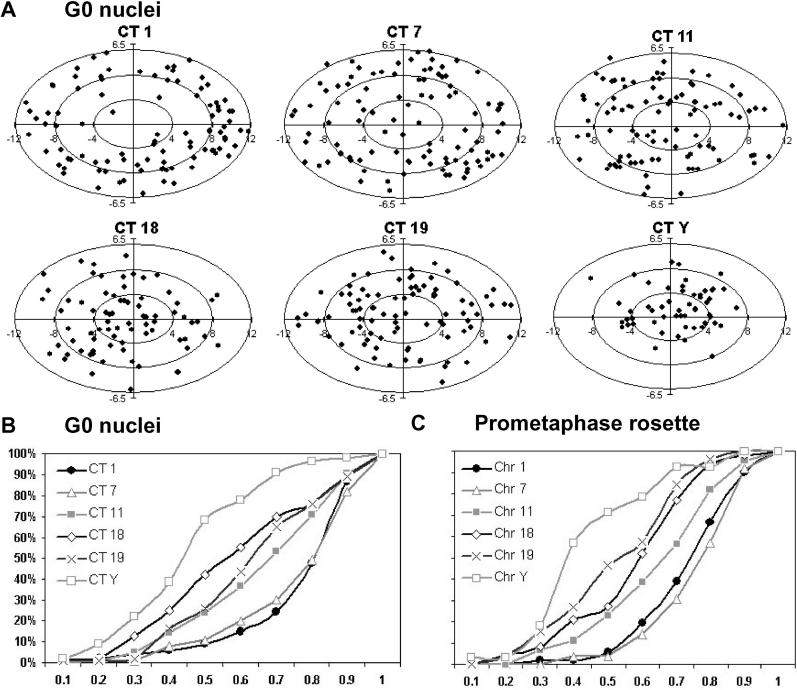
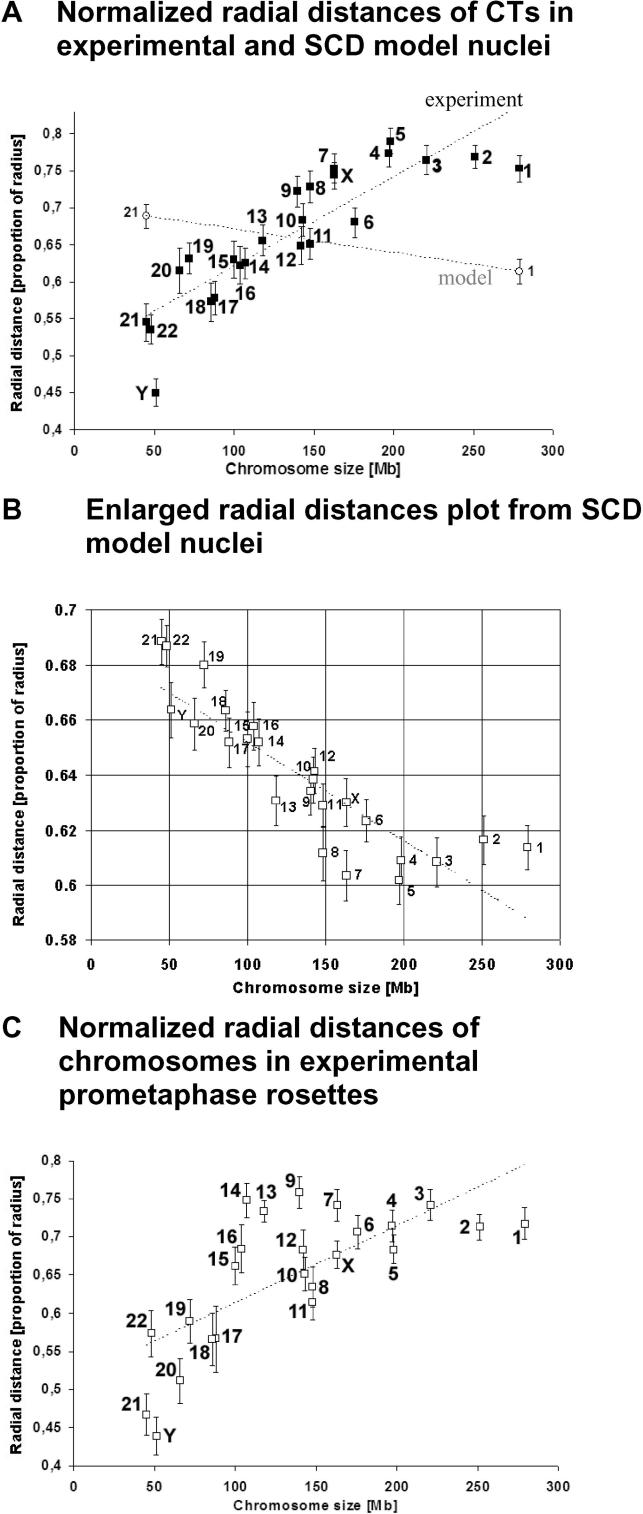
Studies of higher-order chromatin arrangements are an essential part of ongoing attempts to explore changes in epigenome structure and their functional implications during development and cell differentiation. However, the extent and cell-type-specificity of three-dimensional (3D) chromosome arrangements has remained controversial. In order to overcome technical limitations of previous studies, we have developed tools that allow the quantitative 3D positional mapping of all chromosomes simultaneously. We present unequivocal evidence for a probabilistic 3D order of prometaphase chromosomes, as well as of chromosome territories (CTs) in nuclei of quiescent (G0) and cycling (early S-phase) human diploid fibroblasts (46, XY). Radial distance measurements showed a probabilistic, highly nonrandom correlation with chromosome size: small chromosomes-independently of their gene density-were distributed significantly closer to the center of the nucleus or prometaphase rosette, while large chromosomes were located closer to the nuclear or rosette rim. This arrangement was independently confirmed in both human fibroblast and amniotic fluid cell nuclei. Notably, these cell types exhibit flat-ellipsoidal cell nuclei, in contrast to the spherical nuclei of lymphocytes and several other human cell types, for which we and others previously demonstrated gene-density-correlated radial 3D CT arrangements. Modeling of 3D CT arrangements suggests that cell-type-specific differences in radial CT arrangements are not solely due to geometrical constraints that result from nuclear shape differences. We also found gene-density-correlated arrangements of higher-order chromatin shared by all human cell types studied so far. Chromatin domains, which are gene-poor, form a layer beneath the nuclear envelope, while gene-dense chromatin is enriched in the nuclear interior. We discuss the possible functional implications of this finding.
对高阶染色质排列的研究是当前探索表观基因组结构变化及其在发育和细胞分化过程中的功能意义的重要组成部分。然而,三维(3D)染色体排列的程度和细胞类型特异性仍存在争议。为了克服先前研究的技术局限性,我们开发了能够同时对所有染色体进行定量3D位置映射的工具。我们提供了明确的证据,证明有丝分裂前期染色体以及静止(G0)和增殖(早期S期)人类二倍体成纤维细胞(46, XY)细胞核中的染色体区域(CTs)存在概率性的3D排列顺序。径向距离测量显示,与染色体大小存在概率性的、高度非随机的相关性:小染色体——无论其基因密度如何——分布得明显更靠近细胞核中心或有丝分裂前期玫瑰花结的中心,而大染色体则更靠近细胞核或玫瑰花结的边缘。这种排列在人类成纤维细胞和羊水细胞核中均得到了独立验证。值得注意的是,与淋巴细胞和其他几种人类细胞类型的球形细胞核不同,这些细胞类型呈现扁平椭圆形细胞核,我们和其他人之前已证明这些球形细胞核中存在与基因密度相关的径向3D CT排列。3D CT排列的建模表明,径向CT排列中的细胞类型特异性差异并非仅仅由于核形状差异导致的几何约束。我们还发现了迄今为止所研究的所有人类细胞类型共有的与基因密度相关的高阶染色质排列。基因贫乏的染色质结构域在核膜下方形成一层,而基因密集的染色质则富集于核内部。我们讨论了这一发现可能的功能意义。