Seiwert T Y, Cohen E E W
Department of Medicine, Section of Hematology/Oncology, Pritzker School of Medicine, The University of Chicago, Chicago, IL 60637-1470, USA.
Br J Cancer. 2005 Apr 25;92(8):1341-8. doi: 10.1038/sj.bjc.6602510.
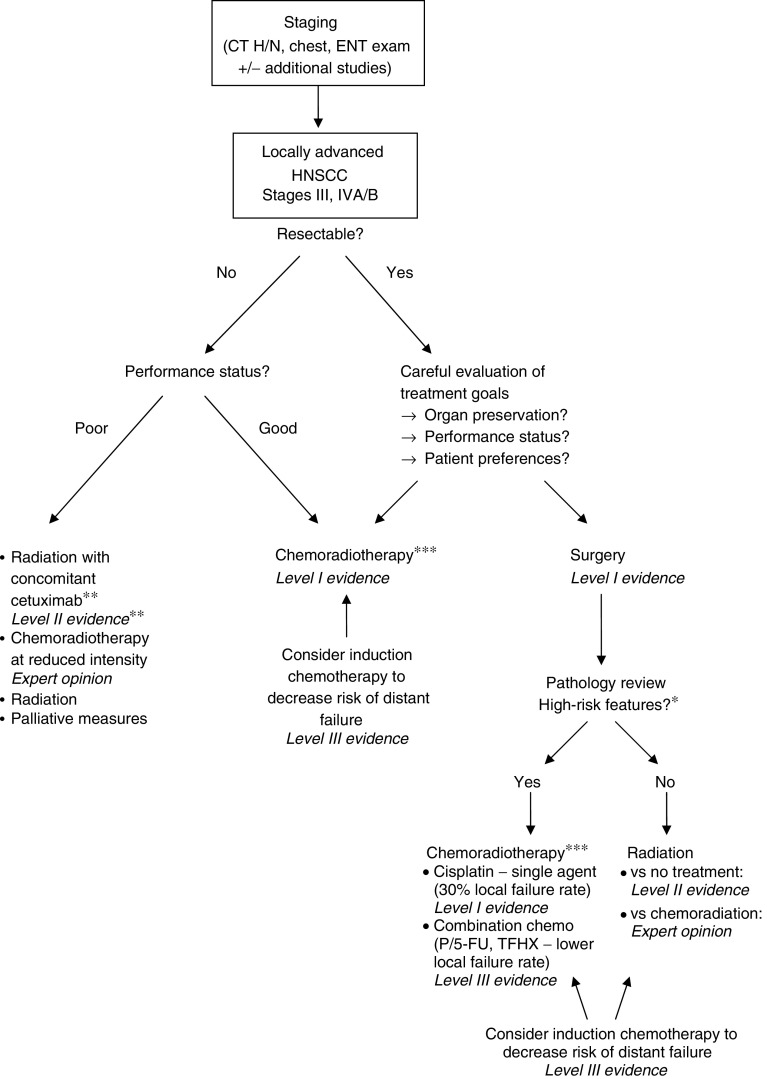
During the past 20 years, treatments for head and neck squamous cell carcinoma (HNSCC) have changed dramatically owing largely to the advent of novel approaches such as combined modality therapy as well as improvements in surgical and radiotherapeutic techniques. Locally advanced disease in particular, which engendered very high recurrence and mortality rates, is now associated with long-term disease-free survival in the majority of cases. This article will focus on locally advanced HNSCC, which frequently remains a clinical challenge, review state-of-the-art therapy, and introduce promising novel therapies. The field continues to evolve rapidly with new evidence during the past year clearly establishing the benefit of adjuvant chemoradiotherapy (CRT), as well as early evidence showing improved survival with the use of an epidermal growth factor receptor inhibitor in combination with radiotherapy. There are varied regimens in use for patients with locally advanced disease, but at the same time the multitude of options can plague the clinician when trying to select the most appropriate one. This article will attempt to put the various approaches into perspective and propose an evidence-based treatment algorithm.
在过去20年中,头颈部鳞状细胞癌(HNSCC)的治疗发生了巨大变化,这主要归功于联合治疗等新方法的出现以及手术和放射治疗技术的改进。特别是局部晚期疾病,其复发率和死亡率非常高,现在在大多数情况下与长期无病生存相关。本文将重点关注局部晚期HNSCC,这仍然是一个临床挑战,回顾最新的治疗方法,并介绍有前景的新疗法。在过去一年中,随着新证据明确证实辅助放化疗(CRT)的益处,以及早期证据表明表皮生长因子受体抑制剂与放疗联合使用可提高生存率,该领域继续迅速发展。对于局部晚期疾病患者,有多种治疗方案在使用,但与此同时,众多的选择可能会困扰临床医生选择最合适的方案。本文将试图对各种方法进行客观分析,并提出一种基于证据的治疗算法。