Peeters J E, Villacorta I, Vanopdenbosch E, Vandergheynst D, Naciri M, Ares-Mazás E, Yvoré P
Section of Parasitology, National Institute of Veterinary Research, Brussels, Belgium.
Infect Immun. 1992 Jun;60(6):2309-16. doi: 10.1128/iai.60.6.2309-2316.1992.
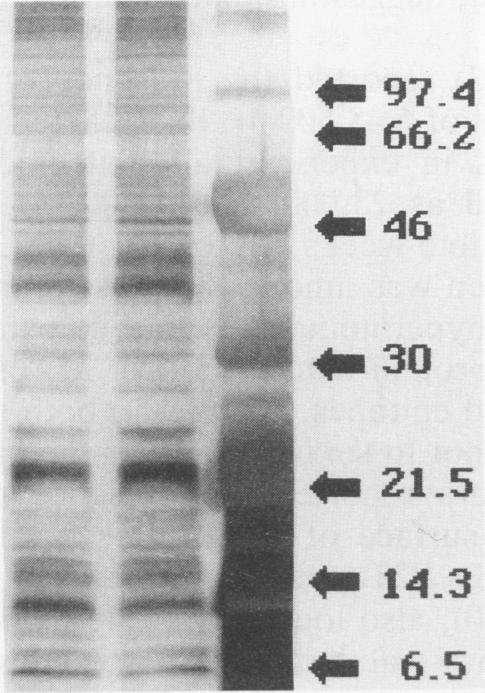
Fecal and serum anti-Cryptosporidium parvum immunoglobulin A (IgA), IgM, and IgG were monitored by an enzyme-linked immunosorbent assay after experimental and natural infection of calves with C. parvum. Although all experimentally infected calves showed high levels of colostral antibodies in the feces, they acquired C. parvum infection. Three of five animals died. Calves which acquired natural infection showed only diarrhea. Levels of colostral coproantibodies dropped quickly. Experimental infection was followed by a rise in local anti-C. parvum IgM levels from day 5 postinfection (p.i.). IgM peaked at day 14 p.i. and then disappeared quickly. Anti-C. parvum IgA levels rose between days 7 and 14 p.i. and decreased slowly. Rising levels of coproantibodies coincided with falling oocyst output. Fecal anti-C. parvum IgG levels rose slightly during oocyst output, and IgG disappeared 3 weeks p.i. Similar kinetics were established in naturally infected calves. Although fecal anti-C. parvum IgA levels declined slowly, reinfections were established 5, 7, and 14 weeks after the primary contact. Serum anti-C. parvum IgG levels rose during maximal oocyst excretion, whereas serum anti-C. parvum IgA levels peaked later than did local IgA levels. Challenge reinfection of naturally infected calves at day 112 was not followed by clinical signs or oocyst output or by a secondary antibody response. Sequential Western immunoblotting with fecal extracts revealed up to 32 different parasite antigens. Convalescent-phase sera recognized up to 23 antigens. Fecal IgA reacted intensely with antigens with relative molecular weights (M(r)) of approximately 11,000 and 15,000. These antigens were not recognized by convalescent-phase serum IgG. Both local IgA and serum IgG also showed strong reactions with 23,000- and 44,000-M(r) antigens and with several antigens of between 66,200 and 200,000 M(r). Most bands remained detectable for at least 16 weeks p.i.
在犊牛经实验性和自然感染微小隐孢子虫后,通过酶联免疫吸附测定法监测粪便和血清中的抗微小隐孢子虫免疫球蛋白A(IgA)、IgM和IgG。尽管所有经实验感染的犊牛粪便中初乳抗体水平都很高,但它们仍感染了微小隐孢子虫。五只动物中有三只死亡。自然感染的犊牛仅出现腹泻。初乳粪便抗体水平迅速下降。实验感染后,从感染后第5天起,局部抗微小隐孢子虫IgM水平开始升高。IgM在感染后第14天达到峰值,然后迅速消失。抗微小隐孢子虫IgA水平在感染后第7天至14天之间升高,并缓慢下降。粪便抗体水平的升高与卵囊排出量的下降同时发生。粪便抗微小隐孢子虫IgG水平在卵囊排出期间略有升高,感染后3周IgG消失。在自然感染的犊牛中也观察到类似的动力学变化。尽管粪便抗微小隐孢子虫IgA水平下降缓慢,但在初次接触后5、7和14周再次发生感染。血清抗微小隐孢子虫IgG水平在最大卵囊排泄期间升高,而血清抗微小隐孢子虫IgA水平的峰值出现时间晚于局部IgA水平。在第112天对自然感染的犊牛进行再次感染激发后,未出现临床症状、卵囊排出或二次抗体反应。用粪便提取物进行连续免疫印迹分析显示多达32种不同的寄生虫抗原。恢复期血清可识别多达23种抗原。粪便IgA与相对分子质量(M(r))约为11,000和15,000的抗原强烈反应。这些抗原未被恢复期血清IgG识别。局部IgA和血清IgG也与23,000和44,000 M(r)的抗原以及几种66,200至200,000 M(r)之间的抗原发生强烈反应。大多数条带在感染后至少16周仍可检测到。