Department of Parasitology, College of Veterinary Medicine, Northwest A&F University, Yangling, 712100, People's Republic of China.
Center of Animal Disease Prevention and Control of Huyi District, Xi'an, 710300, People's Republic of China.
Parasit Vectors. 2021 Jun 26;14(1):336. doi: 10.1186/s13071-021-04834-y.
Cryptosporidium baileyi is an economically important zoonotic pathogen that causes serious respiratory symptoms in chickens for which no effective control measures are currently available. An accumulating body of evidence indicates the potential and usefulness of metabolomics to further our understanding of the interaction between pathogens and hosts, and to search for new diagnostic or pharmacological biomarkers of complex microorganisms. The aim of this study was to identify the impact of C. baileyi infection on the serum metabolism of chickens and to assess several metabolites as potential diagnostic biomarkers for C. baileyi infection.
Ultraperformance liquid chromatography-mass spectrometry (UPLC-MS) and subsequent multivariate statistical analysis were applied to investigate metabolomics profiles in the serum samples of chickens infected with C. baileyi, and to identify potential metabolites that can be used to distinguish chickens infected with C. baileyi from non-infected birds.
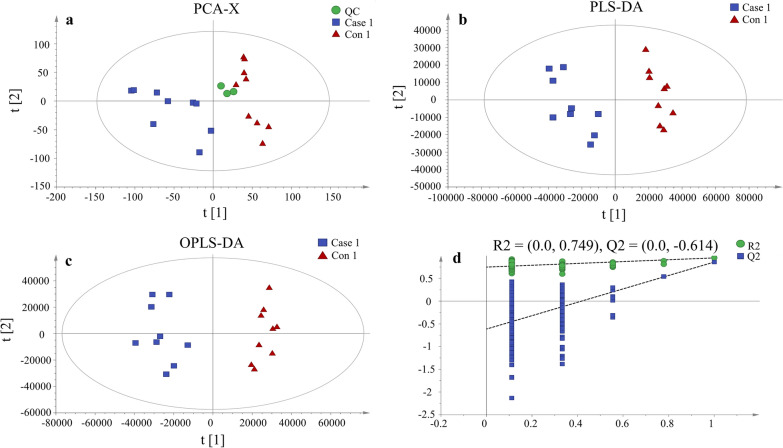
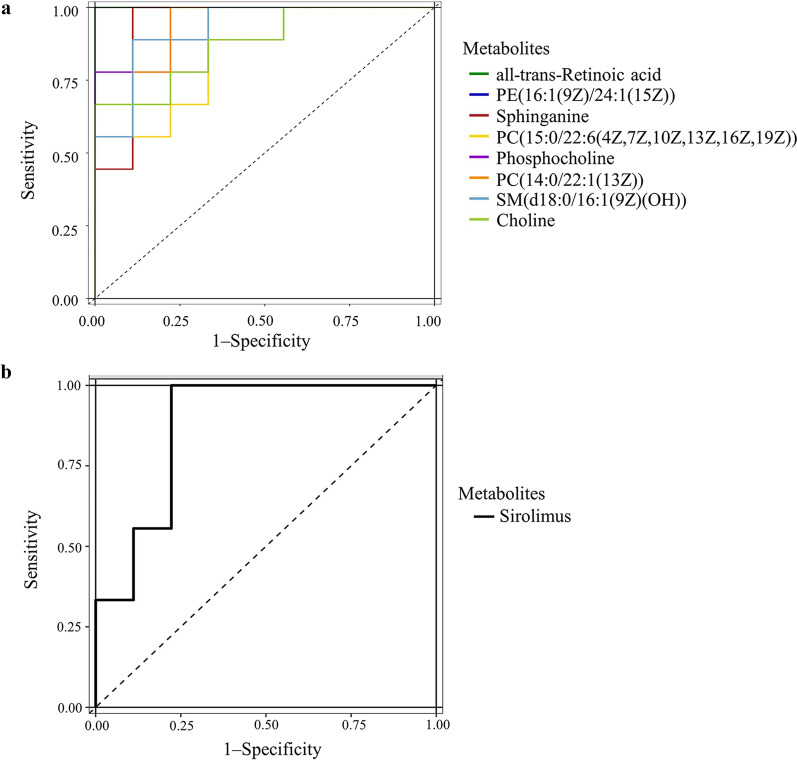
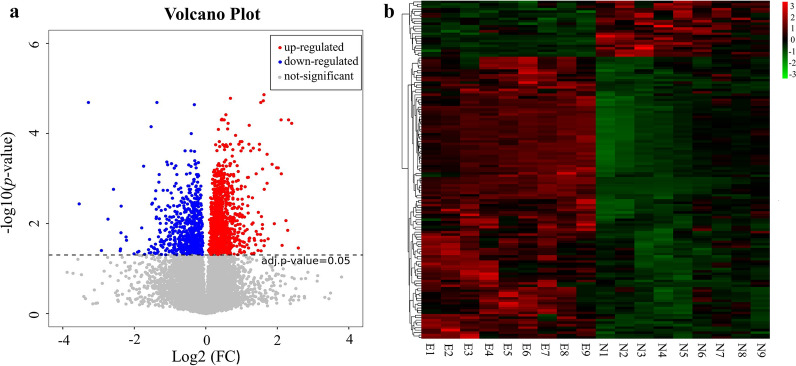
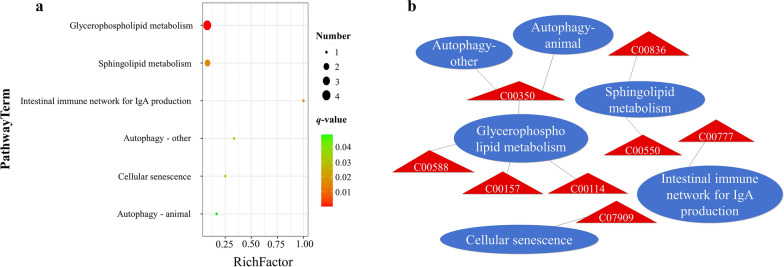
Multivariate statistical analysis identified 138 differential serum metabolites between mock- and C. baileyi-infected chickens at 5 days post-infection (dpi), including 115 upregulated and 23 downregulated compounds. These metabolites were significantly enriched into six pathways, of which two pathways associated with energy and lipid metabolism, namely glycerophospholipid metabolism and sphingolipid metabolism, respectively, were the most enriched. Interestingly, some important immune-related pathways were also significantly enriched, including the intestinal immune network for IgA production, autophagy and cellular senescence. Nine potential C. baileyi-responsive metabolites were identified, including choline, sirolimus, all-trans retinoic acid, PC(14:0/22:1(13Z)), PC(15:0/22:6(4Z,7Z,10Z,13Z,16Z,19Z)), PE(16:1(9Z)/24:1(15Z)), phosphocholine, SM(d18:0/16:1(9Z)(OH)) and sphinganine.
This is the first report on serum metabolic profiling of chickens with early-stage C. baileyi infection. The results provide novel insights into the pathophysiological mechanisms of C. baileyi in chickens.
Cryptosporidium baileyi 是一种具有重要经济意义的人畜共患病病原体,可导致鸡出现严重的呼吸道症状,但目前尚无有效的控制措施。越来越多的证据表明,代谢组学具有潜在的有用性,可以帮助我们进一步了解病原体与宿主之间的相互作用,并寻找复杂微生物的新诊断或药理生物标志物。本研究旨在确定 C. baileyi 感染对鸡血清代谢的影响,并评估几种代谢物作为 C. baileyi 感染的潜在诊断生物标志物。
采用超高效液相色谱-质谱联用(UPLC-MS)及后续的多变量统计分析方法,研究 C. baileyi 感染鸡的血清代谢组学图谱,鉴定出可用于区分 C. baileyi 感染鸡和非感染鸡的潜在代谢物。
多变量统计分析在感染后 5 天(dpi)的模拟和 C. baileyi 感染鸡的血清样本中鉴定出 138 种差异表达的血清代谢物,包括 115 种上调和 23 种下调化合物。这些代谢物显著富集到 6 条通路中,其中两条与能量和脂质代谢相关的通路,即甘油磷脂代谢和鞘脂代谢,分别是最富集的。有趣的是,一些重要的免疫相关通路也显著富集,包括 IgA 产生的肠道免疫网络、自噬和细胞衰老。鉴定出 9 种潜在的 C. baileyi 反应代谢物,包括胆碱、西罗莫司、全反式视黄酸、PC(14:0/22:1(13Z))、PC(15:0/22:6(4Z,7Z,10Z,13Z,16Z,19Z))、PE(16:1(9Z)/24:1(15Z))、磷酸胆碱、SM(d18:0/16:1(9Z)(OH))和神经酰胺。
这是首次报道早期 C. baileyi 感染鸡的血清代谢组学分析。结果为了解 C. baileyi 在鸡体内的病理生理学机制提供了新的见解。