Antoch Marina P, Kondratov Roman V, Takahashi Joseph S
Department of Cancer Biology, Lerner Research Institute, Cleveland Clinic Foundation, Cleveland, Ohio 44195, USA.
Cell Cycle. 2005 Jul;4(7):901-7. doi: 10.4161/cc.4.7.1792. Epub 2005 Jul 26.
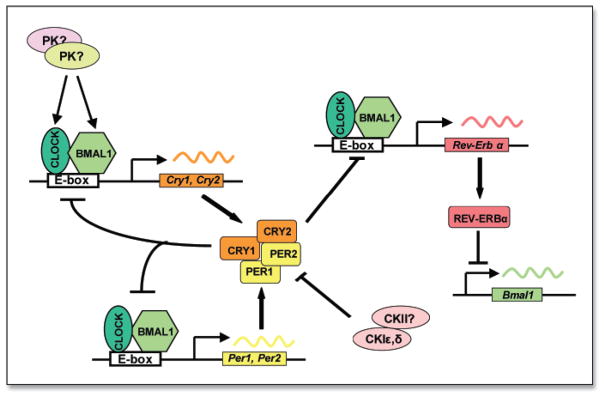
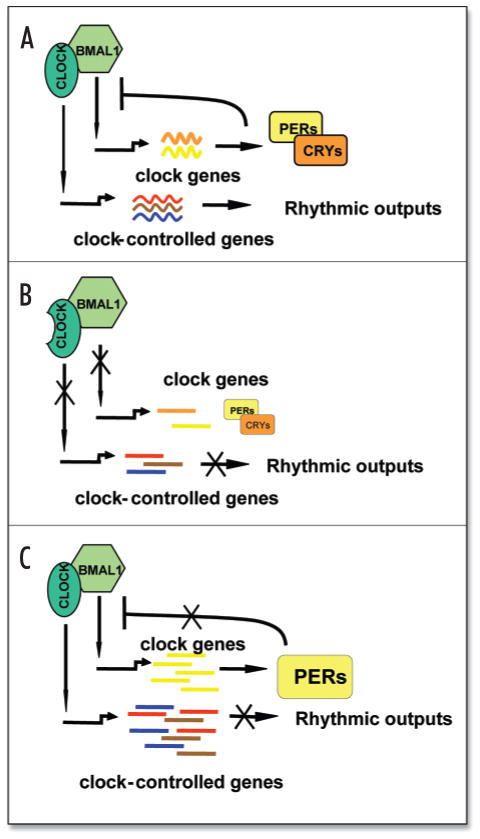
A broad variety of organisms display circadian rhythms (i.e., oscillations with 24-hr periodicities) in many aspects of their behavior, physiology and metabolism. These rhythms are under genetic control and are generated endogenously at the cellular level. In mammals, the core molecular mechanism of the oscillator consists of two transcriptional activators, CLOCK and BMAL1, and their transcriptional targets, CRYPTOCHROMES (CRYS) and PERIODS (PERS). The CRY and PER proteins function as negative regulators of CLOCK/BMAL1 activity, thus forming the major circadian autoregulatory feedback loop. It is believed that the circadian clock system regulates daily variations in output physiology and metabolism through periodic activation/repression of the set of clock-controlled genes that are involved in various metabolic pathways. Importantly, circadian-controlled pathways include those that determine in vivo responses to genotoxic stress. By using circadian mutant mice deficient in different components of the molecular clock system, we have established genetic models that correlate with the two opposite extremes of circadian cycle as reflected by the activity of the CLOCK/BMAL1 transactivation complex. Comparison of the in vivo responses of these mutants to the chemotherapeutic drug, cyclophosphamide (CY), has established a direct correlation between drug toxicity and the functional status of the CLOCK/BMAL1 transcriptional complex. We have also demonstrated that CLOCK/BMAL1 modulates sensitivity to drug-induced toxicity by controlling B cell responses to active CY metabolites. These results suggest that the sensitivity of cells to genotoxic stress induced by anticancer therapy may be modulated by CLOCK/BMAL1 transcriptional activity. Further elucidation of the molecular mechanisms of circadian control as well as identification of specific pharmacological modulators of CLOCK/BMAL1 activity are likely to lead to the development of new anti-cancer treatment schedules with increased therapeutic index and reduced morbidity.
多种生物在其行为、生理和代谢的许多方面都表现出昼夜节律(即24小时周期性振荡)。这些节律受基因控制,并在细胞水平内源性产生。在哺乳动物中,振荡器的核心分子机制由两种转录激活因子CLOCK和BMAL1及其转录靶点隐花色素(CRYs)和周期蛋白(PERs)组成。CRY和PER蛋白作为CLOCK/BMAL1活性的负调节因子,从而形成主要的昼夜自调节反馈环。据信,昼夜节律系统通过周期性激活/抑制参与各种代谢途径的一组生物钟控制基因来调节输出生理和代谢的每日变化。重要的是,昼夜节律控制的途径包括那些决定体内对基因毒性应激反应的途径。通过使用缺乏分子时钟系统不同成分的昼夜节律突变小鼠,我们建立了与CLOCK/BMAL1反式激活复合物活性所反映的昼夜周期两个相反极端相关的遗传模型。比较这些突变体对化疗药物环磷酰胺(CY)的体内反应,已确定药物毒性与CLOCK/BMAL1转录复合物的功能状态之间存在直接关联。我们还证明,CLOCK/BMAL1通过控制B细胞对活性CY代谢物的反应来调节对药物诱导毒性的敏感性。这些结果表明,细胞对抗癌治疗诱导的基因毒性应激的敏感性可能受CLOCK/BMAL1转录活性的调节。进一步阐明昼夜节律控制的分子机制以及鉴定CLOCK/BMAL1活性的特定药理学调节剂,可能会导致开发出具有更高治疗指数和更低发病率的新型抗癌治疗方案。