Golden Brian, Levin Lara, Ban Yoshiyuki, Concepcion Erlinda, Greenberg David A, Tomer Yaron
Division of Endocrinology, Diabetes, and Bone Diseases, Department of Medicine, Mount Sinai School of Medicine, New York, New York 10029, USA.
J Clin Endocrinol Metab. 2005 Aug;90(8):4904-11. doi: 10.1210/jc.2004-2236. Epub 2005 May 31.
Epidemiological data suggest a common genetic susceptibility to type 1 diabetes (T1D) and autoimmune thyroid disease (AITD).
Our objective was to identify the joint susceptibility genes for T1D and AITD.
We conducted a family-based linkage and association study.
The study took place at an academic medical center.
Participants included 55 multiplex families (290 individuals) in which T1D and AITD clustered (T1D-AITD families).
We conducted tests for linkage and family-based associations (transmission disequilibrium test) with four candidate genes: human leukocyte antigen (HLA), cytotoxic T lymphocyte-associated antigen 4 (CTLA-4), insulin variable number of tandem repeats (VNTR), and thyroglobulin.
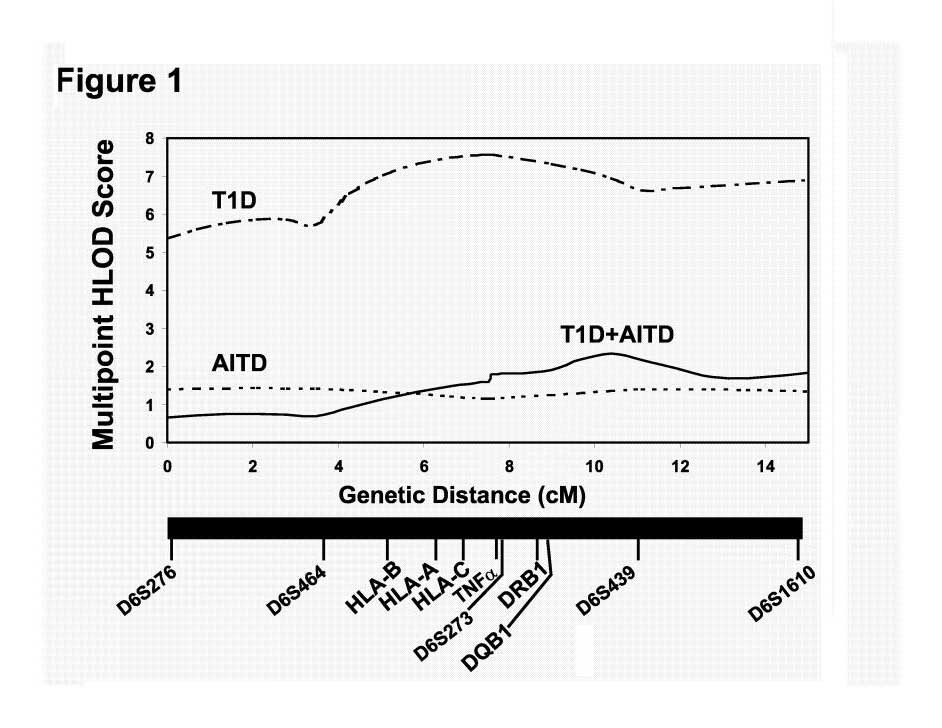
Linkage evidence to HLA appeared when subjects with either T1D or AITD were considered affected [maximum LOD score (MLS), 2.2]. The major HLA haplotype contributing to the shared susceptibility was DR3-DQB1*0201, with DR3 conferring most of the shared risk. The CTLA-4 gene showed evidence for linkage only when individuals with both T1D and AITD were considered affected (MLS, 1.7), and the insulin VNTR showed evidence for linkage when individuals with either T1D or AITD were considered affected (MLS, 1.9); i.e. it may contribute to the familial aggregation of T1D and AITD.
The HLA class II locus contributes to the shared risk for T1D and AITD, and the major HLA haplotype contributing to this association is DR3-DQB1*0201. Additional non-HLA loci contribute to the joint susceptibility to T1D and AITD, and two potential candidates include the CTLA-4 and insulin VNTR loci.
流行病学数据表明1型糖尿病(T1D)和自身免疫性甲状腺疾病(AITD)存在共同的遗传易感性。
我们的目的是确定T1D和AITD的共同易感基因。
我们进行了一项基于家系的连锁和关联研究。
该研究在一家学术医疗中心进行。
参与者包括55个T1D和AITD聚集的多重家系(290人)(T1D-AITD家系)。
我们对四个候选基因进行了连锁和基于家系的关联检测(传递不平衡检测):人类白细胞抗原(HLA)、细胞毒性T淋巴细胞相关抗原4(CTLA-4)、胰岛素可变串联重复序列(VNTR)和甲状腺球蛋白。
当将患有T1D或AITD的受试者视为患病时,出现了与HLA的连锁证据[最大对数似然比分数(MLS),2.2]。导致共同易感性的主要HLA单倍型是DR3-DQB1*0201,其中DR3赋予了大部分共同风险。仅当同时患有T1D和AITD的个体被视为患病时,CTLA-4基因才显示出连锁证据(MLS,1.7),而当患有T1D或AITD的个体被视为患病时,胰岛素VNTR显示出连锁证据(MLS,1.9);即它可能导致T1D和AITD的家族聚集。
HLA II类基因座导致T1D和AITD的共同风险,导致这种关联的主要HLA单倍型是DR3-DQB1*0201。其他非HLA基因座导致T1D和AITD的共同易感性,两个潜在候选基因包括CTLA-4和胰岛素VNTR基因座。