Collins Mary, Ling Vincent, Carreno Beatriz M
Wyeth Research, 200 Cambridge Park Drive, Cambridge, MA 02140, USA.
Genome Biol. 2005;6(6):223. doi: 10.1186/gb-2005-6-6-223. Epub 2005 May 31.
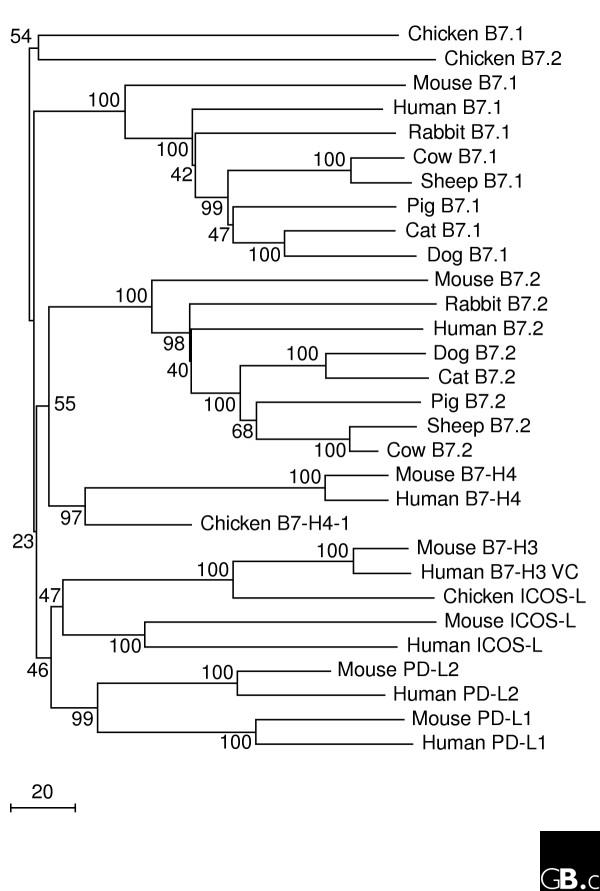
The B7 family consists of structurally related, cell-surface protein ligands, which bind to receptors on lymphocytes that regulate immune responses. Activation of T and B lymphocytes is initiated by engagement of cell-surface, antigen-specific T-cell receptors or B-cell receptors, but additional signals delivered simultaneously by B7 ligands determine the ultimate immune response. These 'costimulatory' or 'coinhibitory' signals are delivered by B7 ligands through the CD28 family of receptors on lymphocytes. Interaction of B7-family members with costimulatory receptors augments immune responses, and interaction with coinhibitory receptors attenuates immune responses. There are currently seven known members of the family: B7.1 (CD80), B7.2 (CD86), inducible costimulator ligand (ICOS-L), programmed death-1 ligand (PD-L1), programmed death-2 ligand (PD-L2), B7-H3, and B7-H4. Members of the family have been characterized predominantly in humans and mice, but some members are also found in birds. They share 20-40% amino-acid identity and are structurally related, with the extracellular domain containing tandem domains related to variable and constant immunoglobulin domains. B7 ligands are expressed in lymphoid and non-lymphoid tissues. The importance of the family in regulating immune responses is shown by the development of immunodeficiency and autoimmune diseases in mice with mutations in B7-family genes. Manipulation of the signals delivered by B7 ligands has shown potential in the treatment of autoimmunity, inflammatory diseases and cancer.
B7家族由结构相关的细胞表面蛋白配体组成,这些配体与调节免疫反应的淋巴细胞上的受体结合。T淋巴细胞和B淋巴细胞的激活由细胞表面的抗原特异性T细胞受体或B细胞受体的结合引发,但B7配体同时传递的额外信号决定了最终的免疫反应。这些“共刺激”或“共抑制”信号由B7配体通过淋巴细胞上的CD28受体家族传递。B7家族成员与共刺激受体的相互作用增强免疫反应,与共抑制受体的相互作用减弱免疫反应。该家族目前已知有七个成员:B7.1(CD80)、B7.2(CD86)、诱导性共刺激配体(ICOS-L)、程序性死亡-1配体(PD-L1)、程序性死亡-2配体(PD-L2)、B7-H3和B7-H4。该家族成员主要在人类和小鼠中得到了表征,但在鸟类中也发现了一些成员。它们具有20%-40%的氨基酸同一性,结构相关,细胞外结构域包含与可变和恒定免疫球蛋白结构域相关的串联结构域。B7配体在淋巴组织和非淋巴组织中表达。B7家族基因发生突变的小鼠出现免疫缺陷和自身免疫性疾病,这表明该家族在调节免疫反应中的重要性。对B7配体传递的信号进行操控已显示出在治疗自身免疫性疾病、炎症性疾病和癌症方面的潜力。