Zucs Phillip, Buchholz Udo, Haas Walter, Uphoff Helmut
Swiss Federal Office of Public Health, Berne, Switzerland.
Emerg Themes Epidemiol. 2005 Jun 21;2:6. doi: 10.1186/1742-7622-2-6.
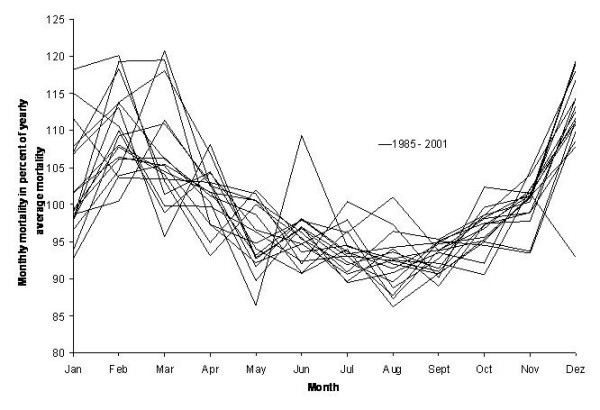
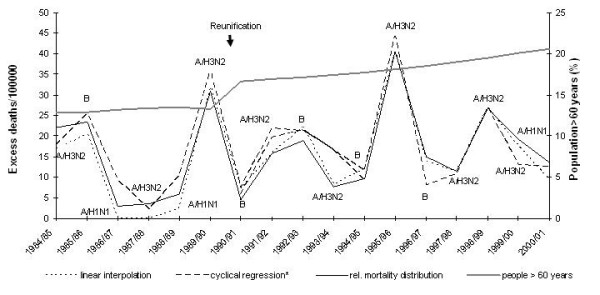
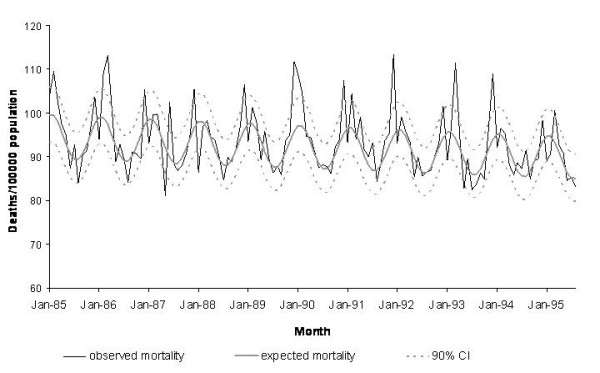
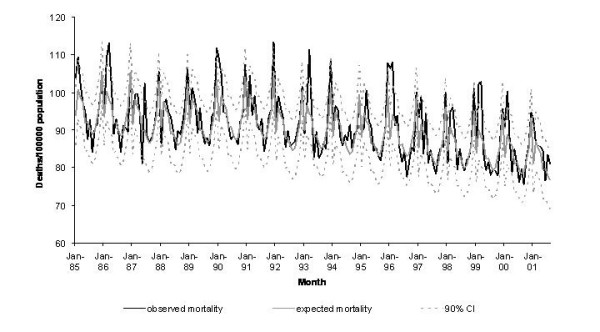
Influenza-associated excess mortality is widely used to assess the severity of influenza epidemics. In Germany, however, it is not yet established as a routine component of influenza surveillance. We therefore applied a simple method based on the annual distribution of monthly relative mortality (relative mortality distribution method, RMDM) to a time-series of German monthly all-cause mortality data from 1985-2001 to estimate influenza-associated excess mortality. Results were compared to those obtained by cyclical regression. Both methods distinguished stronger from milder influenza seasons, but RMDM gave the better fit (R2 = 0.80). For the years after reunification, i.e. 1990/91 through 2000/01, RMDM yielded an average of 6900 (conservative estimate) to 13,600 influenza-associated excess deaths per season (crude estimate). The most severe epidemics occurred during subtype A/H3N2 seasons. While German all-cause mortality declined over the study period, the number of excess deaths displayed an upward trend, coinciding with an increase of the proportion of the elderly population.
流感相关超额死亡率被广泛用于评估流感流行的严重程度。然而,在德国,它尚未成为流感监测的常规组成部分。因此,我们将一种基于每月相对死亡率年度分布的简单方法(相对死亡率分布法,RMDM)应用于1985 - 2001年德国每月全因死亡率数据的时间序列,以估计流感相关超额死亡率。将结果与通过周期性回归获得的结果进行比较。两种方法都能区分流感季节的严重程度,但RMDM的拟合效果更好(R2 = 0.80)。对于统一后的年份,即1990/91年至2000/01年,RMDM得出每个季节平均有6900例(保守估计)至13600例流感相关超额死亡(粗略估计)。最严重的流行发生在A/H3N2亚型季节。在研究期间,德国全因死亡率下降,但超额死亡人数呈上升趋势,这与老年人口比例增加相吻合。