Zhang Yuan, Zheng Nan, Hao Pei, Cao Ying, Zhong Yang
School of Life Sciences, Fudan University, Shanghai 200433, China.
Comput Biol Chem. 2005 Jun;29(3):254-7. doi: 10.1016/j.compbiolchem.2005.04.008.
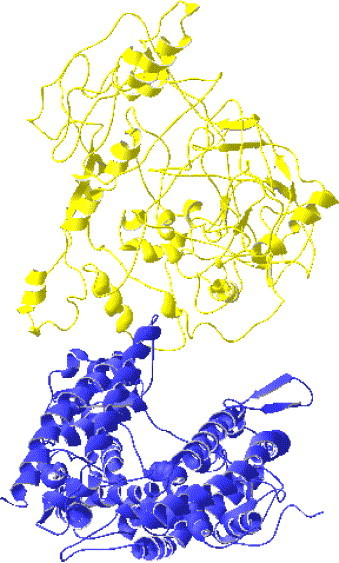
The exact residues within severe acute respiratory syndrome coronavirus (SARS-CoV) S1 protein and its receptor, human ACE2, involved in their interaction still remain largely undetermined. Identification of exact amino acid residues that are crucial for the interaction of S1 with ACE2 could provide working hypotheses for experimental studies and might be helpful for the development of antiviral inhibitor. In this paper, a molecular docking model of SARS-CoV S1 protein in complex with human ACE2 was constructed. The interacting residue pairs within this complex model and their contact types were also identified. Our model, supported by significant biochemical evidence, suggested receptor-binding residues were concentrated in two segments of S1 protein. In contrast, the interfacial residues in ACE2, though close to each other in tertiary structure, were found to be widely scattered in the primary sequence. In particular, the S1 residue ARG453 and ACE2 residue LYS341 might be the key residues in the complex formation.
严重急性呼吸综合征冠状病毒(SARS-CoV)S1蛋白及其受体人血管紧张素转换酶2(ACE2)之间相互作用所涉及的具体残基在很大程度上仍未确定。确定S1与ACE2相互作用至关重要的精确氨基酸残基可为实验研究提供可行的假设,并且可能有助于抗病毒抑制剂的开发。本文构建了SARS-CoV S1蛋白与人ACE2复合物的分子对接模型。还确定了该复合物模型内相互作用的残基对及其接触类型。我们的模型得到了重要生化证据的支持,表明受体结合残基集中在S1蛋白的两个区域。相比之下,ACE2中的界面残基虽然在三级结构中彼此靠近,但在一级序列中却广泛分散。特别是,S1残基ARG453和ACE2残基LYS341可能是复合物形成中的关键残基。