Changizi Vahid, Oghabian Mohammad A, Speller Robert, Sarkar Saeed, Kheradmand Ali Arab
Department of Medical Physics, Faculty of Medicine, Tehran University of Medical Sciences, & Research Center for Science & Technology in Medicine, Imam Khomaini Hospital, Bolvare Keshavarz, Tehran, Iran.
Int J Med Sci. 2005;2(3):118-21. doi: 10.7150/ijms.2.118. Epub 2005 Jul 5.
Small angle, between 3 degrees and 10 degrees, X ray scattering is predominantly coherent giving rise to diffraction effects that can be observed as constructive and destructive interferences. These interferences carry information about the molecular structure of the tissue and hence can be used to identify changes that occur due to cancer.
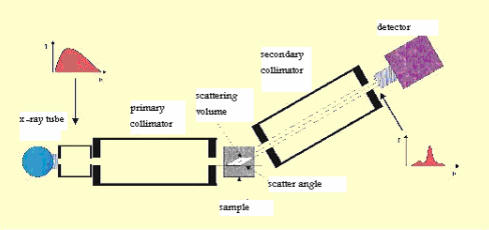
In this study an energy dispersive X-ray diffraction method was used. The optimum scattering angle, determined from a series of measurements on adipose breast tissue at several angles from 4 to 7.3 degrees, was found to be 6.5 degrees. Once optimized the system was used to measure the diffraction profiles (corrected scattered intensity versus momentum transfer) of a total of 99 breast tissue samples. The samples were both normal and tumour samples.
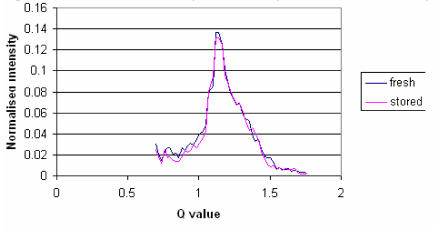
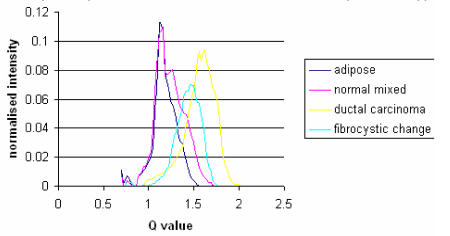
Adipose tissue showed a sharp, high intensity peak at low momentum transfer values of approximately 1.1nm-1. Adipose tissue, mixed tissue (adipose & fibroglandular) and tumor have peaks at different values of momentum transfer that can be used to identify the tissue. Benign and malignant breast tissues can also be differentiated by both peak positions and peak heights. It was also observed that the results were reproducible even after the tissue had been preserved at liquid nitrogen temperatures.
We were able to differentiate between normal, benign and malignant breast tissues by using energy dispersive small angle x-ray scattering.
小角度(3度至10度)X射线散射主要是相干散射,会产生衍射效应,可观察到相长干涉和相消干涉。这些干涉携带了有关组织分子结构的信息,因此可用于识别因癌症而发生的变化。
在本研究中使用了能量色散X射线衍射方法。通过对脂肪乳腺组织在4度至7.3度的几个角度进行一系列测量,确定最佳散射角为6.5度。一旦优化后,该系统用于测量总共99个乳腺组织样本的衍射图谱(校正后的散射强度与动量转移关系)。样本包括正常样本和肿瘤样本。
脂肪组织在约1.1nm-1的低动量转移值处显示出一个尖锐的高强度峰。脂肪组织、混合组织(脂肪与纤维腺组织)和肿瘤在不同的动量转移值处有峰,可用于识别组织。良性和恶性乳腺组织也可通过峰位置和峰高进行区分。还观察到即使在液氮温度下保存组织后,结果仍具有可重复性。
我们能够通过使用能量色散小角度X射线散射来区分正常、良性和恶性乳腺组织。