Lee Rebecca E, Booth Katie M, Reese-Smith Jacqueline Y, Regan Gail, Howard Hugh H
Health and Human Performance, University of Houston, Garrison Gymnasium 104E, Houston, TX 77204, USA.
Int J Behav Nutr Phys Act. 2005 Sep 14;2:13. doi: 10.1186/1479-5868-2-13.
Neighborhood environment factors may influence physical activity (PA). The purpose of this study was to develop and test a brief instrument to systematically document and describe the type, features, amenities, quality and incivilities of a variety of PA resources.
The one-page Physical Activity Resource Assessment (PARA) instrument was developed to assess all publicly available PA resources in thirteen urban lower income, high ethnic minority concentration neighborhoods that surrounded public housing developments (HDs) and four higher income, low ethnic minority concentration comparison neighborhoods. Neighborhoods had similar population density and connectivity. Trained field coders rated 97 PA resources (including parks, churches, schools, sports facilities, fitness centers, community centers, and trails) on location, type, cost, features, amenities, quality and incivilities. Assessments typically took about 10 minutes to complete.
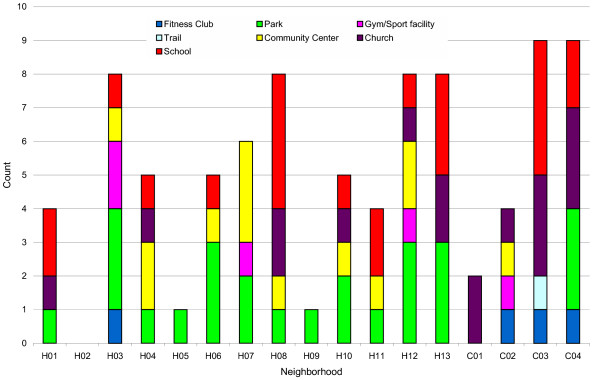
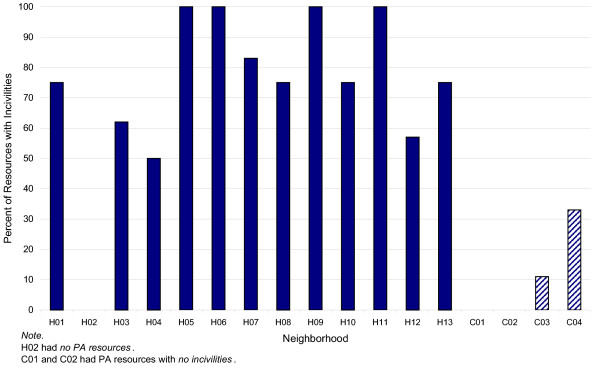
HD neighborhoods had a mean of 4.9 PA resources (n = 73) with considerable variability in the type of resources available for each neighborhood. Comparison neighborhoods had a mean of 6 resources (n = 24). Most resources were accessible at no cost (82%). Resources in both types of neighborhoods typically had about 2 to 3 PA features and amenities, and the quality was usually mediocre to good in both types of neighborhoods. Incivilities at PA resources in HD neighborhoods were significantly more common than in comparison neighborhoods.
Although PA resources were similar in number, features and amenities, the overall appearance of the resources in HD neighborhoods was much worse as indicated by substantially worse incivilities ratings in HD neighborhoods. The more comprehensive assessment, including features, amenities and incivilities, provided by the PARA may be important to distinguish between PA resources in lower and higher deprivation areas.
邻里环境因素可能会影响身体活动(PA)。本研究的目的是开发并测试一种简短的工具,以系统地记录和描述各种身体活动资源的类型、特征、便利设施、质量和不文明行为。
开发了单页的身体活动资源评估(PARA)工具,用于评估围绕公共住房开发项目(HDs)的13个城市低收入、高少数民族聚居社区以及4个高收入、低少数民族聚居的对照社区中所有可公开获取的身体活动资源。这些社区的人口密度和连通性相似。训练有素的实地编码员对97项身体活动资源(包括公园、教堂、学校、体育设施、健身中心、社区中心和步道)的位置、类型、成本、特征、便利设施、质量和不文明行为进行评分。评估通常需要大约10分钟完成。
公共住房开发项目社区平均有4.9项身体活动资源(n = 73),每个社区可用资源的类型存在很大差异。对照社区平均有6项资源(n = 24)。大多数资源免费可得(82%)。两类社区的资源通常都有大约2到3项身体活动特征和便利设施,且两类社区的质量通常都为中等至良好。公共住房开发项目社区身体活动资源处的不文明行为明显比对照社区更常见。
尽管身体活动资源在数量、特征和便利设施方面相似,但公共住房开发项目社区资源的整体外观要差得多,公共住房开发项目社区的不文明行为评分明显更差就表明了这一点。PARA提供的更全面评估,包括特征、便利设施和不文明行为,对于区分较低和较高贫困地区的身体活动资源可能很重要。