Van der Auwera Ingrid, Wera Stefaan, Van Leuven Fred, Henderson Samuel T
NV reMYND, Minderbroederstraat 12, 3000 Leuven, Belgium.
Nutr Metab (Lond). 2005 Oct 17;2:28. doi: 10.1186/1743-7075-2-28.
Alzheimer's disease (AD) is a progressive neurodegenerative disorder that primarily strikes the elderly. Studies in both humans and animal models have linked the consumption of cholesterol and saturated fats with amyloid-beta (Abeta) deposition and development of AD. Yet, these studies did not examine high fat diets in combination with reduced carbohydrate intake. Here we tested the effect of a high saturated fat/low carbohydrate diet on a transgenic mouse model of AD.
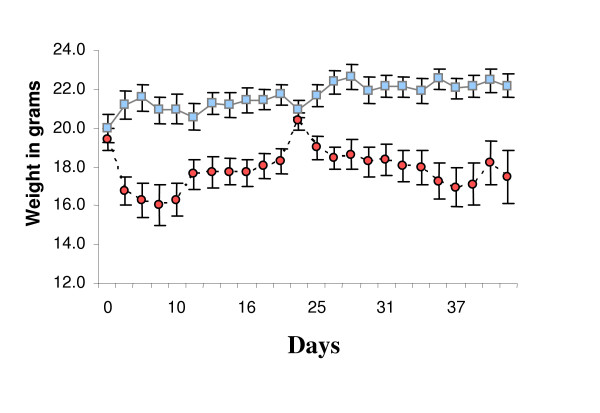
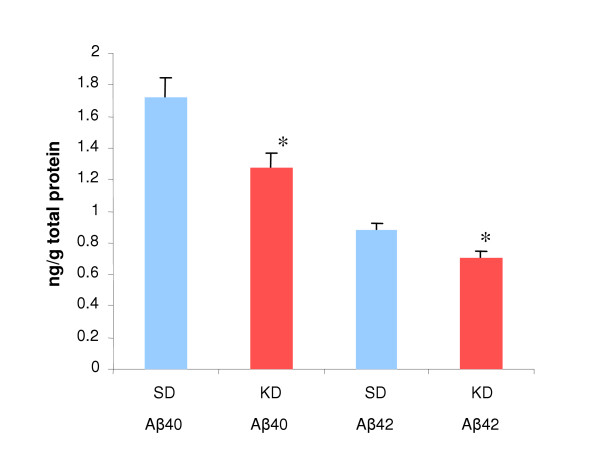
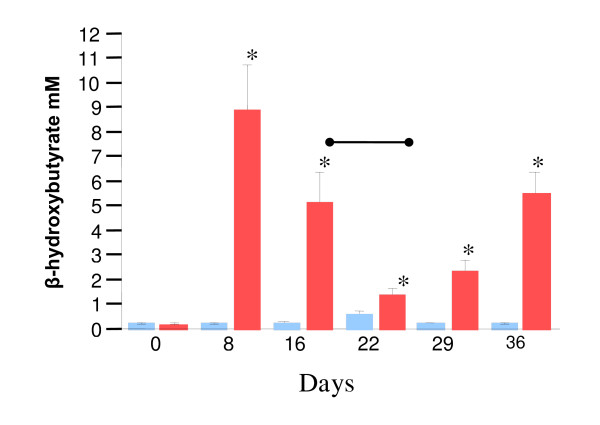
Starting at three months of age, two groups of female transgenic mice carrying the "London" APP mutation (APP/V717I) were fed either, a standard diet (SD) composed of high carbohydrate/low fat chow, or a ketogenic diet (KD) composed of very low carbohydrate/high saturated fat chow for 43 days. Animals fed the KD exhibited greatly elevated serum ketone body levels, as measured by beta-hydroxybutyrate (3.85 +/- 2.6 mM), compared to SD fed animals (0.29 +/- 0.06 mM). In addition, animals fed the KD lost body weight (SD 22.2 +/- 0.6 g vs. KD 17.5 +/- 1.4 g, p = 0.0067). In contrast to earlier studies, the brief KD feeding regime significantly reduced total brain Abeta levels by approximately 25%. Despite changes in ketone levels, body weight, and Abeta levels, the KD diet did not alter behavioral measures.
Previous studies have suggested that diets rich in cholesterol and saturated fats increased the deposition of Abeta and the risk of developing AD. Here we demonstrate that a diet rich in saturated fats and low in carbohydrates can actually reduce levels of Abeta. Therefore, dietary strategies aimed at reducing Abeta levels should take into account interactions of dietary components and the metabolic outcomes, in particular, levels of carbohydrates, total calories, and presence of ketone bodies should be considered.
阿尔茨海默病(AD)是一种主要影响老年人的进行性神经退行性疾病。对人类和动物模型的研究均已将胆固醇和饱和脂肪的摄入与β-淀粉样蛋白(Aβ)沉积及AD的发展联系起来。然而,这些研究并未考察高脂肪饮食与碳水化合物摄入量减少相结合的情况。在此,我们测试了高饱和脂肪/低碳水化合物饮食对AD转基因小鼠模型的影响。
从三个月大开始,两组携带“伦敦”APP突变(APP/V717I)的雌性转基因小鼠分别喂食由高碳水化合物/低脂肪食物组成的标准饮食(SD)或由极低碳水化合物/高饱和脂肪食物组成的生酮饮食(KD),持续43天。与喂食SD的动物相比,喂食KD的动物血清酮体水平大幅升高,通过β-羟基丁酸测量(3.85±2.6 mM),而喂食SD的动物为(0.29±0.06 mM)。此外,喂食KD的动物体重减轻(SD组22.2±0.6克,KD组17.5±1.4克,p = 0.0067)。与早期研究不同,短期的KD喂养方案使总脑Aβ水平显著降低了约25%。尽管酮水平、体重和Aβ水平发生了变化,但KD饮食并未改变行为指标。
先前的研究表明,富含胆固醇和饱和脂肪的饮食会增加Aβ的沉积及患AD的风险。在此我们证明,富含饱和脂肪和低碳水化合物的饮食实际上可以降低Aβ水平。因此,旨在降低Aβ水平的饮食策略应考虑饮食成分之间的相互作用以及代谢结果,特别是应考虑碳水化合物水平、总热量和酮体的存在情况。