Farber Institute for the Neurosciences, Jefferson Medical College, Philadelphia PA USA.
Mol Neurodegener. 2009 Oct 21;4:40. doi: 10.1186/1750-1326-4-40.
Alzheimer's disease (AD) is a progressive neurodegenerative disease of the central nervous system (CNS). Recently, an increased interest in the role diet plays in the pathology of AD has resulted in a focus on the detrimental effects of diets high in cholesterol and fat and the beneficial effects of caloric restriction. The current study examines how dietary composition modulates cerebral amyloidosis and neuronal integrity in the TgCRND8 mouse model of AD.
From 4 wks until 18 wks of age, male and female TgCRND8 mice were maintained on one of four diets: (1) reference (regular) commercial chow; (2) high fat/low carbohydrate custom chow (60 kcal% fat/30 kcal% protein/10 kcal% carbohydrate); (3) high protein/low carbohydrate custom chow (60 kcal% protein/30 kcal% fat/10 kcal% carbohydrate); or (4) high carbohydrate/low fat custom chow (60 kcal% carbohydrate/30 kcal% protein/10 kcal% fat). At age 18 wks, mice were sacrificed, and brains studied for (a) wet weight; (b) solubilizable Abeta content by ELISA; (c) amyloid plaque burden; (d) stereologic analysis of selected hippocampal subregions.
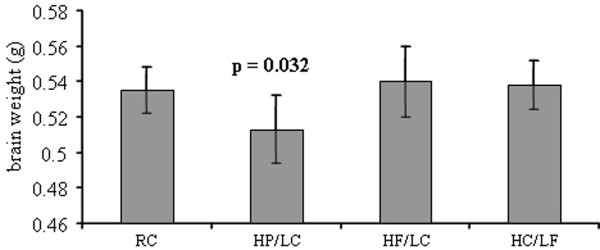
Animals receiving a high fat diet showed increased brain levels of solubilizable Abeta, although we detected no effect on plaque burden. Unexpectedly, brains of mice fed a high protein/low carbohydrate diet were 5% lower in weight than brains from all other mice. In an effort to identify regions that might link loss of brain mass to cognitive function, we studied neuronal density and volume in hippocampal subregions. Neuronal density and volume in the hippocampal CA3 region of TgCRND8 mice tended to be lower in TgCRND8 mice receiving the high protein/low carbohydrate diet than in those receiving the regular chow. Neuronal density and volume were preserved in CA1 and in the dentate gyrus.
Dissociation of Abeta changes from brain mass changes raises the possibility that diet plays a role not only in modulating amyloidosis but also in modulating neuronal vulnerability. However, in the absence of a study of the effects of a high protein/low carbohydrate diet on nontransgenic mice, one cannot be certain how much, if any, of the loss of brain mass exhibited by high protein/low carbohydrate diet-fed TgCRND8 mice was due to an interaction between cerebral amyloidosis and diet. Given the recent evidence that certain factors favor the maintenance of cognitive function in the face of substantial structural neuropathology, we propose that there might also exist factors that sensitize brain neurons to some forms of neurotoxicity, including, perhaps, amyloid neurotoxicity. Identification of these factors could help reconcile the poor clinicopathological correlation between cognitive status and structural neuropathology, including amyloid pathology.

阿尔茨海默病(AD)是一种中枢神经系统(CNS)的进行性神经退行性疾病。最近,人们对饮食在 AD 病理中的作用越来越感兴趣,这导致人们关注高胆固醇和高脂肪饮食的有害影响以及热量限制的有益影响。本研究探讨了饮食成分如何调节 TgCRND8 小鼠 AD 模型中的脑淀粉样蛋白沉积和神经元完整性。
从 4 周龄到 18 周龄,雄性和雌性 TgCRND8 小鼠分别维持在以下四种饮食中的一种:(1)参考(常规)商业饲料;(2)高脂肪/低碳水化合物定制饲料(60%卡路里脂肪/30%卡路里蛋白质/10%卡路里碳水化合物);(3)高蛋白/低碳水化合物定制饲料(60%卡路里蛋白质/30%卡路里脂肪/10%卡路里碳水化合物);或(4)高碳水化合物/低脂肪定制饲料(60%卡路里碳水化合物/30%卡路里蛋白质/10%卡路里脂肪)。在 18 周龄时,处死小鼠,研究大脑的(a)湿重;(b)通过 ELISA 测定可溶性 Abeta 含量;(c)淀粉样斑块负担;(d)海马亚区的立体学分析。
接受高脂肪饮食的动物大脑中的可溶性 Abeta 水平升高,尽管我们没有发现对斑块负担有影响。出乎意料的是,喂食高蛋白/低碳水化合物饮食的小鼠的大脑比其他所有小鼠的大脑低 5%。为了确定可能将脑质量损失与认知功能联系起来的区域,我们研究了海马亚区的神经元密度和体积。TgCRND8 小鼠海马 CA3 区的神经元密度和体积在接受高蛋白/低碳水化合物饮食的 TgCRND8 小鼠中往往低于接受常规饲料的小鼠。CA1 和齿状回的神经元密度和体积得到保留。
Abeta 变化与脑质量变化的分离提出了这样一种可能性,即饮食不仅在调节淀粉样蛋白沉积方面发挥作用,而且在调节神经元易感性方面也发挥作用。然而,由于缺乏高蛋白/低碳水化合物饮食对非转基因小鼠的影响的研究,我们不能确定高蛋白/低碳水化合物饮食喂养的 TgCRND8 小鼠的脑质量损失有多少是由于大脑淀粉样蛋白沉积和饮食之间的相互作用所致。鉴于最近有证据表明某些因素有利于在存在大量结构神经病理学的情况下维持认知功能,我们提出,可能还有一些因素使大脑神经元对某些形式的神经毒性敏感,包括可能的淀粉样蛋白神经毒性。确定这些因素可以帮助调和认知状态与结构神经病理学(包括淀粉样蛋白病理学)之间的不良临床病理相关性。