Albrecht Björn, Banaschewski Tobias, Brandeis Daniel, Heinrich Hartmut, Rothenberger Aribert
Child and Adolescent Psychiatry, University of Göttingen, Germany.
Behav Brain Funct. 2005 Dec 9;1:22. doi: 10.1186/1744-9081-1-22.
Evidence from behavioural studies suggests that impaired motor response inhibition may be common to several externalizing child psychiatric disorders, although it has been proposed to be the core-deficit in AD/HD. Since similar overt behaviour may be accompanied by different covert brain activity, the aim of this study was to investigate both brain-electric-activity and performance measures in three groups of children with externalizing child psychiatric disorders and a group of normal controls.
A Stop-task was used to measure specific aspects of response inhibition in 10 children with attention-deficit hyperactivity disorder (AD/HD), 8 children with oppositional defiant disorder/conduct disorder (ODD/CD), 11 children with comorbid AD/HD+ODD/CD and 11 normal controls. All children were between 8 and 14 years old. Event-related potentials and behavioural responses were recorded. An initial go-signal related microstate, a subsequent Stop-signal related N200, and performance measures were analyzed using ANCOVA with age as covariate.
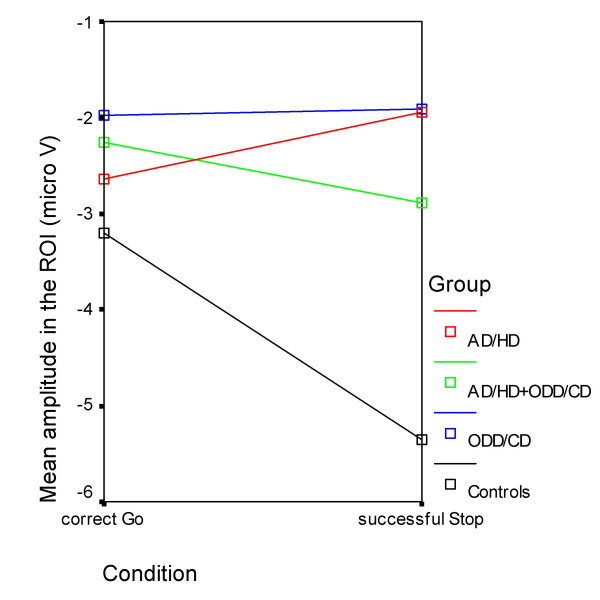
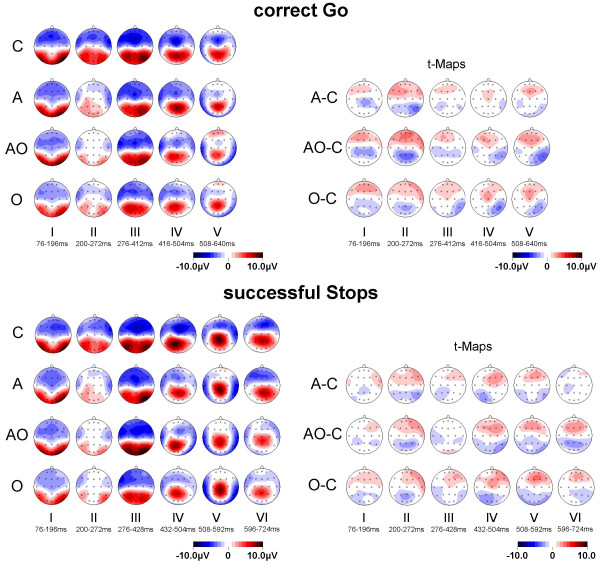
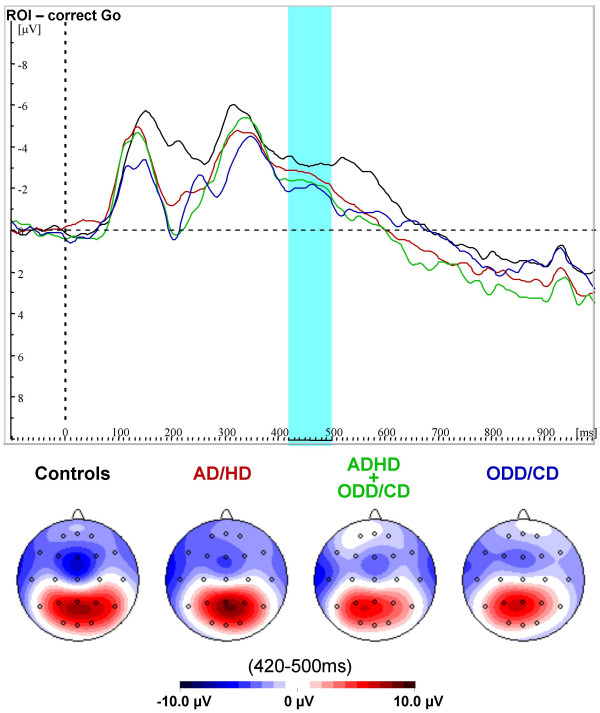
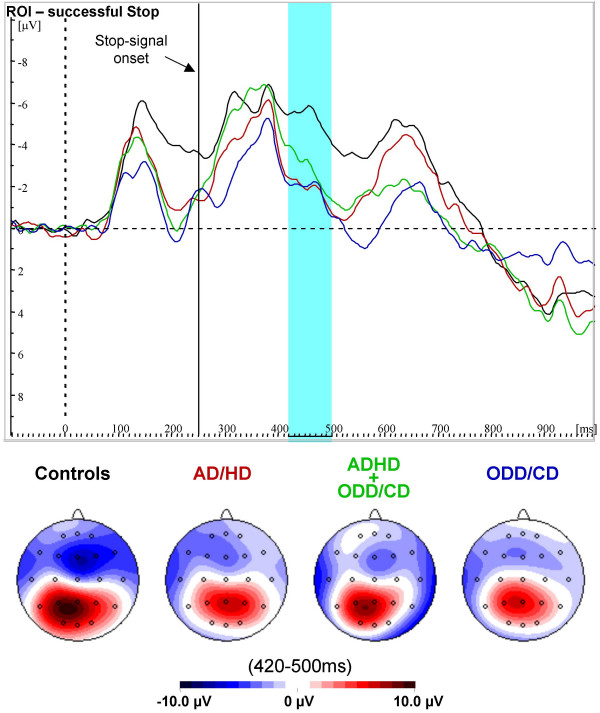
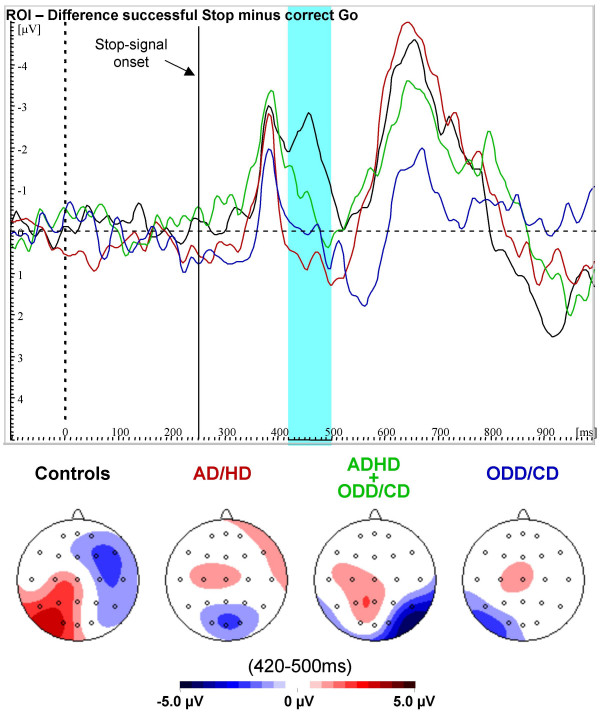
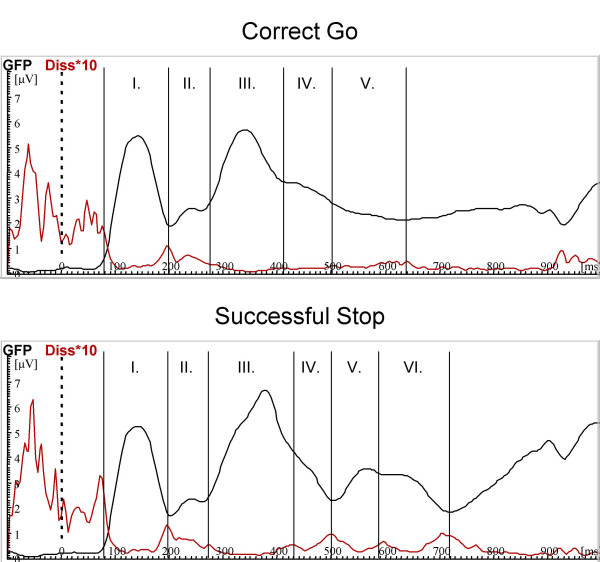
Groups did not differ in accuracy or reaction time to the Go-stimuli. However, all clinical groups displayed reduced map strength in a microstate related to initial processing of the Go-stimulus compared to normal controls, whereas topography did not differ. Concerning motor response inhibition, the AD/HD-only and the ODD/CD-only groups displayed slower Stop-signal reaction times (SSRT) and Stop-failure reaction time compared to normal controls. In children with comorbid AD/HD+ODD/CD, Stop-failure reaction-time was longer than in controls, but their SSRT was not slowed. Moreover, SSRT in AD/HD+ODD/CD was faster than in AD/HD-only or ODD/CD-only. The AD/HD-only and ODD/CD-only groups displayed reduced Stop-N200 mean amplitude over right-frontal electrodes. This effect reached only a trend for comorbid AD/HD+ODD/CD.
Following similar attenuations in initial processing of the Go-signal in all clinical groups compared to controls, distinct Stop-signal related deficits became evident in the clinical groups. Both children with AD/HD and ODD/CD showed deficits in behavioural response-inhibition accompanied by decreased central conflict signalling or inhibition processes. Neither behavioural nor neural markers of inhibitory deficits as found in AD/HD-only and ODD/CD-only were additive. Instead, children with comorbid AD/HD+ODD/CD showed similar or even less prominent inhibition deficits than the other clinical groups. Hence, the AD/HD+ODD/CD-group may represent a separate clinical entity.
行为研究的证据表明,运动反应抑制受损可能是几种外化性儿童精神障碍的共同特征,尽管有人提出这是注意缺陷多动障碍(AD/HD)的核心缺陷。由于相似的外在行为可能伴随着不同的隐蔽脑活动,本研究的目的是调查三组患有外化性儿童精神障碍的儿童和一组正常对照组的脑电活动及行为指标。
采用停止任务来测量10名注意缺陷多动障碍(AD/HD)儿童、8名对立违抗性障碍/品行障碍(ODD/CD)儿童、11名共病AD/HD+ODD/CD儿童和11名正常对照组儿童的反应抑制的特定方面。所有儿童年龄在8至14岁之间。记录事件相关电位和行为反应。使用协方差分析(ANCOVA),以年龄作为协变量,分析与初始启动信号相关的微状态、随后与停止信号相关的N200以及行为指标。
各小组对启动刺激的准确性或反应时间没有差异。然而,与正常对照组相比,所有临床组在与启动刺激初始处理相关的微状态中均表现出图谱强度降低,而地形图没有差异。关于运动反应抑制,仅患AD/HD组和仅患ODD/CD组与正常对照组相比,表现出较慢的停止信号反应时间(SSRT)和停止失败反应时间。在共病AD/HD+ODD/CD的儿童中,停止失败反应时间比对照组更长,但他们的SSRT没有减慢。此外,AD/HD+ODD/CD组的SSRT比仅患AD/HD组或仅患ODD/CD组更快。仅患AD/HD组和仅患ODD/CD组在右前额电极上的停止N200平均波幅降低。这种效应在共病AD/HD+ODD/CD组中仅呈趋势。
与对照组相比,所有临床组在启动信号的初始处理中都有类似的减弱,之后临床组中与停止信号相关的明显缺陷变得明显。患AD/HD和ODD/CD的儿童在行为反应抑制方面均表现出缺陷,同时伴有中枢冲突信号或抑制过程的减少。仅患AD/HD组和仅患ODD/CD组中发现的抑制缺陷的行为和神经标志物都不是相加的。相反,共病AD/HD+ODD/CD的儿童表现出的抑制缺陷与其他临床组相似甚至不那么明显。因此,AD/HD+ODD/CD组可能代表一个独立的临床实体。