Department of Plant Pathology, University of Missouri, Columbia, Missouri 65211.
Appl Environ Microbiol. 1991 Sep;57(9):2468-72. doi: 10.1128/aem.57.9.2468-2472.1991.
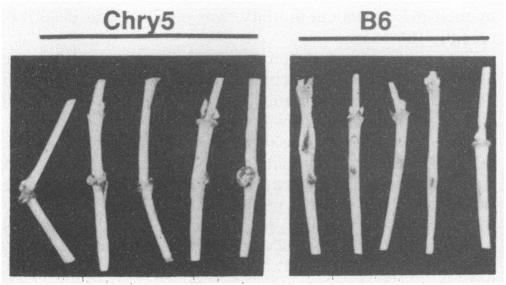
We characterized five isolates of Agrobacterium tumefaciens from naturally occurring galls on Chrysanthemum morifolium. The isolates are similar, possibly identical, members of a single strain of A. tumefaciens that we designate Chry5. The strain is a biotype I, as indicated by its response to both newly described and traditional biotype tests. Chry5 produces tumors on at least 10 plant species. It is unusual in its ability to form efficiently large tumors on soybean (Glycine max), a species normally refractory to transformation. Chry5 is unable to utilize octopine or mannopine as a carbon source. Although Chry5 can catabolize a single isomer each of nopaline and succinamopine, it differs from other known nopaline and succinamopine strains in its insensitivity to agrocin 84. This pattern of opine catabolism is unique among Agrobacterium strains examined to date. All five isolates of Chry5 contain at least two plasmids, one of which shares homology with pTiB6.
我们从 Chrysanthemum morifolium 上自然发生的瘿瘤中分离出了五株根癌农杆菌(Agrobacterium tumefaciens)。这些分离株是单一的根癌农杆菌菌株 Chry5 的相似或相同成员,我们将其命名为 Chry5。该菌株是生物型 I,这一点从其对新描述的和传统生物型测试的反应中可以看出。Chry5 能在至少 10 种植物物种上形成肿瘤。它能在大豆(Glycine max)上高效地形成大肿瘤,这是一种通常对转化有抗性的物种,这一点很不寻常。Chry5 不能利用瓜氨酸或吗啉代赖氨酸作为碳源。尽管 Chry5 可以代谢单个异构成分为胭脂碱和琥珀酸吗啉,但它与其他已知的胭脂碱和琥珀酸吗啉菌株在对农杆菌素 84 的不敏感性上有所不同。这种分解代谢的模式在迄今为止检查过的所有 Agrobacterium 菌株中都是独特的。Chry5 的所有五个分离株至少含有两个质粒,其中一个与 pTiB6 具有同源性。