Plant Microbe Interaction Group, Research School of Biological Sciences, Institute of Advanced Studies, Australian National University, GPO Box 475, Canberra City, Australian Capital Territory 2601, Australia.
Appl Environ Microbiol. 1993 Jun;59(6):1798-804. doi: 10.1128/aem.59.6.1798-1804.1993.
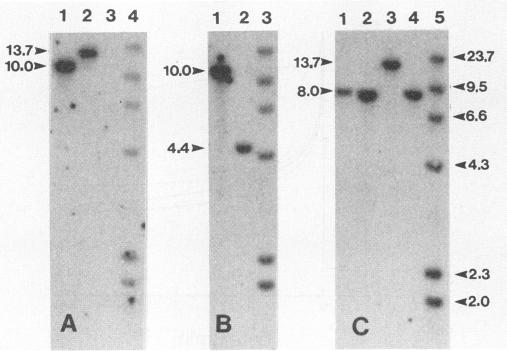
Acid-tolerant Rhizobium leguminosarum biovar trifolii ANU1173 was able to grow on laboratory media at a pH as low as 4.5. Transposon Tn5 mutagenesis was used to isolate mutants of strain ANU1173, which were unable to grow on media at a pH of less than 4.8. The acid-tolerant strain ANU1173 maintained a near-neutral intracellular pH when the external pH was as low as 4.5. In contrast, the acid-sensitive mutants AS25 and AS28 derived from ANU1173 had an acidic intracellular pH when the external pH was less than 5.5. The acid-sensitive R. leguminosarum biovar trifolii ANU794, which was comparatively more sensitive to low pH than mutants AS25 and AS28, showed a more acidic internal pH than the two mutants when the three strains were exposed to medium buffered at a pH of less than 5.5. The two acid-sensitive mutants had an increased membrane permeability to protons but did not change their proton extrusion activities. However, the acid-sensitive strain ANU794 exhibited both a higher membrane permeability to protons and a lower proton extrusion activity compared with the acid-tolerant strain ANU1173. DNA hybridization analysis showed that mutants AS25 and AS28 carried a single copy of Tn5 located in 13.7-kb (AS25) and 10.0-kb (AS28) EcoRI DNA fragments. The wild-type DNA sequences spanning the mutation sites of mutants AS25 and AS28 were cloned from genomic DNA of strain ANU1173. Transfer of these wild-type DNA sequences into corresponding Tn5-induced acid-sensitive mutants, respectively, restored the mutants to their acid tolerance phenotypes. Mapping studies showed that the AS25 locus was mapped to a 5.6-kb EcoRI-BamHI megaplasmid DNA fragment, whilst the AS28 locus was located in an 8.7-kb BglII chromosomal DNA fragment.
耐酸根瘤菌属豌豆根瘤菌生物变种三叶草 ANU1173 能够在 pH 值低至 4.5 的实验室培养基上生长。转座子 Tn5 诱变用于分离 ANU1173 菌株的突变体,这些突变体不能在 pH 值低于 4.8 的培养基上生长。耐酸菌株 ANU1173 在外部 pH 值低至 4.5 时,维持接近中性的细胞内 pH 值。相比之下,源自 ANU1173 的酸敏感突变体 AS25 和 AS28 在外部 pH 值低于 5.5 时,细胞内 pH 值呈酸性。与突变体 AS25 和 AS28 相比,比较敏感于低 pH 的酸敏感 R. leguminosarum biovar trifolii ANU794 在三种菌株暴露于 pH 值低于 5.5 的缓冲培养基时,表现出比两种突变体更酸性的内部 pH 值。两个酸敏感突变体的质子膜通透性增加,但质子外排活性没有改变。然而,与耐酸菌株 ANU1173 相比,酸敏感菌株 ANU794 表现出更高的质子膜通透性和更低的质子外排活性。DNA 杂交分析表明,突变体 AS25 和 AS28 携带一个位于 13.7-kb (AS25) 和 10.0-kb (AS28) EcoRI DNA 片段中的 Tn5 单拷贝。从 ANU1173 菌株的基因组 DNA 中克隆了跨越突变体 AS25 和 AS28 突变位点的野生型 DNA 序列。将这些野生型 DNA 序列分别转移到相应的 Tn5 诱导的酸敏感突变体中,使突变体恢复了其耐酸表型。图谱研究表明,AS25 基因座被定位在一个 5.6-kb EcoRI-BamHI 大片段质粒 DNA 片段上,而 AS28 基因座位于一个 8.7-kb BglII 染色体 DNA 片段上。