Bergmann Cornelia C, Lane Thomas E, Stohlman Stephen A
Cleveland Clinic Foundation, Neurosciences, 9500 Euclid Avenue NC30, Cleveland, Ohio 44195, USA.
Nat Rev Microbiol. 2006 Feb;4(2):121-32. doi: 10.1038/nrmicro1343.
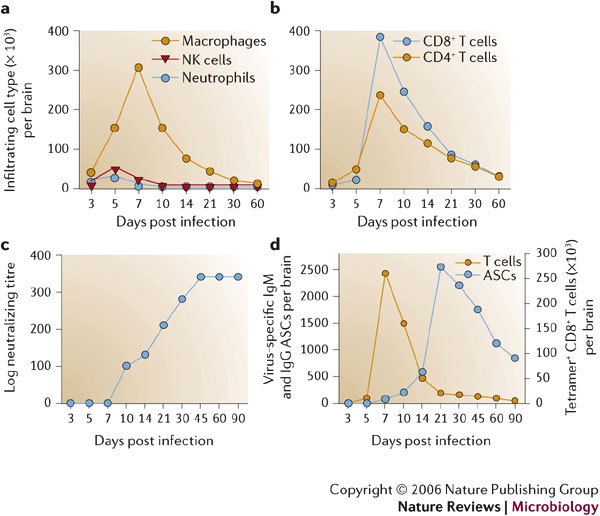
Several viruses infect the mammalian central nervous system (CNS), some with devastating consequences, others resulting in chronic or persistent infections associated with little or no overt pathology. Coronavirus infection of the murine CNS illustrates the contributions of both the innate immune response and specific host effector mechanisms that control virus replication in distinct CNS cell types. Despite T-cell-mediated control of acute virus infection, host regulatory mechanisms, probably designed to protect CNS integrity, contribute to the failure to eliminate virus. Distinct from cytolytic effector mechanisms expressed during acute infection, non-lytic humoral immunity prevails in suppressing infectious virus during persistence.
几种病毒可感染哺乳动物中枢神经系统(CNS),有些会造成毁灭性后果,另一些则导致慢性或持续性感染,几乎不伴有明显病理变化或完全没有病理变化。鼠类中枢神经系统的冠状病毒感染说明了先天免疫反应和特定宿主效应机制在不同中枢神经系统细胞类型中控制病毒复制的作用。尽管T细胞介导对急性病毒感染的控制,但可能旨在保护中枢神经系统完整性的宿主调节机制却导致无法清除病毒。与急性感染期间表达的溶细胞效应机制不同,非溶细胞性体液免疫在持续性感染期间对抑制传染性病毒起主要作用。