Department of Sports Science and Clinical Biomechanics, Faculty of Health Sciences, University of Southern Denmark, Campusvej 55, 5230, Odense M, Denmark.
Department of Orthopaedics and Traumatoloy, University Hospital Basel, Spitalstr 21, CH-4031, Basel, Switzerland.
Chiropr Man Therap. 2020 Aug 4;28(1):45. doi: 10.1186/s12998-020-00330-9.
Knowledge about the occurrence and distribution of musculoskeletal problems in early life is needed. The objectives were to group children aged 8 to 16 according to their distribution of pain in the spine, lower- and upper extremity, determine the proportion of children in each subgroup, and describe these in relation to sex, age, number- and length of episodes with pain.
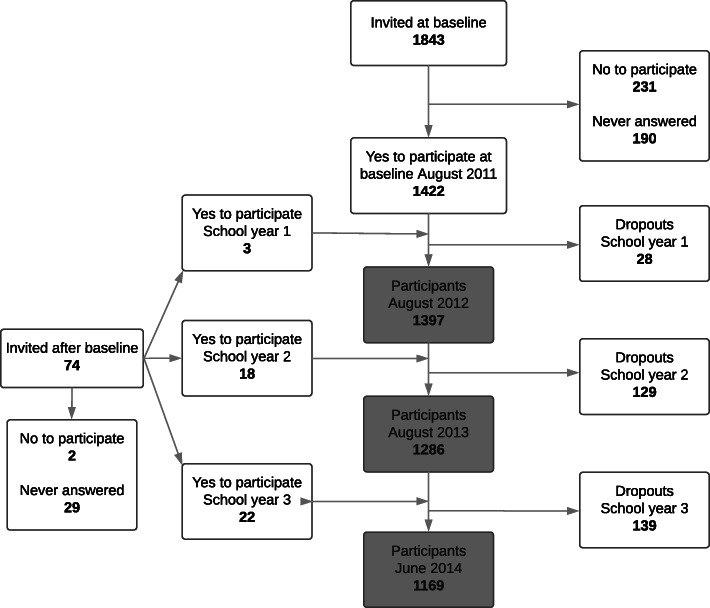
Data on musculoskeletal pain from about 1,000 Danish schoolchildren was collected over 3 school years (2011 to 2014) using weekly mobile phone text message responses from parents, indicating whether their child had pain in the spine, lower extremity and/or upper extremity. Result are presented for each school year individually.
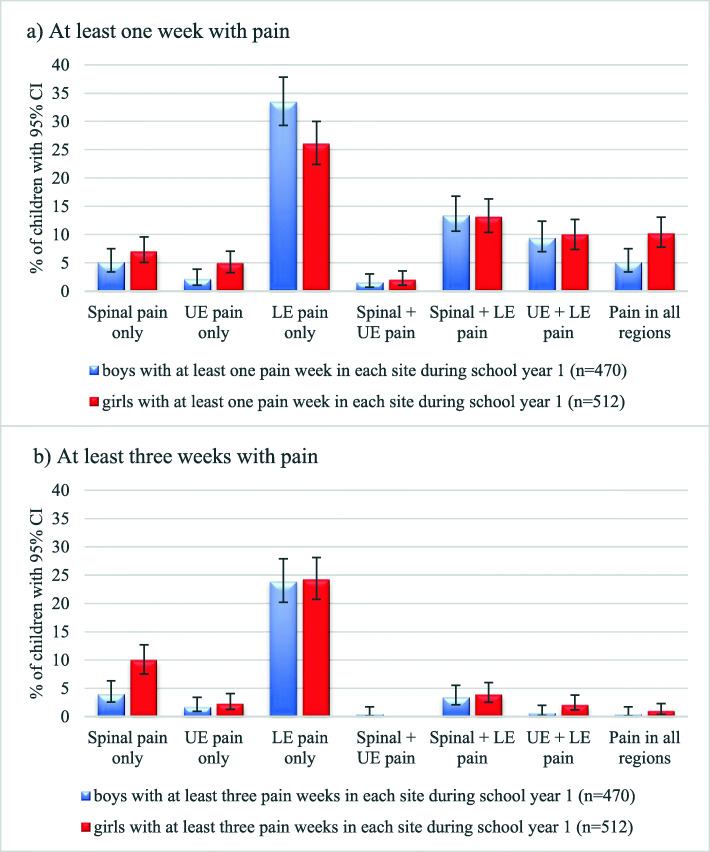
When pain was defined as at least 1 week with pain during a school year, Danish schoolchildren could be divided into three almost equally large groups for all three school years: Around 30% reporting no pain, around 40% reporting pain in one region, and around 30% reporting pain in two or three regions. Most commonly children experienced pain from the lower extremities (~ 60%), followed by the spine (~ 30%) and the upper extremities (~ 23%). Twice as many girls reported pain in all three sites compared to boys (10% vs. 5%) with no other statistically significant sex or age differences observed. When pain was defined as at least 3 weeks with pain during a schoolyear, 40% reported pain with similar patterns to those for the more lenient pain definition of 1 week.
Danish schoolchildren often experienced pain at more than one pain site during a schoolyear, and a significantly larger proportion of girls than boys reported pain in all three regions. This could indicate that, at least in some instances, the musculoskeletal system should be regarded as one entity, both for clinical and research purposes.
需要了解儿童早期肌肉骨骼问题的发生和分布情况。本研究的目的是根据脊柱、下肢和上肢疼痛的分布情况对 8 至 16 岁的儿童进行分组,确定每个亚组中儿童的比例,并描述这些与性别、年龄、疼痛发作次数和持续时间的关系。
在 3 个学年(2011 年至 2014 年)中,通过家长每周用手机短信回复的方式,收集约 1000 名丹麦学童的肌肉骨骼疼痛数据,报告其子女在脊柱、下肢和/或上肢是否有疼痛。结果分别呈现给每个学年。
当疼痛定义为在一个学年中至少有 1 周有疼痛时,丹麦学童可以在所有三个学年中分为三组,每组人数几乎相等:约 30%的学童报告无疼痛,约 40%的学童报告一个部位有疼痛,约 30%的学童报告两个或三个部位有疼痛。最常见的是儿童下肢疼痛(60%),其次是脊柱(30%)和上肢(~23%)。与男孩(5%)相比,报告三个部位都有疼痛的女孩(10%)多两倍,且没有观察到其他具有统计学意义的性别或年龄差异。当疼痛定义为在一个学年中有至少 3 周的疼痛时,40%的学童报告了与更宽松的 1 周疼痛定义相似的疼痛模式。
丹麦学童在一个学年中经常有多个部位疼痛,报告三个部位都有疼痛的女孩比例明显高于男孩。这可能表明,至少在某些情况下,肌肉骨骼系统应被视为一个整体,无论是在临床还是研究方面。