Larsen Kristoffer, Malmström Johan, Wildt Marie, Dahlqvist Camilla, Hansson Lennart, Marko-Varga György, Bjermer Leif, Scheja Agneta, Westergren-Thorsson Gunilla
Experimental Medical Science, Division of Vascular and Airway Research, Lund University, S-221 84 Lund, Sweden.
Respir Res. 2006 Jan 23;7(1):11. doi: 10.1186/1465-9921-7-11.
Activated fibroblasts, which have previously been obtained from bronchoalveolar lavage fluid (BALF), are proposed to be important cells in the fibrotic processes of asthma and scleroderma (SSc). We have studied the motility for BALF derived fibroblasts in patients with SSc that may explain the presence of these cells in the airway lumen. Furthermore, we have compared phenotypic alterations in activated fibroblasts from BALF and bronchial biopsies from patients with mild asthma and SSc that may account for the distinct fibrotic responses.
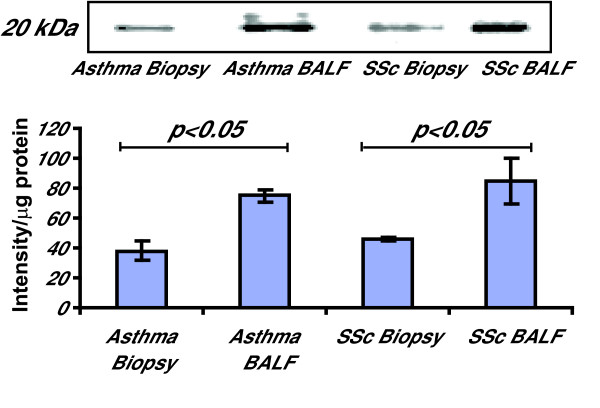
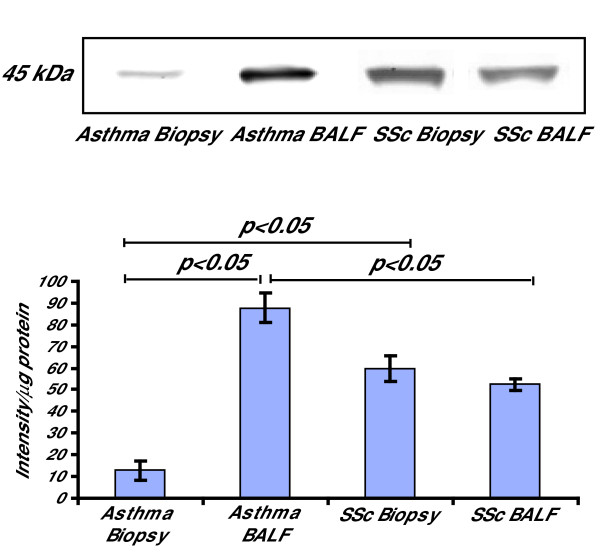
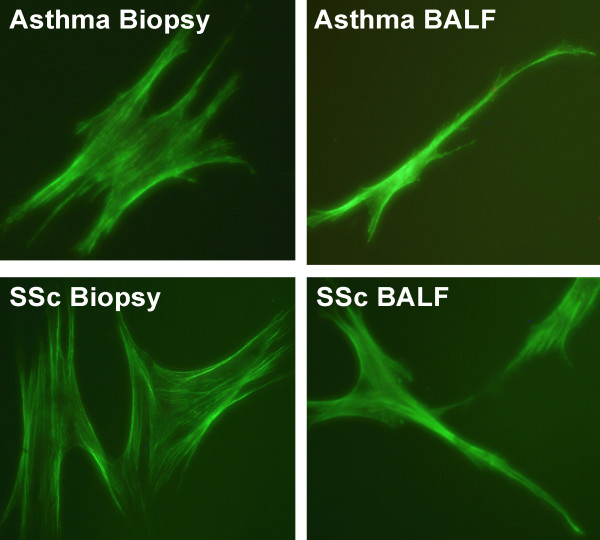
Fibroblasts were cultured from BALF and bronchial biopsies from patients with mild asthma and SSc. The motility was studied using a cell migration assay. Western Blotting was used to study the expression of alpha-smooth muscle actin (alpha-SMA), ED-A fibronectin, and serine arginine splicing factor 20 (SRp20). The protein expression pattern was analyzed to reveal potential biomarkers using two-dimensional electrophoresis (2-DE) and sequencing dual matrix-assisted laser desorption ionization time-of-flight mass spectrometry (MALDI-TOF-TOF). The Mann-Whitney method was used to calculate statistical significance.
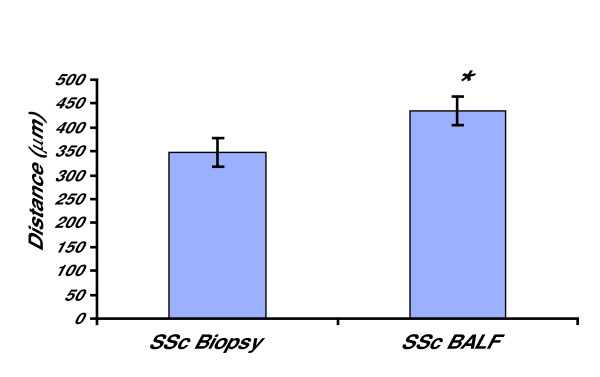
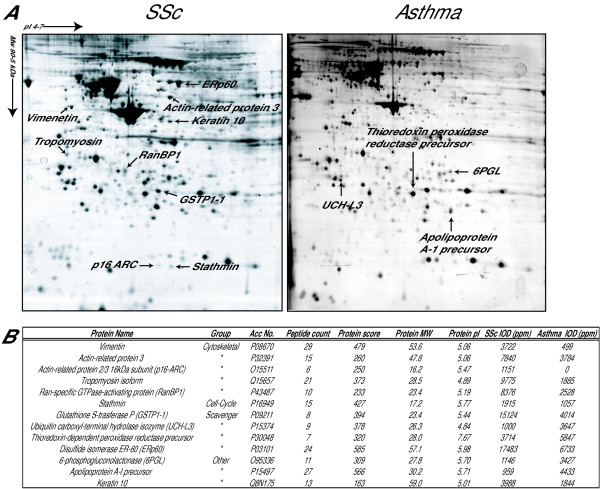
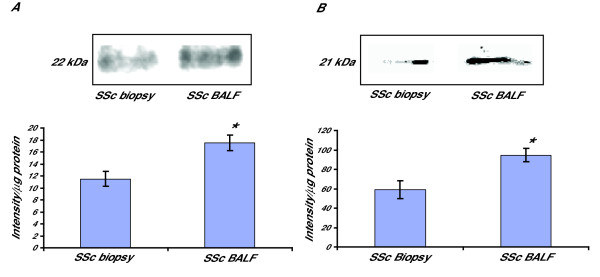
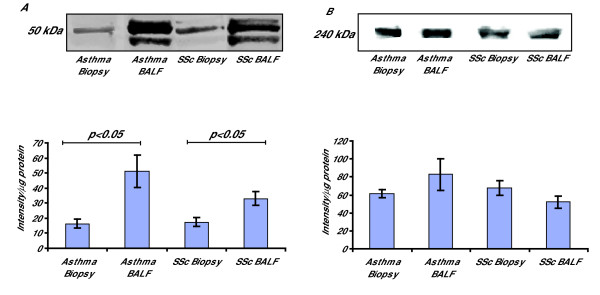
Increased migration and levels of ED-A fibronectin were observed in BALF fibroblasts from both groups of patients, supported by increased expression of RhoA, Rac1, and the splicing factor SRp20. However, these observations were exclusively accompanied by increased expression of alpha-SMA in patients with mild asthma. Compared to BALF fibroblasts in mild asthma, fibroblasts in SSc displayed a differential protein expression pattern of cytoskeletal- and scavenger proteins. These identified proteins facilitate cell migration, oxidative stress, and the excessive deposition of extracellular matrix observed in patients with SSc.
This study demonstrates a possible origin for fibroblasts in the airway lumen in patients with SSc and important differences between fibroblast phenotypes in mild asthma and SSc. The findings may explain the distinct fibrotic processes and highlight the motile BALF fibroblast as a potential target cell in these disorders.
先前已从支气管肺泡灌洗液(BALF)中分离出活化的成纤维细胞,这些细胞被认为在哮喘和硬皮病(SSc)的纤维化过程中起重要作用。我们研究了SSc患者BALF来源的成纤维细胞的迁移能力,这可能解释了这些细胞在气道腔内的存在。此外,我们比较了轻度哮喘和SSc患者BALF及支气管活检组织中活化成纤维细胞的表型改变,这可能解释了不同的纤维化反应。
从轻度哮喘和SSc患者的BALF及支气管活检组织中培养成纤维细胞。使用细胞迁移试验研究细胞迁移能力。采用蛋白质免疫印迹法研究α-平滑肌肌动蛋白(α-SMA)、ED-A纤连蛋白和丝氨酸精氨酸剪接因子20(SRp20)的表达。使用二维电泳(2-DE)和串联基质辅助激光解吸电离飞行时间质谱(MALDI-TOF-TOF)分析蛋白质表达模式以揭示潜在的生物标志物。采用曼-惠特尼方法计算统计学显著性。
两组患者BALF来源的成纤维细胞均观察到迁移增加及ED-A纤连蛋白水平升高,同时RhoA、Rac1和剪接因子SRp20的表达也增加。然而,只有轻度哮喘患者的α-SMA表达增加。与轻度哮喘患者BALF来源的成纤维细胞相比,SSc患者的成纤维细胞在细胞骨架蛋白和清道夫蛋白方面表现出不同的蛋白质表达模式。这些鉴定出的蛋白质促进了SSc患者中观察到细胞迁移、氧化应激和细胞外基质过度沉积。
本研究证明了SSc患者气道腔内成纤维细胞的可能来源,以及轻度哮喘和SSc患者成纤维细胞表型的重要差异。这些发现可能解释了不同的纤维化过程,并突出了具有迁移能力的BALF成纤维细胞作为这些疾病潜在的靶细胞。