Hole D J, Lamont D W
West of Scotland Cancer Surveillance Unit, Ruchill Hospital, Glasgow, U.K.
J Epidemiol Community Health. 1992 Jun;46(3):305-10. doi: 10.1136/jech.46.3.305.
The aim was to examine the extent to which random variation alone will produce differences in observed incidence rates between small areas which will affect measures of spatial clustering and estimates of relative risk.
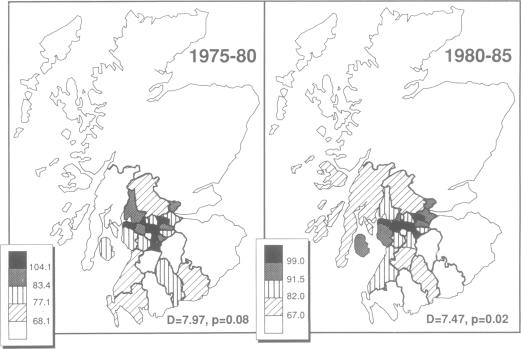
This was a study of changes in the pattern of spatial concentration of cancer incidence over a five year time period. A comparison was made of observed incidence rates for 34 tumour sites with randomly generated values and, where possible, with expected values derived from known relative risks.
Twenty six local government districts in the West of Scotland.
A statistically significant relationship was observed between sample size and the stability of a summary measure of spatial concentration. Almost all observed highest:mean rate ratios were within the 95% confidence interval of the simulated distribution of these values. In three cases examined, both observed and simulated highest:lowest rate ratios were larger than those expected on the basis of known exposures to risk.
In the absence of a prior hypothesis, small area analysis of epidemiological data for periods of less than 10 years will almost always give misleading results for all but the most common diseases.
本研究旨在探讨仅随机变异在多大程度上会导致小区域间观察到的发病率差异,而这种差异会影响空间聚集性测量及相对风险估计。
这是一项关于五年期间癌症发病率空间聚集模式变化的研究。将34个肿瘤部位的观察发病率与随机生成值进行比较,并在可能的情况下与从已知相对风险得出的预期值进行比较。
苏格兰西部的26个地方政府辖区。
观察到样本量与空间聚集性汇总测量的稳定性之间存在统计学显著关系。几乎所有观察到的最高发病率与平均发病率之比均在这些值模拟分布的95%置信区间内。在三个被检查的案例中,观察到的和模拟的最高发病率与最低发病率之比均大于基于已知风险暴露预期的比值。
在没有先验假设的情况下,对少于10年期间的流行病学数据进行小区域分析,几乎总会对除最常见疾病之外的所有疾病给出误导性结果。