Abteilung Biochemie, D-5000 Köln 30, FRG.
EMBO J. 1987 Sep;6(9):2551-6. doi: 10.1002/j.1460-2075.1987.tb02543.x.
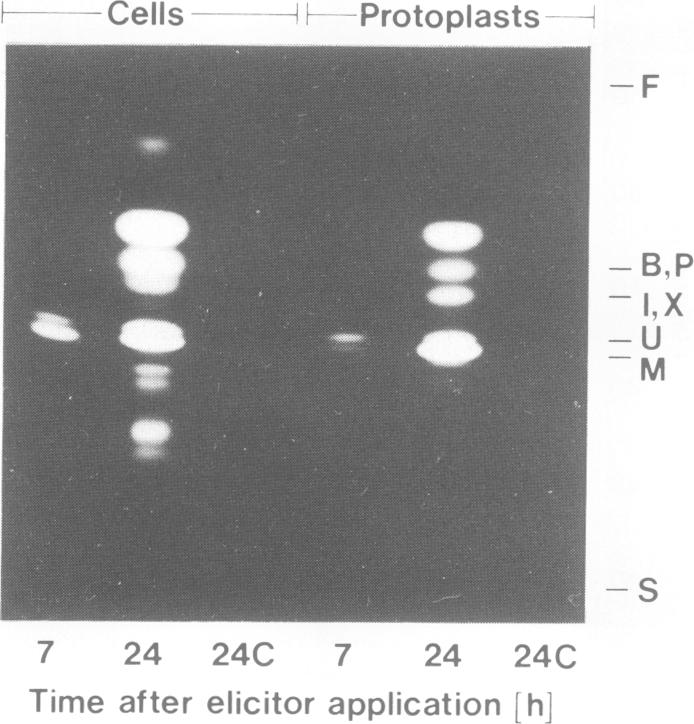
The differential response of cultured parsley cells to u.v. irradiation and elicitor treatment is a paradigm for analysis of specific plant defense responses. We demonstrate that freshly isolated parsley protoplasts, in the absence of detectable cell wall, maintain fully the ability to be activated by these important environmental factors. Stimulated protoplasts synthesize typical qualitative patterns and amounts of potentially protective flavonoid glycosides and coumarin phytoalexins following either u.v. irradiation or treatment with fungal elicitor, respectively. Induced accumulation of mRNAs and enzymes of the phenylpropanoid biosynthetic pathways is nearly identical in protoplasts and cells. Stimulation of protoplasts with elicitor requires only a short period of contact, which is not sufficient for cell wall regeneration. Importantly, there is no activation of these pathways during protoplast preparation. These results establish that parsley protoplasts respond appropriately to two physically distinct stimuli and might serve as an especially suitable system for the analysis of signal transduction and gene activation.
培养的欧芹细胞对紫外线辐射和诱导剂处理的差异反应是分析特定植物防御反应的典范。我们证明,在没有可检测细胞壁的情况下,新分离的欧芹原生质体完全保持被这些重要环境因素激活的能力。受刺激的原生质体在紫外线照射或真菌诱导剂处理后分别合成典型的定性模式和数量的潜在保护黄酮糖苷和香豆素植物抗毒素。苯丙烷生物合成途径的 mRNA 和酶的诱导积累在原生质体和细胞中几乎相同。用诱导剂刺激原生质体只需要很短的接触时间,这不足以进行细胞壁再生。重要的是,在原生质体制备过程中不会激活这些途径。这些结果表明,欧芹原生质体对两种物理上不同的刺激有适当的反应,可能是分析信号转导和基因激活的特别合适的系统。