Freistadt M S, Racaniello V R
Department of Microbiology, Columbia University College of Physicians and Surgeons, New York, New York 10032.
J Virol. 1991 Jul;65(7):3873-6. doi: 10.1128/JVI.65.7.3873-3876.1991.
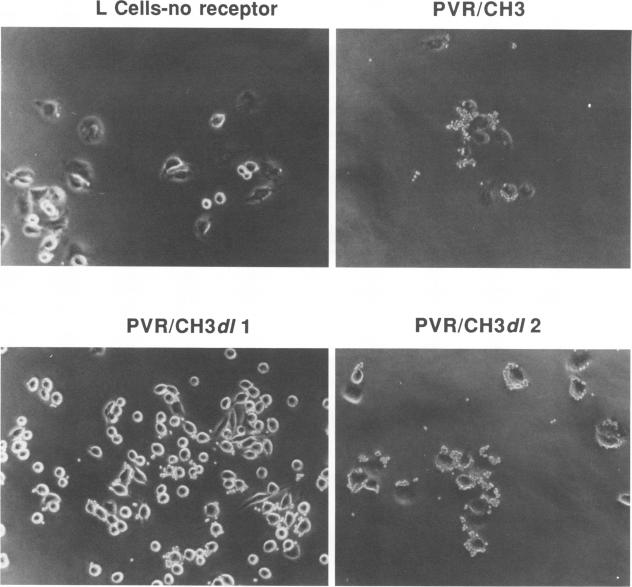
To identify sequences of the cellular poliovirus receptor (PVR) involved in viral infection, mutant PVR cDNAs were constructed and assayed for biological activity in mouse L cells. To confirm that mutant PVRs reached the cell surface, an immunological tag, consisting of part of CH3 from human immunoglobulin G1, was engineered into the PVR. Deletion of PVR amino acids 256 to 320 or 385 to the carboxy terminus yielded receptors that were able to support poliovirus infection. PVRs lacking amino acids 40 to 136 or 137 to 256 were expressed at the cell surface but were not active as receptors for poliovirus. The results show that immunoglobulin-type domain 3 and the extreme carboxy terminus of the PVR are not required for viral receptor function, but sequences within the two amino-terminal domains contribute to the initiation of poliovirus infection.
为了鉴定参与病毒感染的细胞脊髓灰质炎病毒受体(PVR)序列,构建了突变型PVR cDNA,并在小鼠L细胞中检测其生物学活性。为了确认突变型PVR到达细胞表面,将由人免疫球蛋白G1的CH3部分组成的免疫标签设计到PVR中。缺失PVR氨基酸256至320或385至羧基末端产生的受体能够支持脊髓灰质炎病毒感染。缺少氨基酸40至136或137至256的PVR在细胞表面表达,但作为脊髓灰质炎病毒的受体无活性。结果表明,PVR的免疫球蛋白型结构域3和极端羧基末端对于病毒受体功能不是必需的,但两个氨基末端结构域内的序列有助于脊髓灰质炎病毒感染的起始。