Cébe-Suarez S, Zehnder-Fjällman A, Ballmer-Hofer K
Biomolecular Research, Molecular Cell Biology, Paul Scherrer Institut, 5232, Villigen, Switzerland.
Cell Mol Life Sci. 2006 Mar;63(5):601-15. doi: 10.1007/s00018-005-5426-3.
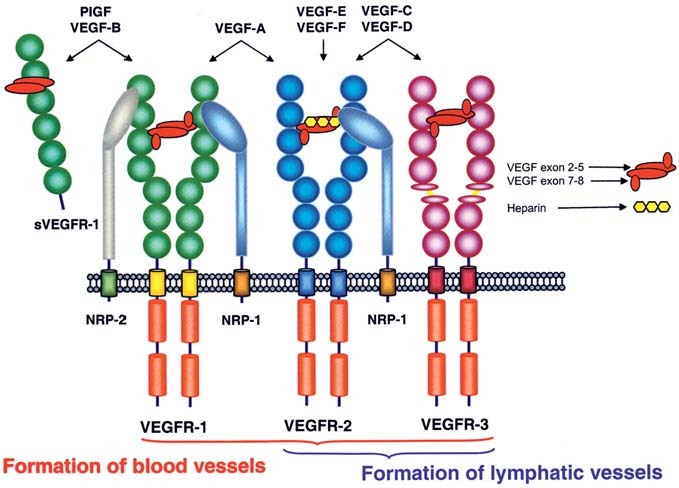
Vascular endothelial growth factors (VEGFs) regulate blood and lymphatic vessel development and homeostasis but also have profound effects on neural cells. VEGFs are predominantly produced by endothelial, hematopoietic and stromal cells in response to hypoxia and upon stimulation with growth factors such as transforming growth factors, interleukins or platelet-derived growth factor. VEGFs bind to three variants of type III receptor tyrosine kinases, VEGF receptor 1, 2 and 3. Each VEGF isoform binds to a particular subset of these receptors giving rise to the formation of receptor homo- and heterodimers that activate discrete signaling pathways. Signal specificity of VEGF receptors is further modulated upon recruitment of coreceptors, such as neuropilins, heparan sulfate, integrins or cadherins. Here we summarize the knowledge accumulated since the discovery of these proteins more than 20 years ago with the emphasis on the signaling pathways activated by VEGF receptors in endothelial cells during cell migration, growth and differentiation.
血管内皮生长因子(VEGFs)调节血管和淋巴管的发育及稳态,而且对神经细胞也有深远影响。VEGFs主要由内皮细胞、造血细胞和基质细胞在缺氧以及受到诸如转化生长因子、白细胞介素或血小板衍生生长因子等生长因子刺激时产生。VEGFs与III型受体酪氨酸激酶的三种变体,即血管内皮生长因子受体1、2和3结合。每种VEGF异构体与这些受体的特定亚群结合,导致受体同二聚体和异二聚体的形成,从而激活不同的信号通路。当共受体(如神经纤毛蛋白、硫酸乙酰肝素、整合素或钙黏着蛋白)被募集时,VEGF受体的信号特异性会进一步受到调节。在此,我们总结了自20多年前发现这些蛋白质以来积累的知识,重点关注内皮细胞在细胞迁移、生长和分化过程中由VEGF受体激活的信号通路。