Stocker Patrick J, Bennett Eric S
Department of Physiology and Biophysics and Program in Neuroscience, University of South Florida College of Medicine, Tampa, 33612, USA.
J Gen Physiol. 2006 Mar;127(3):253-65. doi: 10.1085/jgp.200509423. Epub 2006 Feb 13.
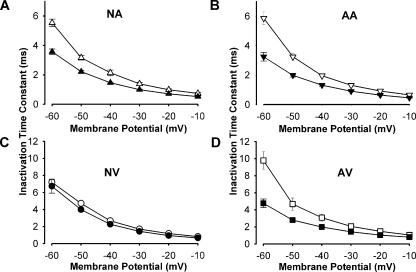
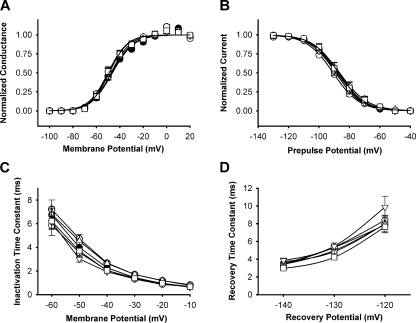
Voltage-gated sodium channel function from neonatal and adult rat cardiomyocytes was measured and compared. Channels from neonatal ventricles required an approximately 10 mV greater depolarization for voltage-dependent gating events than did channels from neonatal atria and adult atria and ventricles. We questioned whether such gating shifts were due to developmental and/or chamber-dependent changes in channel-associated functional sialic acids. Thus, all gating characteristics for channels from neonatal atria and adult atria and ventricles shifted significantly to more depolarized potentials after removal of surface sialic acids. Desialylation of channels from neonatal ventricles did not affect channel gating. After removal of the complete surface N-glycosylation structures, gating of channels from neonatal atria and adult atria and ventricles shifted to depolarized potentials nearly identical to those measured for channels from neonatal ventricles. Gating of channels from neonatal ventricles were unaffected by such deglycosylation. Immunoblot gel shift analyses indicated that voltage-gated sodium channel alpha subunits from neonatal atria and adult atria and ventricles are more heavily sialylated than alpha subunits from neonatal ventricles. The data are consistent with approximately 15 more sialic acid residues attached to each alpha subunit from neonatal atria and adult atria and ventricles. The data indicate that differential sialylation of myocyte voltage-gated sodium channel alpha subunits is responsible for much of the developmental and chamber-specific remodeling of channel gating observed here. Further, cardiac excitability is likely impacted by these sialic acid-dependent gating effects, such as modulation of the rate of recovery from inactivation. A novel mechanism is described by which cardiac voltage-gated sodium channel gating and subsequently cardiac rhythms are modulated by changes in channel-associated sialic acids.
对新生大鼠和成年大鼠心肌细胞的电压门控钠通道功能进行了测量和比较。新生心室的通道在电压依赖性门控事件中所需的去极化程度比新生心房以及成年心房和心室的通道大约高10 mV。我们质疑这种门控移位是否是由于通道相关功能性唾液酸的发育和/或腔室依赖性变化所致。因此,去除表面唾液酸后,新生心房以及成年心房和心室通道的所有门控特性均显著向更去极化的电位偏移。新生心室通道的去唾液酸化不影响通道门控。去除完整的表面N-糖基化结构后,新生心房以及成年心房和心室通道的门控向去极化电位偏移,几乎与新生心室通道测得的电位相同。新生心室通道的门控不受这种去糖基化的影响。免疫印迹凝胶迁移分析表明,新生心房以及成年心房和心室的电压门控钠通道α亚基比新生心室的α亚基唾液酸化程度更高。数据表明,新生心房以及成年心房和心室的每个α亚基上大约多附着了15个唾液酸残基。数据表明,心肌细胞电压门控钠通道α亚基的差异唾液酸化是此处观察到的通道门控发育和腔室特异性重塑的主要原因。此外,心脏兴奋性可能受到这些唾液酸依赖性门控效应的影响,例如对失活恢复速率的调节。本文描述了一种新机制,通过该机制,心脏电压门控钠通道门控以及随后的心律受到通道相关唾液酸变化的调节。