Jones Sunita B, Brooks James D
Department of Urology, Stanford University School of Medicine, Stanford, California 94305, USA.
BMC Cancer. 2006 Mar 15;6:62. doi: 10.1186/1471-2407-6-62.
Prostate cancer is the most commonly diagnosed malignancy in men and is thought to arise as a result of endogenous oxidative stress in the face of compromised carcinogen defenses. We tested whether carcinogen defense (phase 2) enzymes could be induced in the prostate tissues of rats after oral feeding of candidate phase 2 enzyme inducing compounds.
Male F344 rats were gavage fed sulforaphane, beta-naphthoflavone, curcumin, dimethyl fumarate or vehicle control over five days, and on the sixth day, prostate, liver, kidney and bladder tissues were harvested. Cytosolic enzyme activities of nicotinamide quinone oxidoreductase (NQO1), total glutathione transferase (using DCNB) and mu-class glutathione transferase (using CDNB) were determined in the treated and control animals and compared.
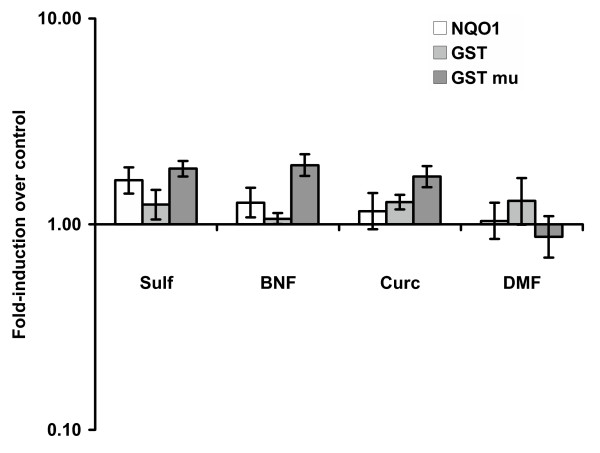
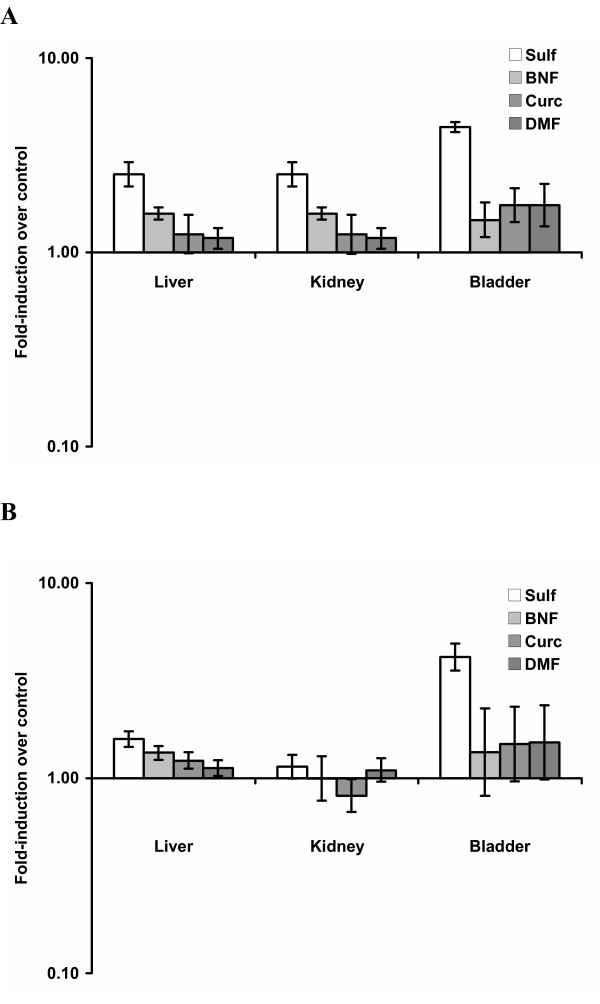
In prostatic tissues, sulforaphane produced modest but significant increases in the enzymatic activities of NQO1, total GST and GST-mu compared to control animals. beta-naphthoflavone significantly increased NQO1 and GST-mu activities and curcumin increased total GST and GST-mu enzymatic activities. Dimethyl fumarate did not significantly increase prostatic phase 2 enzyme activity. Compared to control animals, sulforaphane also significantly induced NQO1 or total GST enzyme activity in the liver, kidney and, most significantly, in the bladder tissues. All compounds were well tolerated over the course of the gavage feedings.
Orally administered compounds will induce modestly phase 2 enzyme activity in the prostate although the significance of this degree of induction is unknown. The 4 different compounds also altered phase 2 enzyme activity to different degrees in different tissue types. Orally administered sulforaphane potently induces phase 2 enzymes in bladder tissues and should be investigated as a bladder cancer preventive agent.
前列腺癌是男性中最常被诊断出的恶性肿瘤,被认为是在致癌物防御受损的情况下,由内源性氧化应激引发的。我们测试了在给大鼠口服候选的二期酶诱导化合物后,其前列腺组织中致癌物防御(二期)酶是否能够被诱导。
雄性F344大鼠连续五天经口灌喂萝卜硫素、β-萘黄酮、姜黄素、富马酸二甲酯或作为对照的赋形剂,在第六天,采集前列腺、肝脏、肾脏和膀胱组织。测定处理组和对照组动物中烟酰胺醌氧化还原酶(NQO1)的胞质酶活性、总谷胱甘肽转移酶(使用1,2-二氯-4-硝基苯(DCNB))和μ类谷胱甘肽转移酶(使用1-氯-2,4-二硝基苯(CDNB)),并进行比较。
在前列腺组织中,与对照动物相比,萝卜硫素使NQO1、总谷胱甘肽转移酶和μ类谷胱甘肽转移酶的酶活性有适度但显著的增加。β-萘黄酮显著增加了NQO1和μ类谷胱甘肽转移酶的活性,姜黄素增加了总谷胱甘肽转移酶和μ类谷胱甘肽转移酶的酶活性。富马酸二甲酯未显著增加前列腺二期酶活性。与对照动物相比,萝卜硫素在肝脏、肾脏以及最显著的是在膀胱组织中也显著诱导了NQO1或总谷胱甘肽转移酶的酶活性。在灌喂过程中,所有化合物的耐受性都良好。
口服化合物会在前列腺中适度诱导二期酶活性,尽管这种诱导程度的意义尚不清楚。这4种不同的化合物在不同组织类型中也不同程度地改变了二期酶活性。口服萝卜硫素能有效诱导膀胱组织中的二期酶,应作为膀胱癌预防剂进行研究。