Hestbaek Lise, Leboeuf-Yde Charlotte, Kyvik Kirsten O
The Back Research Center, Backcenter Funen, Part of Clinical Locomotion Science, University of Southern Denmark.
BMC Musculoskelet Disord. 2006 Mar 16;7:29. doi: 10.1186/1471-2474-7-29.
It has previously been shown that low back pain (LBP) often presents already in the teenage years and that previous LBP predicts future LBP. It is also well documented that there is a large degree of comorbidity associated with LBP, both in adolescents and adults. The objective of this study is to gain a deeper insight into the etiology of low back pain and to possibly develop a tool for early identification of high-risk groups. This is done by investigating whether different types of morbidity in adolescence are associated with LBP in adulthood.
Almost 10,000 Danish twins born between 1972 and 1982 were surveyed by means of postal questionnaires in 1994 and again in 2002. The questionnaires dealt with various aspects of general health, including the prevalence of LBP, classified according to number of days affected during the previous year (0, 1-7, 8-30, >30). The predictor variables used in this study were LBP, headache, asthma and atopic disease at baseline; the outcome variable was persistent LBP (>30 days during the past year) at follow-up. Associations between morbidity in 1994 and LBP in 2002 were investigated.
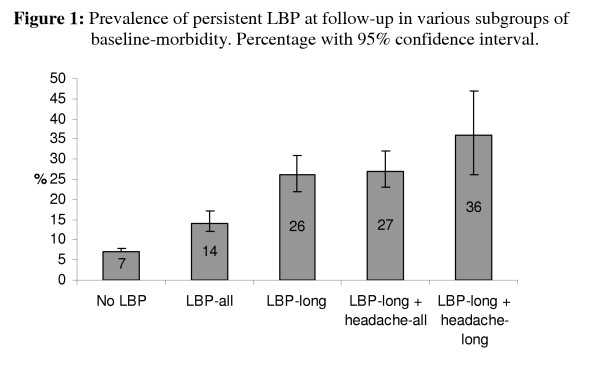
LBP, headache and asthma in adolescence were positively associated with future LBP. There was no association between atopic disease and future LBP. Individuals with persistent LBP at baseline had an odds ratio of 3.5 (2.8-4.5) for future LBP, while the odds ratio for those with persistent LBP, persistent headache and asthma was 4.5 (2.5-8.1). There was a large degree of clustering of these disorders, but atopic disease was not part of this pattern.
Young people from 12 to 22 years of age with persistent LBP during the previous year have an odds ratio of 3.5 persistent LBP eight years later. Both headache and asthma are also positively associated with future LBP and there is a large clustering of LBP, headache and asthma in adolescence.
此前已有研究表明,腰痛(LBP)常在青少年时期就已出现,且既往腰痛可预测未来腰痛。同样有充分文献记载,青少年和成年人中,腰痛都存在大量合并症。本研究的目的是更深入地了解腰痛的病因,并可能开发一种早期识别高危人群的工具。这通过调查青少年时期不同类型的疾病是否与成年后的腰痛相关来实现。
1994年和2002年通过邮寄问卷对近10000名1972年至1982年出生的丹麦双胞胎进行了调查。问卷涉及一般健康的各个方面,包括腰痛的患病率,根据上一年受影响的天数分类(0天、1 - 7天、8 - 30天、>30天)。本研究中使用的预测变量为基线时的腰痛、头痛、哮喘和特应性疾病;结局变量为随访时持续腰痛(过去一年中>30天)。调查了1994年的疾病与2002年腰痛之间的关联。
青少年时期的腰痛、头痛和哮喘与未来腰痛呈正相关。特应性疾病与未来腰痛之间无关联。基线时患有持续性腰痛的个体未来发生腰痛的优势比为3.5(2.8 - 4.5),而患有持续性腰痛、持续性头痛和哮喘的个体的优势比为4.5(2.5 - 8.1)。这些疾病存在很大程度的聚集性,但特应性疾病不属于这种模式。
前一年患有持续性腰痛的12至22岁年轻人,八年后发生持续性腰痛的优势比为3.5。头痛和哮喘也与未来腰痛呈正相关,且青少年时期腰痛、头痛和哮喘存在很大的聚集性。