
1990年至2021年职业工效学因素所致下背痛的全球负担:全球疾病负担的数据分析与预测
Global burden of occupational ergonomic factor-induced low back pain, 1990~2021: data analysis and projections of the global burden of disease.
作者信息
Wu Meng, Wu Peihong, Lu Huaye, Han Lei, Liu Xin
机构信息
Institute of Occupational Disease Prevention, Jiangsu Provincial Center for Disease Control and Prevention, Nanjing, China.
NHC Key Laboratory for Engineering Control of Dust Hazard, Beijing, China.
出版信息
Front Public Health. 2025 May 27;13:1573828. doi: 10.3389/fpubh.2025.1573828. eCollection 2025.
BACKGROUND
Low back pain (LBP) is a global epidemic that severely affects the quality of life and imposes a substantial economic burden worldwide. Occupational ergonomic factors are the most important modifiable contributors to LBP. In this study, we estimated the global burden of occupational ergonomic factor-induced LBP from 1990 to 2021 using the Global Burden of Disease, Injuries, and Risk Factors Study (GBD) 2021 database and projected future trends.
METHODS
Global years lived with disability (YLDs) and age-standardized YLD rate (ASYLDR) for occupational ergonomic factor-induced LBP by sex and Socio-demographic index (SDI) among individuals aged 15-64 from 1990 to 2021 were obtained from the GBD 2021. Long-term trends were evaluated by calculating the average annual percent change (AAPC) of ASYLDR using a Joinpoint model. A Nordpred model was applied to analyze temporal changes in overall and age-specific YLDs and ASYLDR between 1990 and 2021, and to project trends from 2022 to 2045.
RESULTS
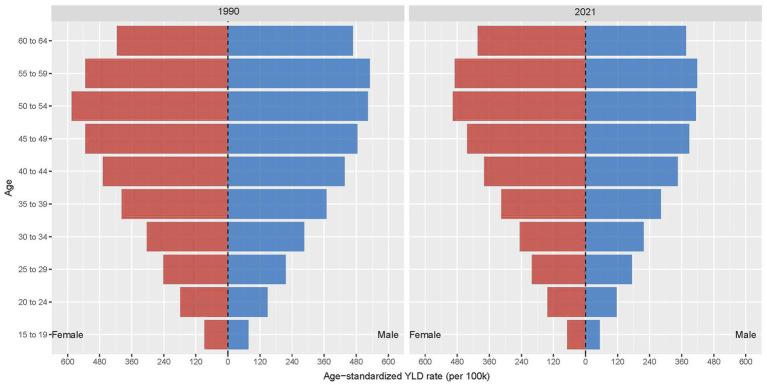
From 1990 to 2021, global YLDs of occupational ergonomic factor-induced LBP increased by 40.63%. Projections indicated that all-age YLDs will exceed 15 million person-years by 2037. The ASYLDR of occupational ergonomic factor-induced LBP had shown a sustained decline since 1990, decreasing by 18.75% between 1990 and 2021, with an AAPC of -0.670% (95% confidence interval: -0.718 to -0.622). This downward trend is expected to persist until 2045. The SDI showed a negative correlation with ASYLDR ( = -0.36, < 0.001). YLDs and ASYLDR were consistently higher in females than in males.
CONCLUSION
While the disease burden of occupational ergonomic factor-induced LBP has decreased, the reduction remains modest. Females, low SDI regions, and middle-aged/older adults (40-64 years) are the main contributors to the disease burden. Occupational ergonomic factor-induced LBP remains a critical public health problem that requires urgent attention to find global, comprehensive, effective, and targeted prevention strategies.
背景
腰痛是一种全球性疾病,严重影响生活质量,并在全球范围内造成巨大经济负担。职业工效学因素是导致腰痛的最重要的可改变因素。在本研究中,我们使用《2021年全球疾病、伤害及风险因素负担研究》(GBD 2021)数据库估算了1990年至2021年职业工效学因素所致腰痛的全球负担,并预测了未来趋势。
方法
从GBD 2021中获取1990年至2021年15至64岁个体中按性别和社会人口指数(SDI)划分的职业工效学因素所致腰痛的全球伤残调整生命年(YLDs)和年龄标准化YLD率(ASYLDR)。使用Joinpoint模型计算ASYLDR的平均年度百分比变化(AAPC)来评估长期趋势。应用Nordpred模型分析1990年至2021年总体和特定年龄YLDs及ASYLDR的时间变化,并预测2022年至2045年的趋势。
结果
1990年至2021年,职业工效学因素所致腰痛的全球YLDs增加了40.63%。预测表明,到2037年,全年龄YLDs将超过1500万人年。职业工效学因素所致腰痛的ASYLDR自1990年以来持续下降,1990年至2021年下降了18.75%,AAPC为-0.670%(95%置信区间:-0.718至-0.622)。预计这一下降趋势将持续到2045年。SDI与ASYLDR呈负相关( = -0.36, < 0.001)。女性的YLDs和ASYLDR始终高于男性。
结论
虽然职业工效学因素所致腰痛的疾病负担有所下降,但降幅仍然不大。女性、低SDI地区以及中年/老年成年人(40-64岁)是疾病负担的主要贡献者。职业工效学因素所致腰痛仍然是一个关键的公共卫生问题,需要紧急关注以找到全球、全面、有效且有针对性的预防策略。


 Zotero 插件