Pantin-Jackwood Mary J, Spackman Erica, Woolcock Peter R
Southeast Poultry Research Laboratory, Agriculture Research Service, US Department of Agriculture, Athens, GA 30605, USA.
Virus Genes. 2006 Apr;32(2):187-92. doi: 10.1007/s11262-005-6875-3.
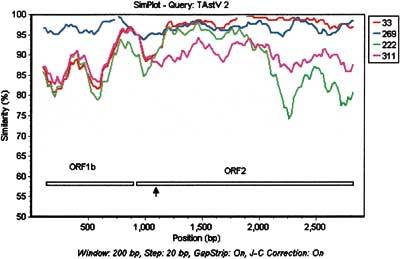
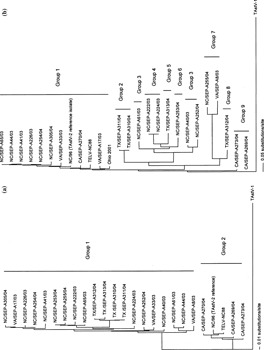
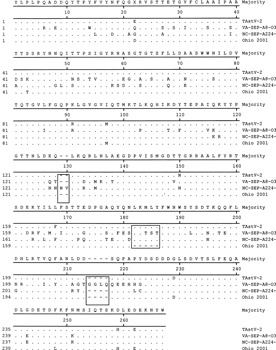
Sequence data was obtained from the capsid (ORF-2) and the polymerase (ORF-lb) genes of 23 turkey astrovirus (TAstV) isolates collected from commercial turkey flocks around the United States between 2003 and 2004. A high level of genetic variation was observed among the isolates, particularly in the capsid gene, where nucleotide sequence identity among them was as low as 69%. Isolates collected on the same farm, on the same day, but from different houses could have as little as 72% identity between their capsid gene sequences when compared. Phylogenetic analysis of the capsid gene revealed no clear assortment by geographic region or isolation date. The polymerase gene was more conserved with between 86 and 99% nucleotide identity and did assort in a geographic manner. Based on differing topologies of the capsid and polymerase gene phylogenetic trees, TAstV appears to undergo recombination.
从2003年至2004年间在美国各地商业火鸡群中收集的23株火鸡星状病毒(TAstV)分离株的衣壳(ORF-2)和聚合酶(ORF-1b)基因中获得了序列数据。在这些分离株中观察到了高度的遗传变异,特别是在衣壳基因中,它们之间的核苷酸序列同一性低至69%。在同一天从同一农场不同鸡舍收集的分离株,其衣壳基因序列之间的同一性相比可能低至72%。衣壳基因的系统发育分析没有显示出按地理区域或分离日期的明显分类。聚合酶基因更为保守,核苷酸同一性在86%至99%之间,并且确实按地理方式进行了分类。基于衣壳和聚合酶基因系统发育树的不同拓扑结构,TAstV似乎经历了重组。