Rhodes Andrew, Wort Stephen J, Thomas Helen, Collinson Paul, Bennett E David
Intensive Care Unit, St Georges's Hospital, London, UK.
Crit Care. 2006;10(2):R60. doi: 10.1186/cc4894.
Risk stratification of severely ill patients remains problematic, resulting in increased interest in potential circulating markers, such as cytokines, procalcitonin and brain natriuretic peptide. Recent reports have indicated the usefulness of plasma DNA as a prognostic marker in various disease states such as trauma, myocardial infarction and stroke. The present study assesses the significance of raised levels of plasma DNA on admission to the intensive care unit (ICU) in terms of its ability to predict disease severity or prognosis.
Fifty-two consecutive patients were studied in a general ICU. Blood samples were taken on admission and were stored for further analysis. Plasma DNA levels were estimated by a PCR method using primers for the human beta-haemoglobin gene.
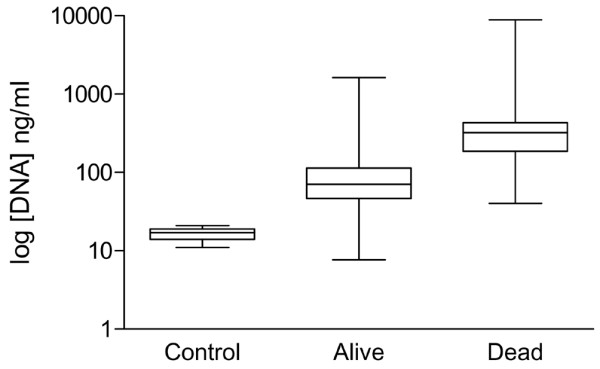
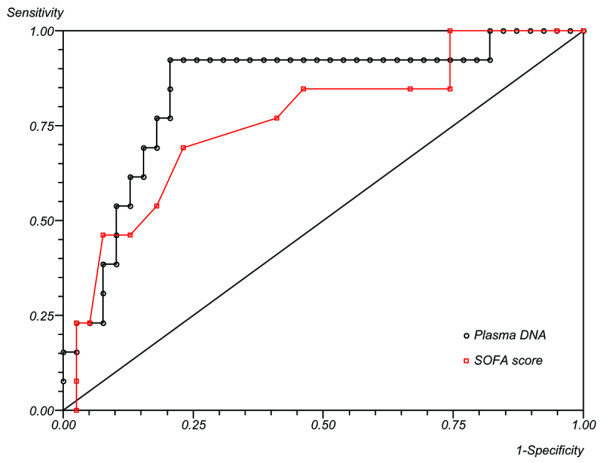
Sixteen of the 52 patients investigated died within 3 months of sampling. Nineteen of the 52 patients developed either severe sepsis or septic shock. Plasma DNA was higher in ICU patients than in healthy controls and was also higher in patients who developed sepsis (192 (65-362) ng/ml versus 74 (46-156) ng/ml, P = 0.03) or who subsequently died either in the ICU (321 (185-430) ng/ml versus 71 (46-113) ng/ml, P < 0.001) or in hospital (260 (151-380) ng/ml versus 68 (47-103) ng/ml, P < 0.001). Plasma DNA concentrations were found to be significantly higher in patients who died in the ICU. Multiple logistic regression analysis determined plasma DNA to be an independent predictor of mortality (odds ratio, 1.002 (95% confidence interval, 1.0-1.004), P = 0.05). Plasma DNA had a sensitivity of 92% and a specificity of 80% when a concentration higher than 127 ng/ml was taken as a predictor for death on the ICU.
Plasma DNA may be a useful prognostic marker of mortality and sepsis in intensive care patients.
重症患者的风险分层仍然存在问题,这使得人们对诸如细胞因子、降钙素原和脑钠肽等潜在循环标志物的兴趣增加。最近的报告表明,血浆DNA作为创伤、心肌梗死和中风等各种疾病状态的预后标志物具有实用性。本研究评估了重症监护病房(ICU)入院时血浆DNA水平升高在预测疾病严重程度或预后方面的意义。
在一家综合ICU对52例连续患者进行了研究。入院时采集血样并储存以备进一步分析。使用人β-珠蛋白基因引物通过PCR方法估计血浆DNA水平。
在调查的52例患者中,有16例在采样后3个月内死亡。52例患者中有19例发生了严重脓毒症或脓毒性休克。ICU患者的血浆DNA水平高于健康对照组,发生脓毒症的患者(192(65 - 362)ng/ml对74(46 - 156)ng/ml,P = 0.03)或随后在ICU死亡(321(185 - 430)ng/ml对71(46 - 113)ng/ml,P < 0.001)或在医院死亡(260(151 - 380)ng/ml对68(47 - 103)ng/ml,P < 0.001)的患者血浆DNA水平也更高。发现ICU死亡患者的血浆DNA浓度显著更高。多因素逻辑回归分析确定血浆DNA是死亡率的独立预测因子(比值比,1.002(95%置信区间,1.0 - 1.004),P = 0.05)。当血浆DNA浓度高于127 ng/ml作为ICU死亡预测指标时,其敏感性为92%,特异性为80%。
血浆DNA可能是重症监护患者死亡率和脓毒症的有用预后标志物。