
惊厥剂荷包牡丹碱可改变中枢神经系统毒蕈碱受体亲和力。
Convulsant bicuculline modifies CNS muscarinic receptor affinity.
作者信息
Schneider Patricia G, Rodríguez de Lores Arnaiz Georgina
机构信息
Instituto de Biología Celular y Neurociencias Prof. E. De Robertis, Facultad de Medicina, Universidad de Buenos Aires, Paraguay 2155, 1121-Buenos Aires, Argentina.
出版信息
BMC Neurosci. 2006 Apr 17;7:32. doi: 10.1186/1471-2202-7-32.
BACKGROUND
Previous work from this laboratory has shown that the administration of the convulsant drug 3-mercaptopropionic acid (MP), a GAD inhibitor, modifies not only GABA synthesis but also binding of the antagonist [3H]-quinuclidinyl benzilate ([3H]-QNB) to central muscarinic receptors, an effect due to an increase in affinity without modifications in binding site number. The cholinergic system has been implicated in several experimental epilepsy models and the ability of acetylcholine to regulate neuronal excitability in the neocortex is well known. To study the potential relationship between GABAergic and cholinergic systems with seizure activity, we analyzed the muscarinic receptor after inducing seizure by bicuculline (BIC), known to antagonize the GABA-A postsynaptic receptor subtype.
RESULTS
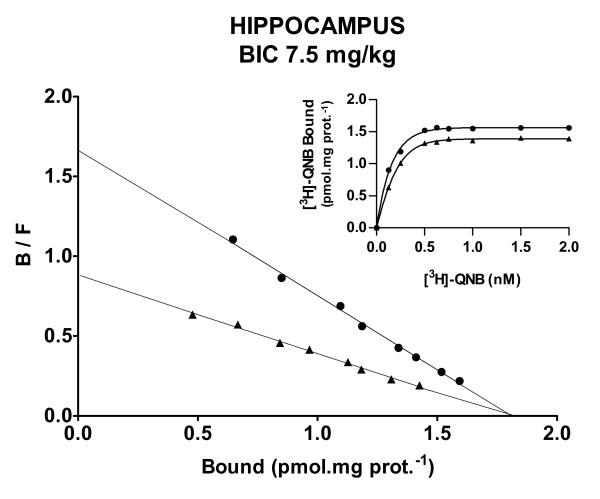
We analyzed binding of muscarinic antagonist [3H]-QNB to rat CNS membranes after i.p. administration of BIC at subconvulsant (1.0 mg/kg) and convulsant (7.5 mg/kg) doses. Subconvulsant BIC dose failed to develop seizures but produced binding alteration in the cerebellum and hippocampus with roughly 40% increase and 10% decrease, respectively. After convulsant BIC dose, which invariably led to generalized tonic-clonic seizures, binding increased 36% and 15% to cerebellar and striatal membranes respectively, but decreased 12% to hippocampal membranes. Kd value was accordingly modified: with the subconvulsant dose it decreased 27% in cerebellum whereas it increased 61% in hippocampus; with the convulsant dose, Kd value decreased 33% in cerebellum but increased 85% in hippocampus. No change in receptor number site was found, and Hill number was invariably close to unity.
CONCLUSION
Results indicate dissimilar central nervous system area susceptibility of muscarinic receptor to BIC. Ligand binding was modified not only by a convulsant BIC dose but also by a subconvulsant dose, indicating that changes are not attributable to the seizure process itself. Findings support the notion that the muscarinic receptors play a major role in experimental epilepsy and provide a new example of differential neuronal plasticity.
背景
本实验室之前的研究表明,惊厥药物3-巯基丙酸(MP)作为一种谷氨酸脱羧酶抑制剂,不仅会改变γ-氨基丁酸(GABA)的合成,还会改变拮抗剂[3H]-喹核醇基苯甲酸酯([3H]-QNB)与中枢毒蕈碱受体的结合,这种效应是由于亲和力增加而结合位点数量未发生改变。胆碱能系统在多种实验性癫痫模型中都有涉及,并且乙酰胆碱调节新皮层神经元兴奋性的能力是众所周知的。为了研究GABA能和胆碱能系统与癫痫发作活动之间的潜在关系,我们在用荷包牡丹碱(BIC)诱导癫痫发作后分析了毒蕈碱受体,已知荷包牡丹碱可拮抗GABA-A突触后受体亚型。
结果
我们在腹腔注射亚惊厥剂量(1.0mg/kg)和惊厥剂量(7.5mg/kg)的BIC后,分析了毒蕈碱拮抗剂[3H]-QNB与大鼠中枢神经系统膜的结合情况。亚惊厥剂量的BIC未能引发癫痫发作,但导致小脑和海马体中的结合发生改变,分别增加了约40%和减少了10%。惊厥剂量的BIC总是会导致全身性强直阵挛性癫痫发作,其与小脑和纹状体膜的结合分别增加了36%和15%,但与海马体膜的结合减少了12%。解离常数(Kd)值相应地发生了改变:亚惊厥剂量时,小脑的Kd值降低了27%,而海马体中的Kd值增加了61%;惊厥剂量时,小脑的Kd值降低了33%,而海马体中的Kd值增加了85%。未发现受体位点数量的变化,且希尔系数始终接近1。
结论
结果表明中枢神经系统不同区域的毒蕈碱受体对BIC的敏感性不同。配体结合不仅受到惊厥剂量BIC的影响,也受到亚惊厥剂量的影响,这表明这些变化并非归因于癫痫发作过程本身。研究结果支持了毒蕈碱受体在实验性癫痫中起主要作用的观点,并提供了一个神经元可塑性差异的新例子。


 Zotero 插件