Johnson Christopher J, Phillips Kristen E, Schramm Peter T, McKenzie Debbie, Aiken Judd M, Pedersen Joel A
Program in Cellular and Molecular Biology, University of Wisconsin Madison, Madison, Wisconsin, United States of America.
PLoS Pathog. 2006 Apr;2(4):e32. doi: 10.1371/journal.ppat.0020032. Epub 2006 Apr 14.
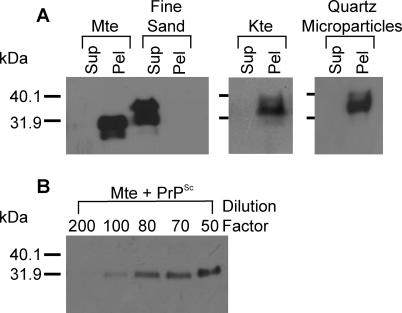
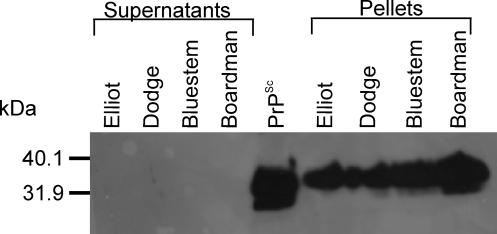
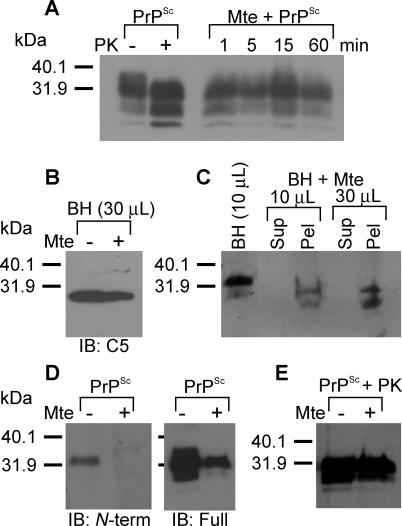
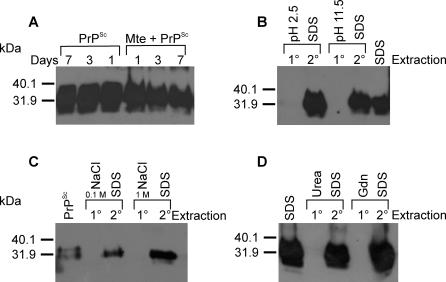
An unidentified environmental reservoir of infectivity contributes to the natural transmission of prion diseases (transmissible spongiform encephalopathies [TSEs]) in sheep, deer, and elk. Prion infectivity may enter soil environments via shedding from diseased animals and decomposition of infected carcasses. Burial of TSE-infected cattle, sheep, and deer as a means of disposal has resulted in unintentional introduction of prions into subsurface environments. We examined the potential for soil to serve as a TSE reservoir by studying the interaction of the disease-associated prion protein (PrP(Sc)) with common soil minerals. In this study, we demonstrated substantial PrP(Sc) adsorption to two clay minerals, quartz, and four whole soil samples. We quantified the PrP(Sc)-binding capacities of each mineral. Furthermore, we observed that PrP(Sc) desorbed from montmorillonite clay was cleaved at an N-terminal site and the interaction between PrP(Sc) and Mte was strong, making desorption of the protein difficult. Despite cleavage and avid binding, PrP(Sc) bound to Mte remained infectious. Results from our study suggest that PrP(Sc) released into soil environments may be preserved in a bioavailable form, perpetuating prion disease epizootics and exposing other species to the infectious agent.
一种未知的传染性环境储存库促成了朊病毒疾病(传染性海绵状脑病[TSEs])在绵羊、鹿和麋鹿中的自然传播。朊病毒传染性可能通过患病动物的排泄物和受感染尸体的分解进入土壤环境。将感染TSE的牛、羊和鹿掩埋作为一种处置方式,已导致朊病毒意外进入地下环境。我们通过研究疾病相关朊病毒蛋白(PrP(Sc))与常见土壤矿物质的相互作用,考察了土壤作为TSE储存库的可能性。在本研究中,我们证明了PrP(Sc)能大量吸附到两种粘土矿物、石英以及四个全土样品上。我们对每种矿物质的PrP(Sc)结合能力进行了定量。此外,我们观察到从蒙脱石粘土上解吸的PrP(Sc)在N端位点被切割,并且PrP(Sc)与蒙脱石(Mte)之间的相互作用很强,使得蛋白质难以解吸。尽管发生了切割和紧密结合,但与蒙脱石结合的PrP(Sc)仍具有传染性。我们的研究结果表明,释放到土壤环境中的PrP(Sc)可能以生物可利用的形式保存下来,使朊病毒疾病在动物中持续流行,并使其他物种接触到感染源。