Fletcher M A, Laufer D S, McIntosh E D G, Cimino C, Malinoski F J
Wyeth Vaccines Research, Paris, France.
Int J Clin Pract. 2006 Apr;60(4):450-6. doi: 10.1111/j.1368-5031.2006.00858.x.
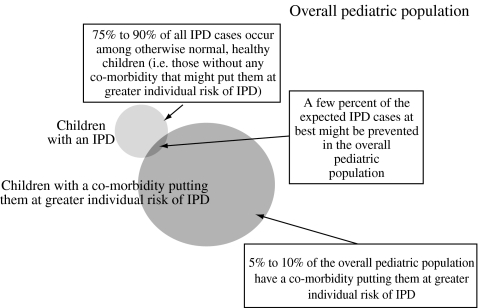
Risk factors for invasive pneumococcal disease (IPD) include young and old age, comorbidities (such as splenic dysfunction, immunodeficiencies, chronic renal disease, chronic heart or lung disease or cerebral spinal fluid leak), crowded environments or poor socioeconomic conditions. Universal use of the 7-valent pneumococcal conjugate (7vPncCRM) vaccine for infants and young children has led to significant decreases in IPD in the vaccinated population (direct protection), and there has also been a decrease in the incidence of IPD among the nonvaccinated population (indirect immunity; herd protection). While 7vPncCRM vaccine is administered universally to children in USA, many countries of the European Union have chosen to target children with comorbidities. This review aims to highlight individual risk factors for IPD, describe studies that evaluated pneumococcal conjugate vaccines in at-risk groups and estimate the proportion of at-risk children who may have been vaccinated in the European Union since the 7vPncCRM vaccine was introduced, using UK as an example. Although immunisation targeting only children with comorbidities may achieve satisfactory results for a few, many otherwise healthy children at risk simply because of their age will be neglected, and herd protection might not be established.
侵袭性肺炎球菌疾病(IPD)的危险因素包括年龄较小和较大者、合并症(如脾功能不全、免疫缺陷、慢性肾病、慢性心或肺疾病或脑脊液漏)、拥挤的环境或社会经济条件差。普遍为婴幼儿接种7价肺炎球菌结合疫苗(7vPncCRM)已使接种人群中的IPD显著减少(直接保护),未接种人群中的IPD发病率也有所下降(间接免疫;群体保护)。在美国,7vPncCRM疫苗普遍用于儿童,但欧盟许多国家选择针对有合并症的儿童。本综述旨在强调IPD的个体危险因素,描述评估高危人群中肺炎球菌结合疫苗的研究,并以英国为例,估计自引入7vPncCRM疫苗以来欧盟可能已接种疫苗的高危儿童比例。虽然仅针对有合并症的儿童进行免疫接种可能对少数人取得满意结果,但许多仅因年龄而处于危险中的健康儿童将被忽视,且可能无法建立群体保护。