Slamovits Claudio H, Keeling Patrick J
Canadian Institute for Advanced Research, Botany Department, University of British Columbia, 3529-6270 University Boulevard, Vancouver, BC, V6T 1Z4, Canada.
BMC Evol Biol. 2006 Apr 25;6:34. doi: 10.1186/1471-2148-6-34.
Certain eukaryotic genomes, such as those of the amitochondriate parasites Giardia and Trichomonas, have very low intron densities, so low that canonical spliceosomal introns have only recently been discovered through genome sequencing. These organisms were formerly thought to be ancient eukaryotes that diverged before introns originated, or at least became common. Now however, they are thought to be members of a supergroup known as excavates, whose members generally appear to have low densities of canonical introns. Here we have used environmental expressed sequence tag (EST) sequencing to identify 17 genes from the uncultivable oxymonad Streblomastix strix, to survey intron densities in this most poorly studied excavate group.
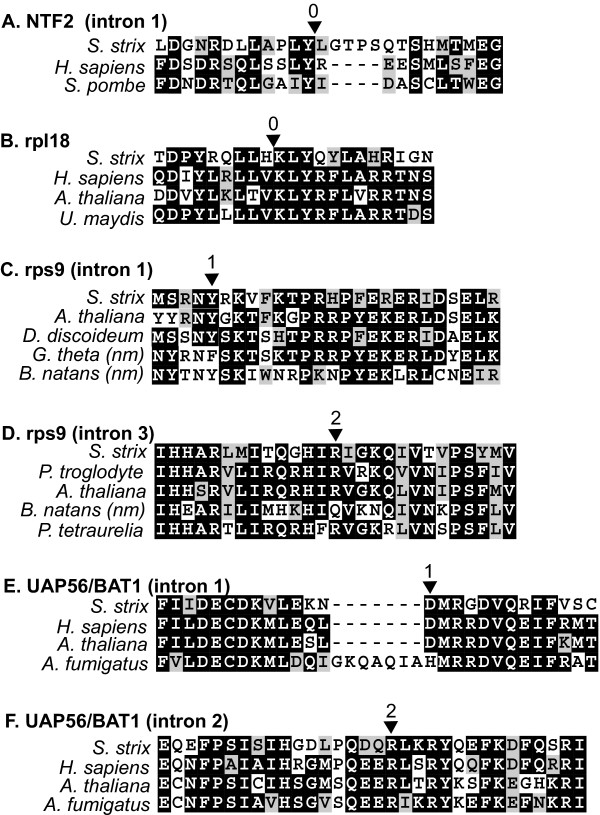
We find that Streblomastix genes contain an unexpectedly high intron density of about 1.1 introns per gene. Moreover, over 50% of these are at positions shared between a broad spectrum of eukaryotes, suggesting they are very ancient introns, potentially present in the last common ancestor of eukaryotes.
The Streblomastix data show that the genome of the ancestor of excavates likely contained many introns and the subsequent evolution of introns has proceeded very differently in different excavate lineages: in Streblomastix there has been much stasis while in Trichomonas and Giardia most introns have been lost.
某些真核生物基因组,如无线粒体寄生虫贾第虫属和毛滴虫属的基因组,内含子密度非常低,低到直到最近才通过基因组测序发现典型的剪接体内含子。这些生物以前被认为是在内含子起源之前就分化出来的古老真核生物,或者至少是在内含子变得普遍之前就分化出来的。然而现在,它们被认为是一个被称为“挖掘类生物”的超群的成员,该超群的成员通常似乎具有较低密度的典型内含子。在这里,我们利用环境表达序列标签(EST)测序从不可培养的尖刺单鞭滴虫中鉴定出17个基因,以调查这个研究最少的挖掘类生物群体中的内含子密度。
我们发现尖刺单鞭滴虫基因的内含子密度出人意料地高,约为每个基因1.1个内含子。此外,其中超过50%的内含子位于广泛的真核生物共有的位置,这表明它们是非常古老的内含子,可能存在于真核生物的最后共同祖先中。
尖刺单鞭滴虫的数据表明,挖掘类生物祖先的基因组可能包含许多内含子,并且内含子在不同的挖掘类生物谱系中的后续进化过程非常不同:在尖刺单鞭滴虫中内含子变化不大,而在毛滴虫属和贾第虫属中大多数内含子已经丢失。