Kemler Martin, Göker Markus, Oberwinkler Franz, Begerow Dominik
Lehrstuhl für Spezielle Botanik und Mykologie, Botanisches Institut, Universität Tübingen, Auf der Morgenstelle 1, D-72076 Tübingen, Germany.
BMC Evol Biol. 2006 Apr 25;6:35. doi: 10.1186/1471-2148-6-35.
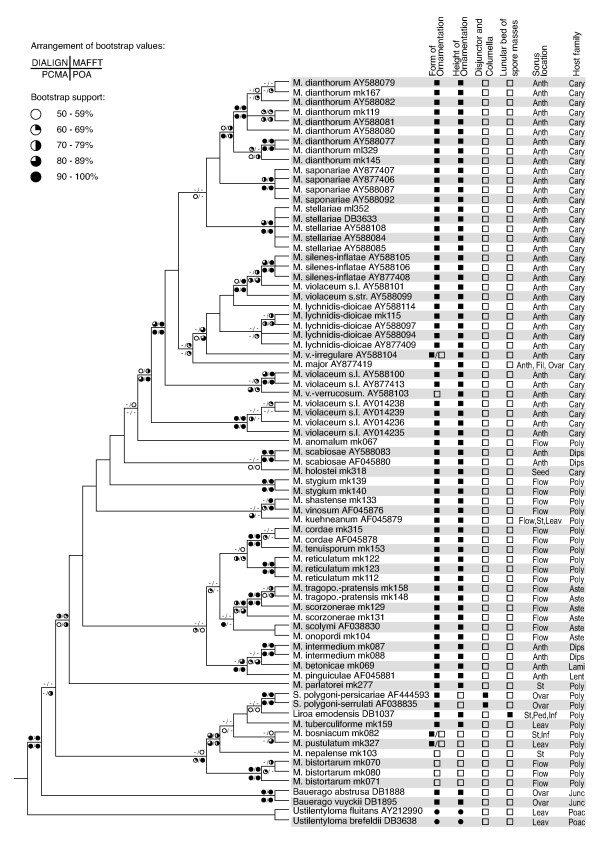
Anther smuts of the basidiomycetous genus Microbotryum on Caryophyllaceae are important model organisms for many biological disciplines. Members of Microbotryum are most commonly found parasitizing the anthers of host plants in the family Caryophyllaceae, however they can also be found on the anthers of members of the Dipsacaceae, Lamiaceae, Lentibulariaceae, and Portulacaceae. Additionally, some members of Microbotryum can be found infecting other organs of mainly Polygonaceae hosts. Based on ITS nrDNA sequences of members of almost all genera in Microbotryaceae, this study aims to resolve the phylogeny of the anther smuts and their relationship to the other members of the family of plant parasites. A multiple analysis strategy was used to correct for the effects of different equally possible ITS sequence alignments on the phylogenetic outcome, which appears to have been neglected in previous studies.
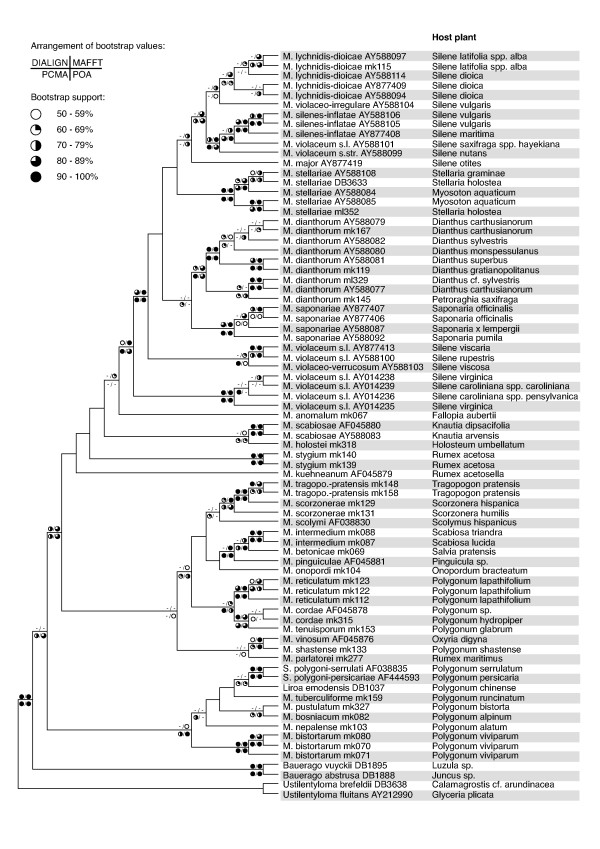
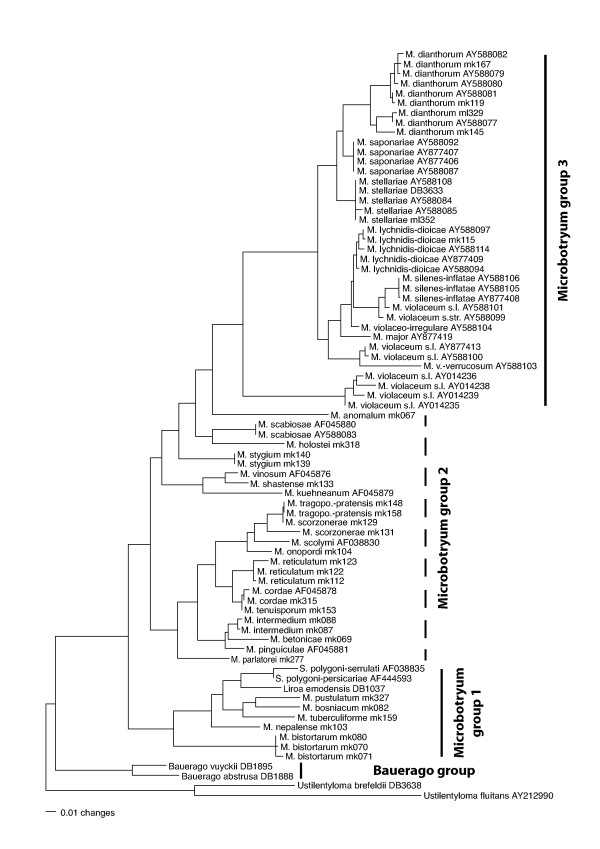
The genera of Microbotryaceae were not clearly resolved, but alignment-independent moderate bootstrap support was achieved for a clade containing the majority of the Microbotryum species. The anther parasites appeared in two different well-supported lineages whose interrelationship remained unresolved. Whereas bootstrap support values for some clades were highly vulnerable to alignment conditions, other clades were more robustly supported. The differences in support between the different alignments were much larger than between the phylogenetic optimality criteria applied (maximum parsimony and maximum likelihood).
The study confirmed, based on a larger dataset than previous work, that the anther smuts on Caryophyllaceae are monophyletic and that there exists a native North American group that diverged from the European clade before the radiation of the European species. Also a second group of anther smuts was revealed, containing parasites on Dipsacaceae, Lamiaceae, and Lentibulariaceae. At least the majority of the parasites of Asteraceae appeared as a monophylum, but delimitations of some species in this group should be reconsidered. Parasitism on Polygonaceae is likely to be the ancestral state for the Microbotryaceae on Eudicot hosts.
担子菌纲微黑粉菌属寄生于石竹科植物花药上的真菌是许多生物学学科的重要模式生物。微黑粉菌属成员最常见于寄生于石竹科宿主植物的花药上,但也可在川续断科、唇形科、狸藻科和马齿苋科植物的花药上发现。此外,一些微黑粉菌属成员可感染主要为蓼科宿主的其他器官。基于微黑粉菌科几乎所有属成员的ITS nrDNA序列,本研究旨在解析花药黑粉菌的系统发育及其与植物寄生菌科其他成员的关系。采用了多重分析策略来校正不同等可能的ITS序列比对对系统发育结果的影响,而这在以往研究中似乎被忽视了。
微黑粉菌科各属未得到明确解析,但对包含大多数微黑粉菌物种的一个分支获得了与比对无关的适度自展支持。花药寄生菌出现在两个得到充分支持的不同谱系中,它们之间的相互关系仍未解决。虽然某些分支的自展支持值极易受到比对条件的影响,但其他分支得到了更强有力的支持。不同比对之间支持度的差异远大于所应用的系统发育最优标准(最大简约法和最大似然法)之间的差异。
基于比以往研究更大的数据集,该研究证实,石竹科植物上的花药黑粉菌是单系的,并且存在一个北美本土类群,它在欧洲物种辐射之前就与欧洲分支分化了。还揭示了另一组花药黑粉菌,其中包括寄生于川续断科、唇形科和狸藻科植物的寄生菌。至少菊科的大多数寄生菌表现为一个单系类群,但该类群中一些物种的界定应重新考虑。蓼科植物上的寄生现象可能是真双子叶植物宿主上微黑粉菌科的祖先状态。