Kay Kathleen M, Whittall Justen B, Hodges Scott A
Department of Plant Biology, Michigan State University, 166 Plant Biology Building, East Lansing, MI 48824, USA.
BMC Evol Biol. 2006 Apr 25;6:36. doi: 10.1186/1471-2148-6-36.
A full understanding of the patterns and processes of biological diversification requires the dating of evolutionary events, yet the fossil record is inadequate for most lineages under study. Alternatively, a molecular clock approach, in which DNA or amino acid substitution rates are calibrated with fossils or geological/climatic events, can provide indirect estimates of clade ages and diversification rates. The utility of this approach depends on the rate constancy of molecular evolution at a genetic locus across time and across lineages. Although the nuclear ribosomal internal transcribed spacer region (nrITS) is increasingly being used to infer clade ages in plants, little is known about the sources or magnitude of variation in its substitution rate. Here, we systematically review the literature to assess substitution rate variation in nrITS among angiosperms, and we evaluate possible correlates of the variation.
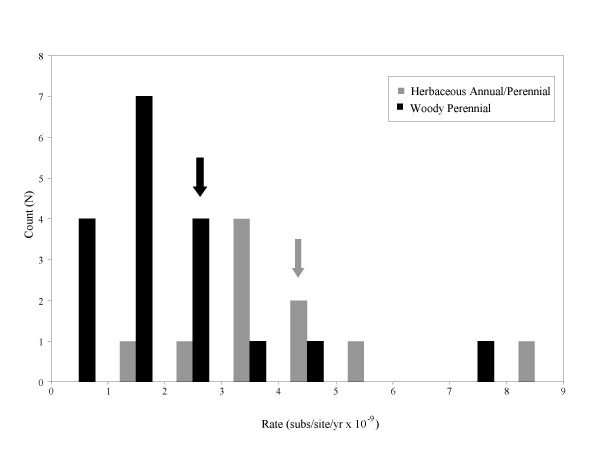
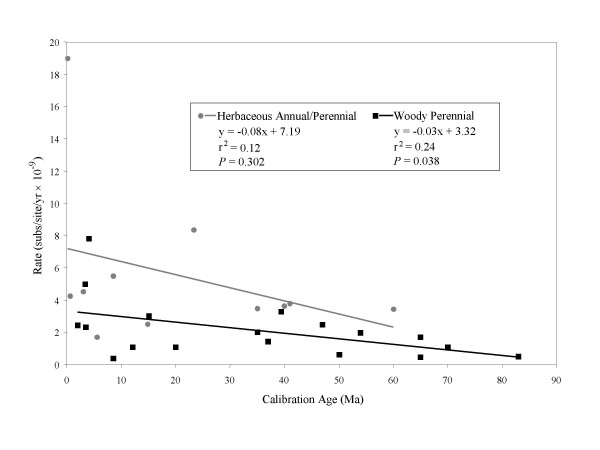
We summarize 28 independently calibrated nrITS substitution rates ranging from 0.38 x 10(-9) to 8.34 x 10(-9) substitutions/site/yr. We find that herbaceous lineages have substitution rates almost twice as high as woody plants, on average. We do not find any among-lineage phylogenetic constraint to the rates, or any effect of the type of calibration used. Within life history categories, both the magnitude of the rates and the variance among rates tend to decrease with calibration age.
Angiosperm nrITS substitution rates vary by approximately an order of magnitude, and some of this variation can be attributed to life history categories. We make cautious recommendations for the use of nrITS as an approximate plant molecular clock, including an outline of more appropriate phylogenetic methodology and caveats against over interpretation of results. We also suggest that for lineages with independent calibrations, much of the variation in nrITS substitution rates may come from uncertainty in calibration date estimates, highlighting the importance of accurate and/or multiple calibration dates.
全面理解生物多样性的模式和过程需要确定进化事件的年代,但对于大多数正在研究的谱系而言,化石记录并不完整。另一种方法是分子钟方法,即通过化石或地质/气候事件校准DNA或氨基酸替换率,从而间接估计进化枝的年龄和多样化速率。这种方法的效用取决于遗传位点上分子进化速率随时间和谱系的恒定性。尽管核糖体DNA内转录间隔区(nrITS)越来越多地被用于推断植物进化枝的年龄,但其替换率变化的来源或幅度却鲜为人知。在此,我们系统地回顾了文献,以评估被子植物中nrITS的替换率变化,并评估这种变化可能的相关因素。
我们总结了28个独立校准的nrITS替换率,范围从0.38×10⁻⁹到8.34×10⁻⁹替换/位点/年。我们发现,草本谱系的替换率平均几乎是木本植物的两倍。我们没有发现谱系间对这些速率存在系统发育限制,也没有发现所用校准类型有任何影响。在生活史类别中,速率的幅度和速率间的方差都倾向于随着校准年龄的增加而减小。
被子植物nrITS替换率的变化幅度约为一个数量级,其中一些变化可归因于生活史类别。我们对将nrITS用作近似植物分子钟提出了谨慎建议,包括更合适的系统发育方法概述以及避免对结果过度解读的注意事项。我们还表明,对于具有独立校准的谱系,nrITS替换率的许多变化可能来自校准日期估计的不确定性,这凸显了准确和/或多个校准日期的重要性。