Lewis L N, Bakhshi J C
University of California, Riverside, California.
Plant Physiol. 1968 Mar;43(3):351-8. doi: 10.1104/pp.43.3.351.
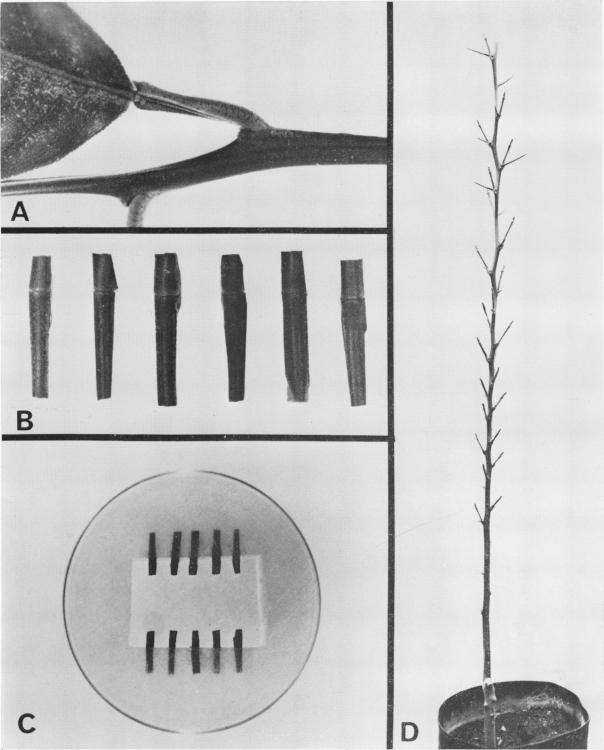
Debladed midribs of citrus leaves showed the typical delay of abscission in response to indoleacetic acid (IAA), and the typical acceleration of abscission in response to gibberellic acid (GA). Interaction experiments with these 2 hormones indicated that the balance of the 2 hormones may be more important in regulating abscission than the quantity of either. The often reported acceleration of abscission with low quantities of IAA did not seem to exist in citrus. IAA did accelerate abscission in this tissue when its application was delayed for at least 24 hours after deblading, which suggests the 2-stage effect is also present in citrus.When abscission was first delayed with IAA and then allowed to continue, the rate of abscission proceeded at a slower rate than was typical for this tissue. This slower rate was also typical of the effect observed when GA overcame the abscission retarding effect of IAA. The phenylurethane, Barban, blocked the GA acceleration of abscission, but it did not affect the rate of abscission of control or IAA treated midribs.
去除叶片中脉的柑橘叶片表现出对吲哚乙酸(IAA)的典型脱落延迟反应,以及对赤霉素(GA)的典型脱落加速反应。这两种激素的相互作用实验表明,在调节脱落过程中,两种激素的平衡可能比任何一种激素的量更为重要。经常报道的低量IAA加速脱落的现象在柑橘中似乎不存在。当在去除叶片后至少延迟24小时施用IAA时,IAA确实会加速该组织的脱落,这表明柑橘中也存在两阶段效应。当先用IAA延迟脱落,然后任其继续时,脱落速率比该组织的典型速率要慢。这种较慢的速率也是GA克服IAA的脱落延迟效应时所观察到的典型效应。苯基脲类除草剂燕麦灵能阻止GA对脱落的加速作用,但不影响对照或IAA处理的中脉的脱落速率。