Cammarata K V, Cheniae G M
University of Kentucky, Lexington, Kentucky 40546.
Plant Physiol. 1987 Jul;84(3):587-95. doi: 10.1104/pp.84.3.587.
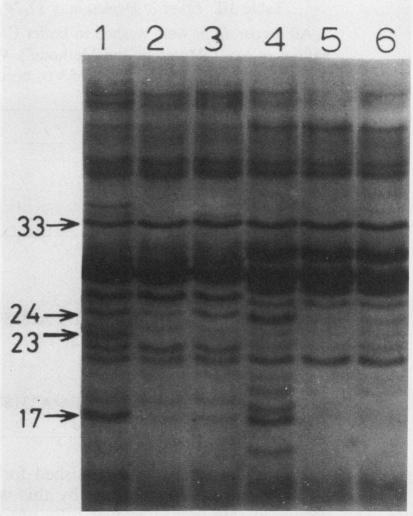
Analyses were made of the effects of extraction of the 17,24 kilodalton extrinsic proteins from spinach versus wheat photosystem II (PSII) membranes on Ca abundance and O(2) evolution capacity determined in the absence and presence of either Cl(-) or Ca(2+). Extraction of these proteins from spinach PSII routinely diminished steady state O(2) evolution by about 70% when assayed in the presence of sufficient Cl(-). Additionally, O(2) evolution of 17,24 kilodalton-less spinach PSII membranes showed about 2-fold more enhancement by Ca(2+) than by Cl(-) during assay. When the same extraction and assay procedures were applied to wheat PSII membranes, we observed, in contrast to 17,24 kilodalton-less spinach PSII, only about 50% inhibition of O(2) evolution and about 2-fold greater enhancement by Cl(-) than by Ca(2+). Irrespective of differences in the magnitude of enhancement of O(2) evolution by Ca(2+)versus Cl(-) in spinach versus wheat, the K(m) values for Cl(-) (about 1.7 millimolar) and Ca(2+) (about 1.5 millimolar) were similar for both type preparations. The abundance of Ca specifically associated with fully functional PSII (about 2 and about 3 Ca/200 chlorophyll for spinach and wheat, respectively) was diminished to about 1 per 200 chlorophyll upon 17.24 kilodalton protein depletion. Further treatment of wheat 17,24 kilodalton-less PSII in darkness with 2 molar NaCl/1 millimolar ethyleneglycol-bis(beta-aminoethyl ether)-N,N'-tetraacetic acid/20 micromolar A23187(2) made O(2) evolution highly dependent on Ca(2+) addition, much like the 17,24 kilodalton-less spinach PSII. Analyses of this Ca(2+) effect on O(2) evolution revealed both high (K(m) about 65 micromolar) and low (K(m) about 1.5 millimolar) affinity Ca(2+) sites in wheat 17,24 kilodalton-less PSII. The results suggest that during 17,24 kilodalton extraction by NaCl, spinach PSII is more susceptible than wheat PSII to loss of high affinity Ca and irreversible inhibition of O(2) evolution.
分析了从菠菜和小麦光系统II(PSII)膜中提取17、24千道尔顿外在蛋白对在有无Cl⁻或Ca²⁺存在下测定的Ca丰度和O₂释放能力的影响。当在足够的Cl⁻存在下进行测定时,从菠菜PSII中提取这些蛋白通常会使稳态O₂释放减少约70%。此外,在测定过程中,不含17、24千道尔顿蛋白的菠菜PSII膜的O₂释放受Ca²⁺增强的程度比受Cl⁻增强的程度高约2倍。当将相同的提取和测定程序应用于小麦PSII膜时,与不含17、24千道尔顿蛋白的菠菜PSII相反,我们观察到O₂释放仅受到约50%的抑制,且受Cl⁻增强的程度比受Ca²⁺增强的程度大2倍左右。无论菠菜和小麦中Ca²⁺与Cl⁻对O₂释放增强程度的差异如何,两种类型制剂中Cl⁻(约1.7毫摩尔)和Ca²⁺(约1.5毫摩尔)的米氏常数(Kₘ)值相似。与完全功能性PSII特异性结合的Ca丰度(菠菜和小麦分别约为每200个叶绿素2个和3个Ca)在17、24千道尔顿蛋白缺失后降至每200个叶绿素约1个。用2摩尔NaCl/1毫摩尔乙二醇双(β - 氨基乙基醚)-N,N'-四乙酸/20微摩尔A23187(2)在黑暗中对不含17、24千道尔顿蛋白的小麦PSII进行进一步处理,使O₂释放高度依赖于Ca²⁺的添加,这与不含17、24千道尔顿蛋白的菠菜PSII非常相似。对这种Ca²⁺对O₂释放的影响进行分析发现,不含17、24千道尔顿蛋白的小麦PSII中存在高亲和力(Kₘ约65微摩尔)和低亲和力(Kₘ约1.5毫摩尔)的Ca²⁺位点。结果表明,在通过NaCl提取17、24千道尔顿蛋白的过程中,菠菜PSII比小麦PSII更容易失去高亲和力Ca并受到O₂释放的不可逆抑制。