Department of Botany, University of Wisconsin, Madison, Wisconsin 53706.
Plant Physiol. 1987 Nov;85(3):780-5. doi: 10.1104/pp.85.3.780.
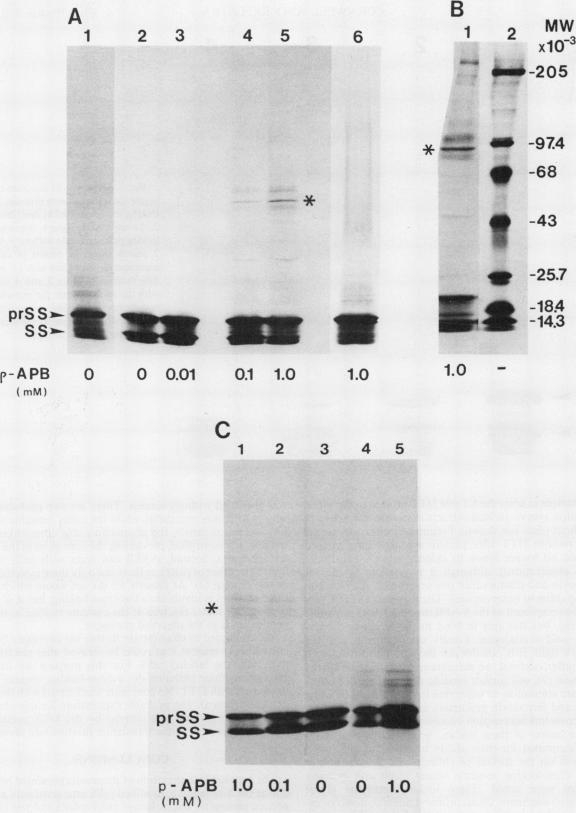
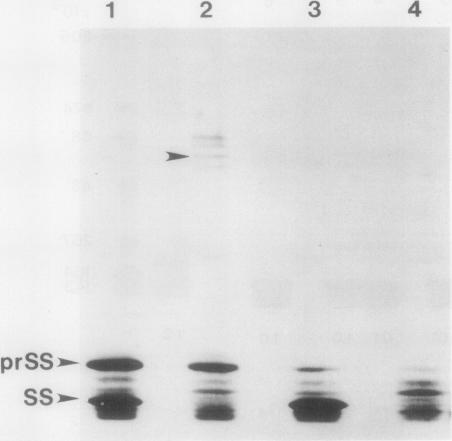
Most chloroplast proteins are encoded by nuclear genes and synthesized in the cytoplasm as higher molecular weight precursors. These precursors are imported posttranslationally into the chloroplasts, where they are proteolytically processed, and sorted to their proper locations. The first step of this import process is thought to be the binding of precursors to putative receptors on the outer envelope membrane of chloroplasts. We have investigated the interaction of the precursor to the small subunit of ribulose-1,5-bisphosphate carboxylase with its putative receptor by using a heterobifunctional, photoactivatable cross-linker. The resulting cross-linked conjugate has a molecular weight of 86,000, and is present on the surface of chloroplasts as determined by its sensitivity to digestion with protease. Control experiments demonstrated that the label in the conjugate is derived from small subunit precursor and that the conjugate is formed only when modified precursor is reacted in the presence of chloroplasts. Based on these results, we postulate that a protein on the surface of chloroplasts is part of the receptor which interacts with the small subunit precursor.
大多数叶绿体蛋白由核基因编码,并在细胞质中作为高分子量前体合成。这些前体被翻译后导入叶绿体,在那里进行蛋白水解加工,并分拣到适当的位置。这个导入过程的第一步被认为是前体与叶绿体外膜上假定的受体结合。我们使用一种异双功能光活化交联剂研究了核酮糖-1,5-二磷酸羧化酶小亚基前体与其假定受体的相互作用。所得交联缀合物的分子量为 86,000,并且如通过用蛋白酶消化的敏感性所确定的,存在于叶绿体的表面上。对照实验表明,缀合物中的标记物来自于小亚基前体,并且仅当在存在叶绿体的情况下反应修饰的前体时才形成缀合物。基于这些结果,我们推测叶绿体表面的一种蛋白质是与小亚基前体相互作用的受体的一部分。