Tsai Chung-Jung, Zheng Jie, Nussinov Ruth
Basic Research Program, SAIC-Frederick, Inc., Center for Cancer Research, Nanobiology Program, National Cancer Institute-Frederick, Frederick, Maryland, United States of America.
PLoS Comput Biol. 2006 Apr;2(4):e42. doi: 10.1371/journal.pcbi.0020042. Epub 2006 Apr 28.
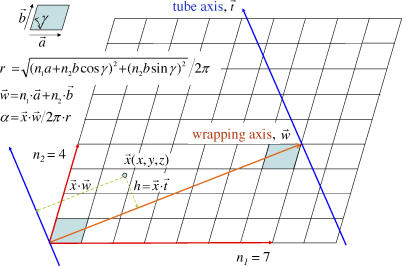
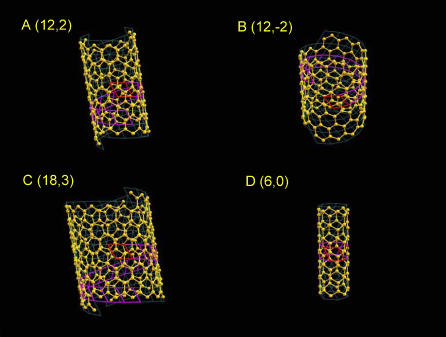
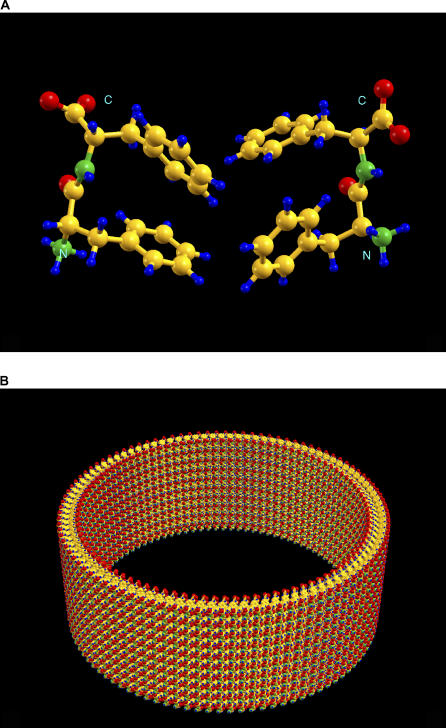
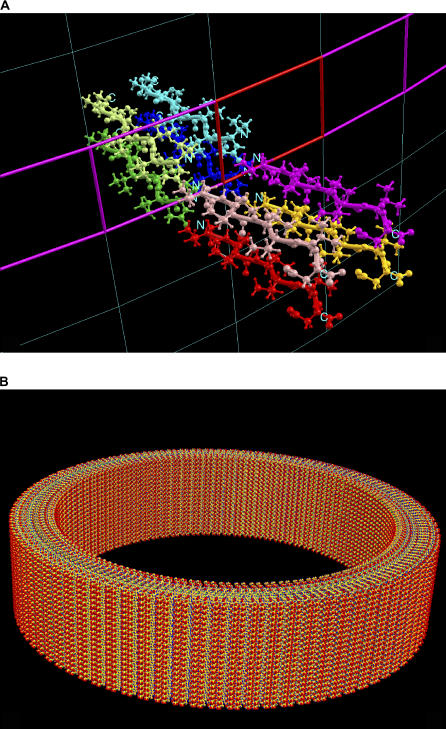
Here our goal is to carry out nanotube design using naturally occurring protein building blocks. Inspection of the protein structural database reveals the richness of the conformations of proteins, their parts, and their chemistry. Given target functional protein nanotube geometry, our strategy involves scanning a library of candidate building blocks, combinatorially assembling them into the shape and testing its stability. Since self-assembly takes place on time scales not affordable for computations, here we propose a strategy for the very first step in protein nanotube design: we map the candidate building blocks onto a planar sheet and wrap the sheet around a cylinder with the target dimensions. We provide examples of three nanotubes, two peptide and one protein, in atomistic model detail for which there are experimental data. The nanotube models can be used to verify a nanostructure observed by low-resolution experiments, and to study the mechanism of tube formation.
我们的目标是利用天然存在的蛋白质构建模块进行纳米管设计。对蛋白质结构数据库的检查揭示了蛋白质及其部分的构象丰富性以及它们的化学性质。给定目标功能性蛋白质纳米管的几何形状,我们的策略包括扫描候选构建模块库,将它们组合组装成所需形状并测试其稳定性。由于自组装发生的时间尺度对于计算来说是不可承受的,因此我们在此提出蛋白质纳米管设计第一步的策略:我们将候选构建模块映射到一个平面薄片上,并将该薄片围绕具有目标尺寸的圆柱体包裹起来。我们提供了三个纳米管的原子模型细节示例,其中两个是肽纳米管,一个是蛋白质纳米管,并且有相关实验数据。这些纳米管模型可用于验证通过低分辨率实验观察到的纳米结构,并研究管形成的机制。