García-Sanmartín Josune, Nagore Daniel, García-Pérez Ana L, Juste Ramón A, Hurtado Ana
Department of Animal Health, NEIKER--Instituto Vasco de Investigación y Desarrollo Agrario, Berreaga 1, 48160 Derio, Bizkaia, Spain.
BMC Vet Res. 2006 May 9;2:16. doi: 10.1186/1746-6148-2-16.
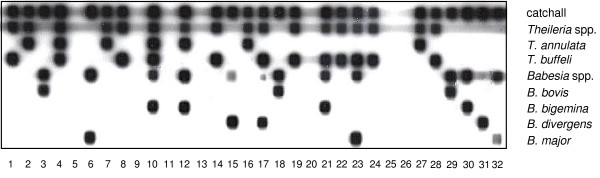
Piroplasmosis in cattle is caused by tick-borne haemoprotozoan parasites of the genera Theileria and Babesia. Molecular detection techniques offer higher sensitivity and specificity than microscopy examination methods and serological tests. A reverse line blot (RLB) macroarray that included generic and species-specific probes for Theileria annulata, Theileria buffeli, Babesia bovis, Babesia bigemina, Babesia divergens and Babesia major was used to study the presence and identity of the piroplasm species infecting 263 bovine blood samples from 79 farms, most of them in Northern Spain. Microscopy examination of blood smears and haematology were also performed whenever possible to identify animals with parasitaemia.
RLB hybridisation identified infection in 54.0% of the samples, whereas only 28.8% were positive by microscopy examination. The most frequently found species was T. buffeli, present in 42.6% of the samples. T. annulata was found in 22 samples (8.4%) from 12 farms, including 9 farms (14 samples) located in Northern Spain where presence of the vector is not very common. Babesia infections were less frequently detected: B. major was found in 3.0% of the samples, B. bigemina in 2.7%, B. bovis in 2.3% and B. divergens in 1.1%. Mixed infections were detected in 14 samples, accounting for six different combinations of species.
This is the first report in which B. major and B. divergens have been detected in Spain using molecular identification techniques and the first time that B. bovis has been detected in Northern Spain. The detection of T. annulata in Northern Spain suggests that the distribution of Mediterranean theileriosis might be changing. Samples with positive RLB hybridisation but negative microscopy had haematology values within the normal ranges suggesting that they corresponded to chronic carriers that may serve as reservoirs of the infection. In this sense, sensitive and specific laboratorial tests like RLB that clearly identify the parasite and can detect subclinical infections are essential to establish good control measures.
牛梨形虫病由泰勒虫属和巴贝斯虫属的蜱传播血原虫寄生虫引起。分子检测技术比显微镜检查方法和血清学检测具有更高的灵敏度和特异性。一种反向线印迹(RLB)宏阵列,包含环形泰勒虫、水牛泰勒虫、牛巴贝斯虫、双芽巴贝斯虫、分歧巴贝斯虫和大型巴贝斯虫的通用和种特异性探针,用于研究感染来自79个农场的263份牛血样的梨形虫种类的存在情况和鉴定,其中大部分农场位于西班牙北部。只要有可能,还对血涂片进行显微镜检查和血液学检查,以识别有寄生虫血症的动物。
RLB杂交在54.0%的样本中检测到感染,而显微镜检查仅28.8%呈阳性。最常发现的种类是水牛泰勒虫,存在于42.6%的样本中。在来自12个农场的22个样本(8.4%)中发现了环形泰勒虫,其中包括位于西班牙北部的9个农场(14个样本),而该地区媒介的存在并不常见。巴贝斯虫感染的检测频率较低:大型巴贝斯虫在3.0%的样本中被发现,双芽巴贝斯虫在2.7%,牛巴贝斯虫在2.3%,分歧巴贝斯虫在1.1%。在14个样本中检测到混合感染,占六种不同的种类组合。
这是首次使用分子鉴定技术在西班牙检测到大型巴贝斯虫和分歧巴贝斯虫,也是首次在西班牙北部检测到牛巴贝斯虫。在西班牙北部检测到环形泰勒虫表明地中海泰勒虫病的分布可能正在发生变化。RLB杂交呈阳性但显微镜检查呈阴性的样本,其血液学值在正常范围内,表明它们对应于可能作为感染储存宿主的慢性携带者。从这个意义上说,像RLB这样能够清晰识别寄生虫并能检测亚临床感染的灵敏且特异的实验室检测对于建立良好的控制措施至关重要。