Buzdin Anton, Kovalskaya-Alexandrova Elena, Gogvadze Elena, Sverdlov Eugene
Shemyakin-Ovchinnikov Institute of Bioorganic Chemistry, 16/10 Miklukho-Maklaya, Moscow 117997, Russia.
Nucleic Acids Res. 2006 May 12;34(9):e67. doi: 10.1093/nar/gkl335.
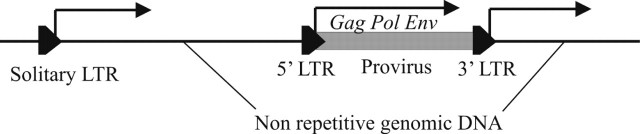
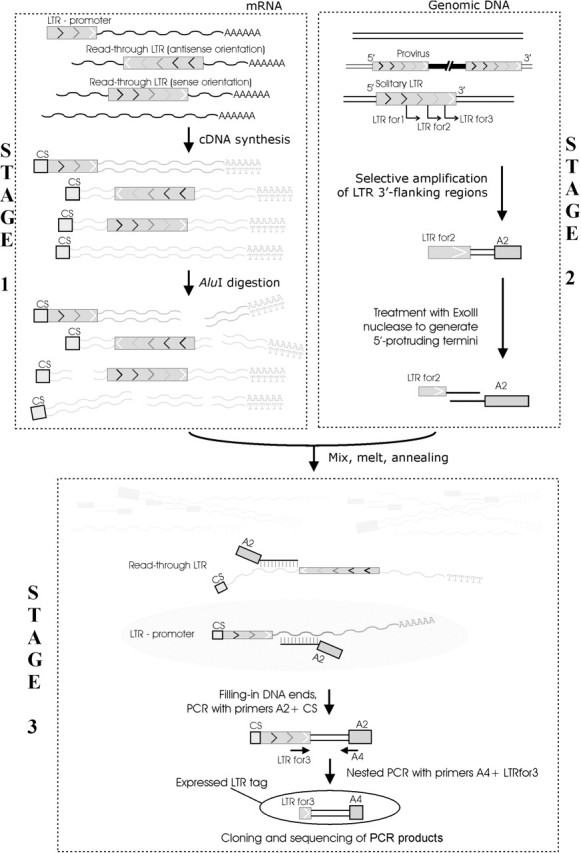
We developed a technique called GREM (Genomic Repeat Expression Monitor) that can be applied to genome-wide isolation and quantitative analysis of any kind of transcriptionally active repetitive elements. Briefly, the technique includes three major stages: (i) generation of a transcriptome wide library of cDNA 5' terminal fragments, (ii) selective amplification of repeat-flanking genomic loci and (iii) hybridization of the cDNA library (i) to the amplicon (ii) with subsequent selective amplification and cloning of the cDNA-genome hybrids. The sequences obtained serve as 'tags' for promoter active repetitive elements. The advantage of GREM is an unambiguous mapping of individual promoter active repeats at a genome-wide level. We applied GREM for genome-wide experimental identification of human-specific endogenous retroviruses and their solitary long terminal repeats (LTRs) acting in vivo as promoters. Importantly, GREM tag frequencies linearly correlated with the corresponding LTR-driven transcript levels found using RT-PCR. The GREM technique enabled us to identify 54 new functional human promoters created by retroviral LTRs.
我们开发了一种名为GREM(基因组重复序列表达监测器)的技术,该技术可用于全基因组范围内对任何类型转录活性重复元件的分离和定量分析。简而言之,该技术包括三个主要阶段:(i)生成一个转录组范围的cDNA 5'末端片段文库,(ii)重复序列侧翼基因组位点的选择性扩增,以及(iii)将cDNA文库(i)与扩增子(ii)杂交,随后对cDNA-基因组杂交体进行选择性扩增和克隆。获得的序列作为启动子活性重复元件的“标签”。GREM的优点是能够在全基因组水平上明确地定位单个启动子活性重复序列。我们应用GREM对人类特异性内源性逆转录病毒及其在体内作为启动子起作用的单独长末端重复序列(LTR)进行全基因组实验鉴定。重要的是,GREM标签频率与使用RT-PCR发现的相应LTR驱动的转录水平呈线性相关。GREM技术使我们能够鉴定出54个由逆转录病毒LTR产生的新的功能性人类启动子。