Glenn Songer J, Miskimins Dale W
Department of Veterinary Science and Microbiology, The University of Arizona, Tucson, AZ 85721, USA.
Anaerobe. 2005 Oct;11(5):290-4. doi: 10.1016/j.anaerobe.2004.12.004. Epub 2005 Apr 25.
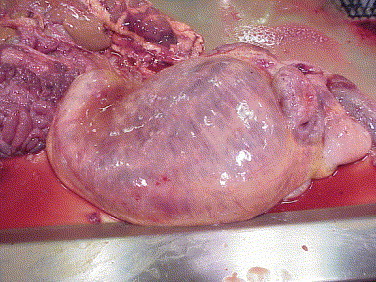
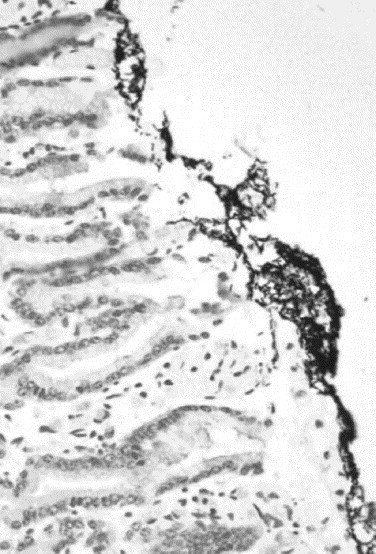
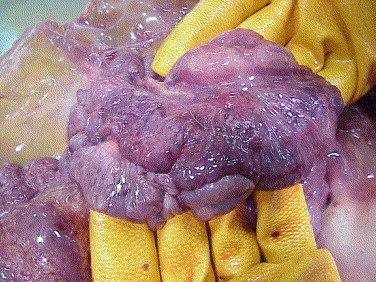
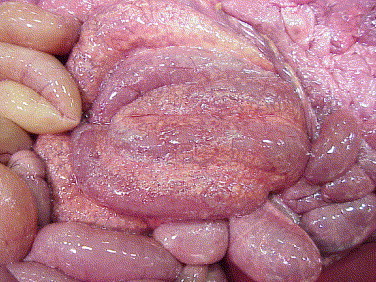
Infections by Clostridium perfringens type A are perhaps the most common causes of clostridial hemorrhagic enteritis in neonatal ruminants. Affected calves exhibit tympany, hemorrhagic abomasitis, and abomasal ulceration. Gram-positive bacilli are often found on affected mucosa and in submucosa. Aspects of etiology beyond the infecting organism are little understood, but probably include dietary issues, perhaps relating to overfeeding, feeding of barely thawed or contaminated colostrum, or conditions which effect decreased gut motility. Fatal hemorrhagic enteritis in a cloned gaur calf is illustrative of the syndrome. The calf developed pasty yellow and bloody diarrhea, and the abdomen became distended and painful. In spite of intensive therapy, the calf died approximately 48 h after birth. At necropsy, the distended abomasum contained clotted milk and bloody fluid, and the abomasal and omasal walls were thickened and hemorrhagic. The proximal duodenum was hemorrhagic and emphysematous, and microscopic examination revealed Gram-positive rods in association with acute, necrotizing, hemorrhagic mucosal inflammation. Isolates of C. perfringens from this calf were PCR positive for cpb2, the gene encoding beta2 toxin. This finding is of unknown significance; only 14.3% (8/56) of isolates from other calves with the syndrome have been cpb2 positive, and only 50% of cpb2 positive bovine isolates express CPB2. The most prominent needs to further our understanding of this problem are consistent experimental reproduction of the disease, elucidation of virulence attributes, and development and application of prevention and control strategies.
A型产气荚膜梭菌感染可能是新生反刍动物梭菌性出血性肠炎最常见的病因。患病犊牛表现出鼓胀、出血性皱胃炎和皱胃溃疡。在患病的黏膜和黏膜下层常发现革兰氏阳性杆菌。除感染病原体之外的病因方面了解甚少,但可能包括饮食问题,或许与过度喂养、喂食刚解冻或受污染的初乳,或影响肠道蠕动减弱的状况有关。一头克隆印度野牛犊牛发生的致命性出血性肠炎就是该综合征的例证。这头犊牛出现糊状黄色和血性腹泻,腹部膨胀且疼痛。尽管进行了强化治疗,犊牛仍在出生后约48小时死亡。尸检时,膨胀的皱胃内含有凝乳和血性液体,皱胃和网胃壁增厚且出血。十二指肠近端出血且气肿,显微镜检查显示革兰氏阳性杆菌与急性、坏死性、出血性黏膜炎症相关。从这头犊牛分离出的产气荚膜梭菌菌株cpb2基因(编码β2毒素的基因)的PCR检测呈阳性。这一发现的意义尚不清楚;患有该综合征的其他犊牛分离株中只有14.3%(8/56)的cpb2呈阳性,且cpb2阳性的牛分离株中只有50%表达CPB2。为进一步了解这个问题,最迫切需要的是对该疾病进行一致的实验性再现、阐明毒力特性以及制定和应用预防与控制策略。