Viboud Cécile, Tam Theresa, Fleming Douglas, Miller Mark A, Simonsen Lone
National Institutes of Health, Fogarty International Center, Bethesda, Maryland 20892, USA.
Emerg Infect Dis. 2006 Apr;12(4):661-8. doi: 10.3201/eid1204.050695.
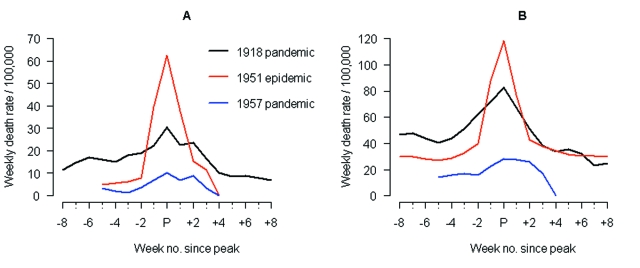
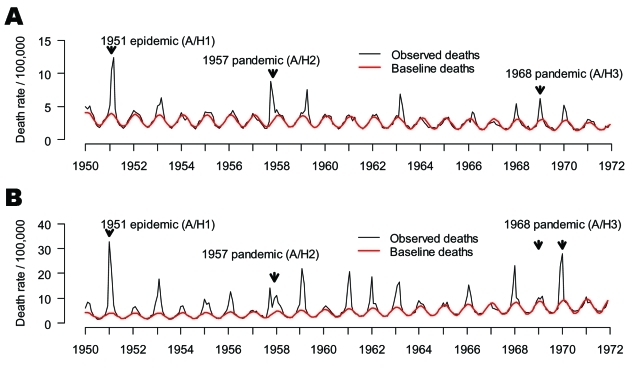
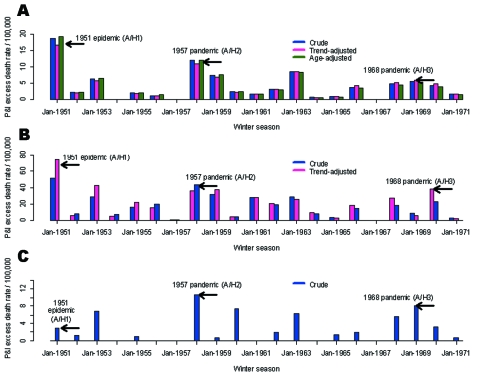
Influenza poses a continuing public health threat in epidemic and pandemic seasons. The 1951 influenza epidemic (A/H1N1) caused an unusually high death toll in England; in particular, weekly deaths in Liverpool even surpassed those of the 1918 pandemic. We further quantified the death rate of the 1951 epidemic in 3 countries. In England and Canada, we found that excess death rates from pneumonia and influenza and all causes were substantially higher for the 1951 epidemic than for the 1957 and 1968 pandemics (by > or =50%). The age-specific pattern of deaths in 1951 was consistent with that of other interpandemic seasons; no age shift to younger age groups, reminiscent of pandemics, occurred in the death rate. In contrast to England and Canada, the 1951 epidemic was not particularly severe in the United States. Why this epidemic was so severe in some areas but not others remains unknown and highlights major gaps in our understanding of interpandemic influenza.
在流感流行季和大流行季,流感持续对公众健康构成威胁。1951年的流感疫情(A/H1N1)在英国造成了异常高的死亡人数;特别是利物浦的每周死亡人数甚至超过了1918年大流行时期。我们进一步量化了1951年疫情在3个国家的死亡率。在英国和加拿大,我们发现1951年疫情中肺炎和流感以及所有原因导致的超额死亡率比1957年和1968年大流行时期大幅更高(高出50%或更多)。1951年特定年龄的死亡模式与其他大流行间期季节一致;死亡率未出现向更年轻年龄组转移的情况,而这是大流行的特征。与英国和加拿大不同,1951年的疫情在美国并不特别严重。为何此次疫情在一些地区严重而在其他地区并非如此,仍然未知,这凸显了我们对大流行间期流感理解上的重大差距。