De Angelis Paula M, Svendsrud Debbie H, Kravik Katherine L, Stokke Trond
Institute of Pathology, Section for Molecular Chemoresistance, Rikshospitalet-Radiumhospitalet HF, Oslo, Norway.
Mol Cancer. 2006 May 18;5:20. doi: 10.1186/1476-4598-5-20.
Treatment of cells with the anti-cancer drug 5-fluorouracil (5-FU) causes DNA damage, which in turn affects cell proliferation and survival. Two stable wild-type TP53 5-FU-resistant cell lines, ContinB and ContinD, generated from the HCT116 colon cancer cell line, demonstrate moderate and strong resistance to 5-FU, respectively, markedly-reduced levels of 5-FU-induced apoptosis, and alterations in expression levels of a number of key cell cycle- and apoptosis-regulatory genes as a result of resistance development. The aim of the present study was to determine potential differential responses to 8 and 24-hour 5-FU treatment in these resistant cell lines. We assessed levels of 5-FU uptake into DNA, cell cycle effects and apoptosis induction throughout treatment and recovery periods for each cell line, and alterations in expression levels of DNA damage response-, cell cycle- and apoptosis-regulatory genes in response to short-term drug exposure.
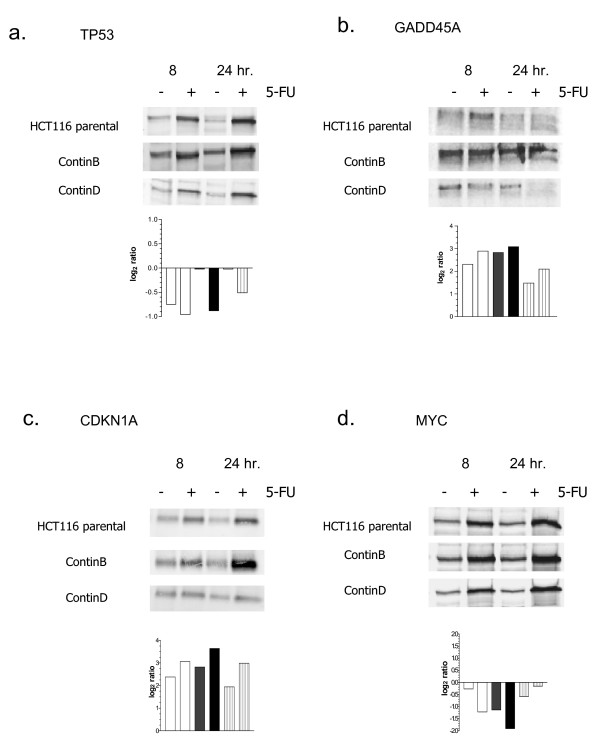
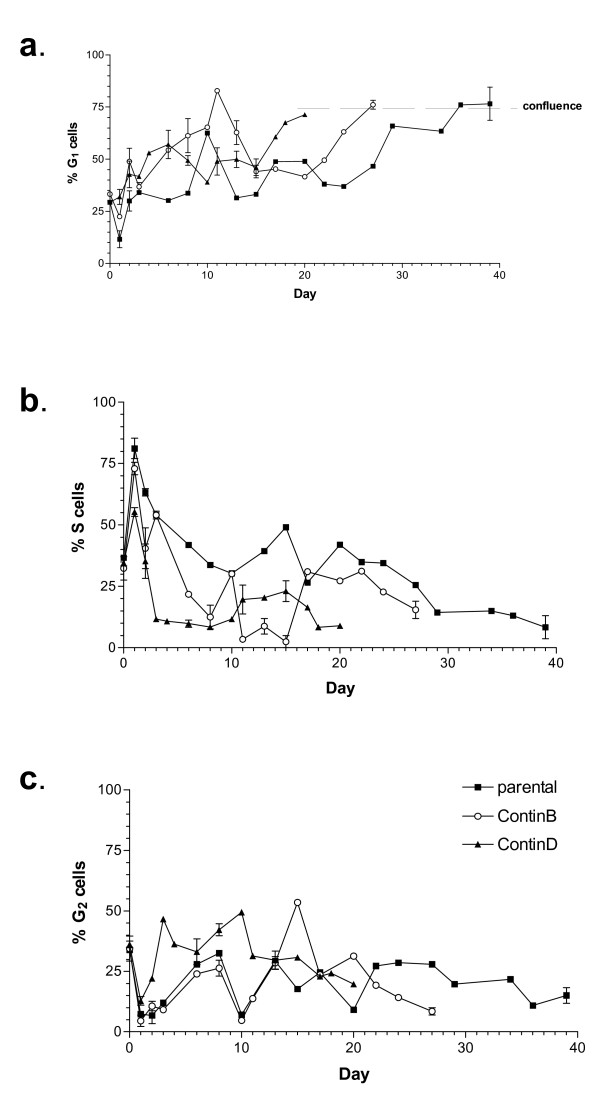
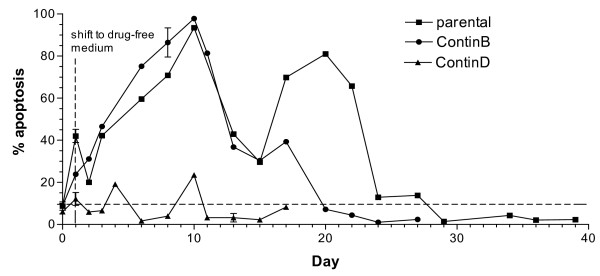
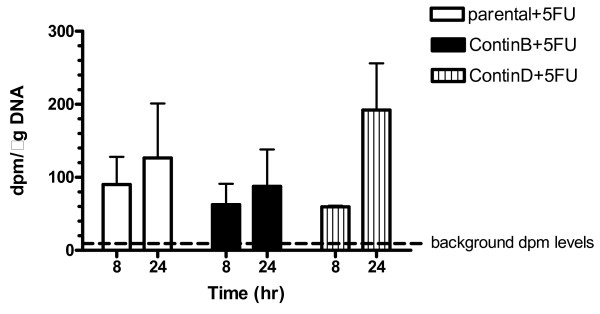
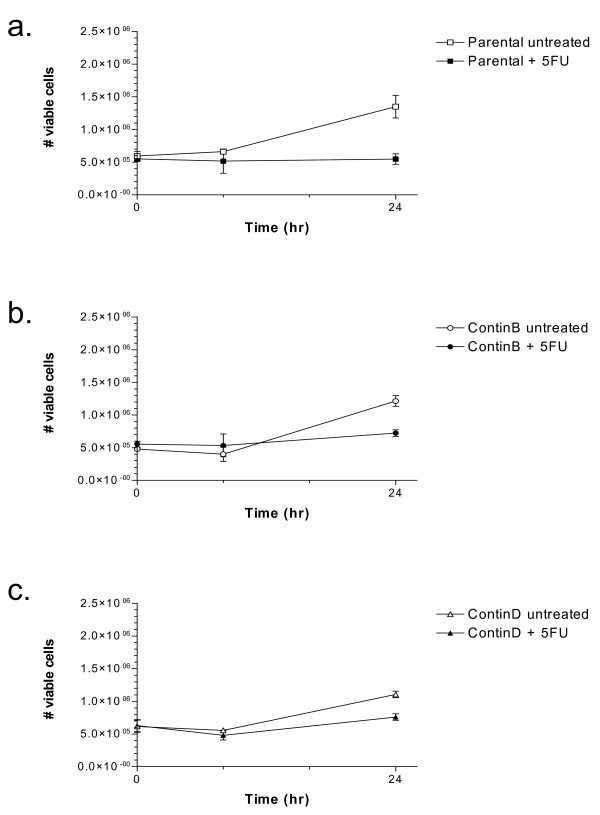
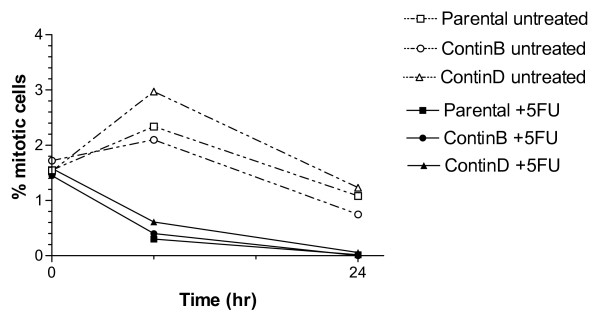
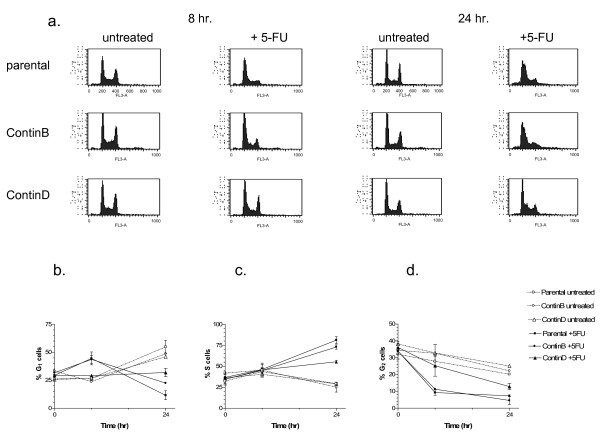
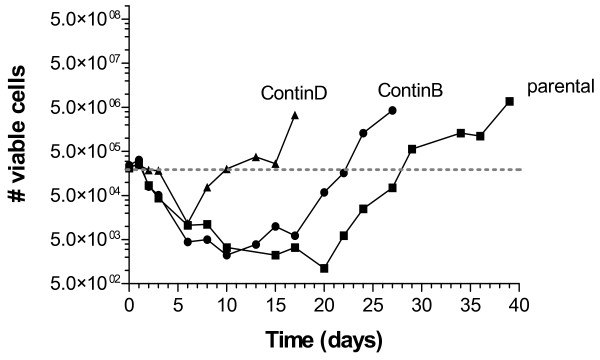
5-FU treatment for 24 hours resulted in S phase arrests, p53 accumulation, up-regulation of p53-target genes on DNA damage response (ATF3, GADD34, GADD45A, PCNA), cell cycle-regulatory (CDKN1A), and apoptosis-regulatory pathways (FAS), and apoptosis induction in the parental and resistant cell lines. Levels of 5-FU incorporation into DNA were similar for the cell lines. The pattern of cell cycle progression during recovery demonstrated consistently that the 5-FU-resistant cell lines had the smallest S phase fractions and the largest G2(/M) fractions. The strongly 5-FU-resistant ContinD cell line had the smallest S phase arrests, the lowest CDKN1A levels, and the lowest levels of 5-FU-induced apoptosis throughout the treatment and recovery periods, and the fastest recovery of exponential growth (10 days) compared to the other two cell lines. The moderately 5-FU-resistant ContinB cell line had comparatively lower apoptotic levels than the parental cells during treatment and recovery periods and a recovery time of 22 days. Mitotic activity ceased in response to drug treatment for all cell lines, consistent with down-regulation of mitosis-regulatory genes. Differential expression in response to 5-FU treatment was demonstrated for genes involved in regulation of nucleotide binding/metabolism (ATAD2, GNL2, GNL3, MATR3), amino acid metabolism (AHCY, GSS, IVD, OAT), cytoskeleton organization (KRT7, KRT8, KRT19, MAST1), transport (MTCH1, NCBP1, SNAPAP, VPS52), and oxygen metabolism (COX5A, COX7C).
Our gene expression data suggest that altered regulation of nucleotide metabolism, amino acid metabolism, cytoskeleton organization, transport, and oxygen metabolism may underlie the differential resistance to 5-FU seen in these cell lines. The contributory roles to 5-FU resistance of some of the affected genes on these pathways will be assessed in future studies.
用抗癌药物5-氟尿嘧啶(5-FU)处理细胞会导致DNA损伤,进而影响细胞增殖和存活。从HCT116结肠癌细胞系产生的两种稳定的野生型TP53 5-FU抗性细胞系ContinB和ContinD,分别对5-FU表现出中度和强抗性,5-FU诱导的凋亡水平显著降低,并且由于抗性发展,一些关键细胞周期和凋亡调节基因的表达水平发生改变。本研究的目的是确定这些抗性细胞系对8小时和24小时5-FU处理的潜在差异反应。我们评估了每个细胞系在整个处理和恢复期内5-FU摄取到DNA中的水平、细胞周期效应和凋亡诱导情况,以及短期药物暴露后DNA损伤反应、细胞周期和凋亡调节基因表达水平的变化。
24小时的5-FU处理导致亲代细胞系和抗性细胞系出现S期阻滞、p53积累、DNA损伤反应(ATF3、GADD34、GADD45A、PCNA)、细胞周期调节(CDKN1A)和凋亡调节途径(FAS)上p53靶基因的上调,以及凋亡诱导。各细胞系中5-FU掺入DNA的水平相似。恢复期间细胞周期进展模式一致表明,5-FU抗性细胞系的S期分数最小,G2(/M)期分数最大。在整个处理和恢复期,强5-FU抗性的ContinD细胞系S期阻滞最小,CDKN1A水平最低,5-FU诱导的凋亡水平最低,与其他两个细胞系相比,指数生长恢复最快(10天)。中度5-FU抗性的ContinB细胞系在处理和恢复期的凋亡水平相对低于亲代细胞,恢复时间为22天。所有细胞系的有丝分裂活性因药物处理而停止,这与有丝分裂调节基因的下调一致。对于参与核苷酸结合/代谢(ATAD2、GNL2、GNL3、MATR3)、氨基酸代谢(AHCY、GSS、IVD、OAT)、细胞骨架组织(KRT7、KRT8、KRT19、MAST1)、运输(MTCH1、NCBP1、SNAPAP、VPS52)和氧代谢(COX5A、COX7C)调节的基因,显示出对5-FU处理的差异表达。
我们的基因表达数据表明,核苷酸代谢、氨基酸代谢、细胞骨架组织、运输和氧代谢的调节改变可能是这些细胞系对5-FU产生差异抗性的基础。这些途径中一些受影响基因对5-FU抗性的贡献作用将在未来研究中评估。